

Hãng thông tấn Reuters thuộc sở hữu của tập đoàn thông tin đa quốc gia Thomson Reuters.
Dù thuộc sở hữu tập đoàn thương mại, hoạt động đưa tin của Reuters vẫn tuân thủ các Nguyên tắc Tin cậy (Reuters Trust Principles) nhằm đảm bảo tính độc lập, chính xác và tự do khỏi sự can thiệp chính trị.
***
Carolina Journal là một dịch vụ tin tức phi đảng phái thuộc Quỹ John Locke, cam kết duy trì chất lượng báo chí ở mức cao nhất và luôn bám sát sự thật. Các tin bài của Carolina Journal được thực hiện dựa trên quan điểm ủng hộ thị trường tự do và chính phủ tinh gọn, với lợi ích của người đóng thuế và cử tri luôn là trọng tâm trong công tác đưa tin.
***
Một nền hành chính tốt là khi nền hành chính đó phục vụ những người đóng thuế cho họ. North Carolina có nền hành chính tốt khi để phục vụ những người đóng thuế, họ kiện VinFast.
Mong nền hành chính Việt Nam càng ngày càng tốt hơn.
Phạm Thu Hương
- North Carolina sues Vietnam’s VinFast over delayed EV project, Reuters, May 22, 2026
- State objects to sealing documents linked to Vinfast suit, The Carolina Journal, September 24, 2026
***
North Carolina sues Vietnam’s VinFast over delayed EV project
By Reuters
May 22, 2026 – 8:57 AM GMT+7 Updated May 22, 2026

- Companies
HANOI, May 22 (Reuters) – The State of North Carolina has sued Vietnamese EV maker VinFast (VFS.O), opens new tab for its alleged failure to meet its commitments to build an electric vehicle and battery factory in the state, Attorney General Jeff Jackson said in a statement.
Jumpstart your morning with the latest legal news delivered straight to your inbox from The Daily Docket newsletter. Sign up here.
- VinFast has abandoned work on the 712-hectare (1,759-acre) site in Chatham County for over a year, according to the statement issued on Thursday.
- VinFast was earlier licenced to build the plant with commitments to create 7,500 jobs and invest over $3 billion in North Carolina, the statement said.
- “VinFast has defaulted on its agreements with the State, and VinFast’s continued inaction all but guarantees imminent further default,” it said.
- VinFast told Reuters it had not yet received any official documentation from the State.
- “Contracts with contractors have already been signed, and construction activities are expected to commence shortly in accordance with the planned schedule,” it said in a statement.
- In 2022, VinFast said the plant would have an annual production capacity of 150,000 vehicles. In 2024, it said it would delay the launch of the plant to 2028 amid market uncertainties.
- North Carolina should be allowed to exercise its option to purchase the land for a future manufacturer, and wants to be repaid $80 million allocated to VinFast for site preparation, the statement said.
- VinFast initially targeted to have the factory up and running by July 1 this year, but had later said it couldn’t do so until 2028, according to the statement.
- The EV maker said in the statement that recent changes in U.S. policies related to the EV industry have impacted the project timeline, requiring more time “to evaluate appropriate implementation conditions”.
- VinFast announced last week it will sell its Vietnamese manufacturing business for 13.3 trillion dong ($506 million) to a group of investors who will also assume roughly $6.9 billion in debt.
- Shares in Vingroup, VinFast’s parent company, fell 3.5% on Friday morning in Hanoi.
Updates with VinFast’s comment in bullets 4,5,9
Reporting by Khanh Vu, Francesco Guarascio and Phuong Nguyen; Editing by David Stanway
Our Standards: The Thomson Reuters Trust Principles.
State objects to sealing documents linked to Vinfast suit
The Carolina Journal – September 24, 2026
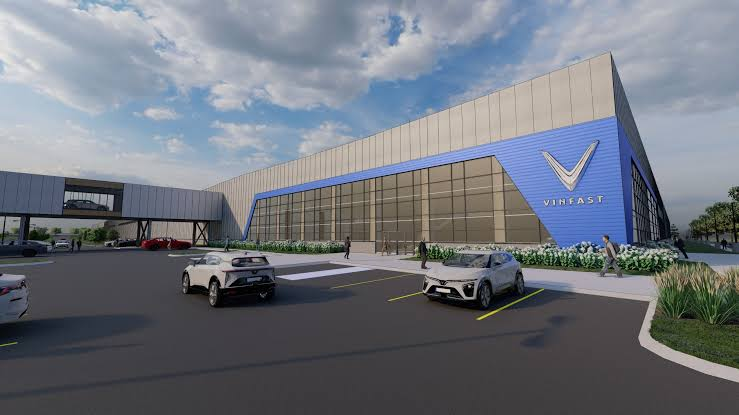
Rendering of VinFast proposed EV site in Moncure, Chatham County. Courtesy of media release by VinFast.
- The North Carolina Department of Commerce objects to Vinfast’s proposal to keep information related to the state’s lawsuit against the auto manufacturer confidential.
- A hearing on the issue is scheduled Tuesday in Wake County Superior Court.
- Most of the information Vinfast seeks to seal “has or will become public records because it has been or will be submitted to the State,” according to a court document lawyers with the state Department of Justice filed this week.
The North Carolina Department of Commerce is objecting to Vinfast’s request to seal documents related to the state’s lawsuit against the auto manufacturer.
A hearing on the issue is scheduled Tuesday in Wake County Superior Court.
State Attorney General Jeff Jackson announced the Commerce Department lawsuit in May. It’s designed to allow the state to take over the Chatham County megasite that had been designated for VinFast’s operations.
Lawyers with Jackson’s Department of Justice and lawyers representing Vinfast filed court documents in July agreeing to seal the amended lawsuit and other paperwork related to the case. That action was based on Vinfast’s argument that some information in the suit was confidential and exempt from public disclosure.
Next week’s hearing focuses on whether to keep that information under seal.
Jackson’s lawyers argued this week in favor of making the sealed information public.
“The majority of the redactions VinFast has proposed do not concern trade secrets,” Justice Department lawyers wrote Tuesday. “Absent trade secret protections, most of this information has or will become public records because it has been or will be submitted to the State. A significant portion of this content is also available via public search. Accordingly, this information must remain open and accessible to the public.”
NCDOJ lawyers filed a July 2 motion to seal an amended complaint and an attached exhibit. “Plaintiff has done so because the Amended Complaint quotes and paraphrases materials that have been designated as confidential by the Defendants and may be exempt from public disclosure pursuant to N.C. Gen. Stat. § 132-1.2,” state government lawyers wrote.
VinFast’s lawyers filed a brief supporting the government’s plan to keep the complaint and exhibit sealed permanently.
“The redacted material falls into four categories of confidential and proprietary information: (1) employee and headcount information — specific revised employment projections VinFast disclosed to the State in confidence; (2) contractor and vendor names — the identities of VinFast’s third-party contractors and financial partners; (3) contract/bid terms and financing details — specific financial terms, investment figures, and project schedules VinFast shared with the State; and (4) internal project and location details — specific locations, operational dates, and characterizations of contractor proposals,” wrote Danielle Williams, the Charlotte-based lawyer representing the Vietnamese company.
“This information constitutes confidential and proprietary business information and trade secrets that, if publicly disclosed, would cause serious competitive and commercial harm to VinFast and its business partners,” the court filing continued. “VinFast has consistently designated this information as confidential, and the governing Community Economic Development Agreement (‘CEDA’) between the parties expressly contemplates the protection of trade secret information. Sealing is warranted to protect VinFast’s compelling interest in preserving the confidentiality of this proprietary information.”
“VinFast agreed to build a factory and create jobs for North Carolinians – it didn’t do either,” Jackson said in a news release announcing the lawsuit. “When North Carolina makes a deal, we build in protection for taxpayers. VinFast broke the deal, so we’re using that protection to find a project for this site that will create jobs.”
The lawsuit states that the company has defaulted on its agreement, which was to create 7,500 jobs and over $3 billion in private investments in order to receive all grant payments with the state and that “VinFast’s continued inaction all but guarantees further imminent default” and “will continue to default on its obligations in several key ways,” noting that each gives the state the right to take the land back contractually.
The first way, the suit states, is that the company failed to commence “vertical construction of buildings and structures on Parcel A” of the site by Jan. 1, 2024. VinFast’s default, therefore, gives the state contractual rights to purchase the site.
As a result, the suit says, “it is now impossible for the Company to meet its contractual deadline to have an operational manufacturing plant on the Site by July 1, 2026,” and that the company admitted publicly that it will be unable to construct an operational facility until at least 2028.
The suit also alleges that new plans the company announced in March would not meet jobs or investment commitments to the state.
Additionally, Jackson’s suit said that since the facility wouldn’t be operational until 2028, it wouldn’t be able to meet its commitment of creating 1,750 jobs for the site by Dec. 31.
Finally, the suit stated that VinFast ceased operations on the site in December 2024.
“VinFast has failed to take any concrete action that shows it can and will fulfill its obligations to the state,” the suit says.
The state Justice Department notified VinFast in January that it had defaulted on its agreement and that the state intended to protect its investment by exercising its right to acquire the site, according to Jackson’s news release. In response, VinFast argued that it had met its construction deadlines and would have a facility opened on a delayed 2028 timeline. The state’s action seeks to protect taxpayer investments and enforce the commitments tied to the project, according to the release.
“North Carolina will always compete aggressively for jobs and investment, but we also protect taxpayers by requiring the company to hold up its end of the deal,” Gov. Josh Stein, a Democrat, said in the May news release. “VinFast has not fulfilled its commitments. Today’s action is about protecting taxpayers and getting the Chatham County mega-site back on the market to support future good-paying manufacturing jobs.”
In 2022, the embattled company received a Job Development and Investment Grant of up to $316.1 million in state reimbursements over three decades, along with another $400 million incentive package from Chatham County, contingent on the company meeting its hiring goal of 7,500 and investing $4 billion.
Then Gov. Roy Cooper attended the groundbreaking in July 2023 with company officials.
The state was also spending $450 million on infrastructure around the site, including a new highway to gain access in and out of the site.
Merry Oaks Baptist Church, which stood on the border between Moncure and New Hill on the corner of Old US 1 and New Elam Church Road since 1888, met with a wrecking ball in June to make way for the highway.
The church, along with 27 homes and five businesses, had to forfeit its land under eminent domain to make way for the North Carolina Department of Transportation’s highway plans.

