By Robbie Gramer, a diplomacy and national security reporter at Foreign Policy, and Amy Mackinnon, a national security and intelligence reporter at Foreign Policy.
An aerial view of crosses, floral tributes, and photographs of the victims of the battles for Irpin and Bucha that mark the graves in a cemetery in Irpin, Ukraine, on May 16.
JUNE 10, 2022, 3:48 PM
As Russia continues its assault on Ukraine, top Biden administration officials are working behind the scenes with the Ukrainian government and European allies to document a tsunami of war crimes allegedly committed by Russian forces.
But the sheer volume of the documented war crime cases could be too overwhelming for Ukraine’s justice system as well as for the International Criminal Court (ICC), raising questions of how many cases will be brought to trial and how many accused Russian war criminals could ultimately face justice.
Responding to widespread criticism of the Biden administration’s paltry offer of funding for Southeast Asian partners at a recent summit, a wise friend offered a colorful metaphor: “If we’re dating and I sense that you’re being transactional, then I want you to take me to the best restaurant in town and get the priciest bottle of wine. If you want a long-term relationship, buy me a cheap bottle of Chianti and we can sit on the roof and watch the sunset.”
My friend is right: no amount of money will win hearts and minds in the vital Indo-Pacific region unless it comes with a credible demonstration of long-term commitment to the region.
Mình nói tâm ý là “trái tim và trí óc” của bạn. “Tâm ý” cũng chính là “tâm” mà chúng ta thường dùng. Tâm trong nhà Phật luôn là tâm và ý. Lâu lâu đổi cách nói một chút để theo kiểu Tây phương – dân Tây luôn chia đôi tình cảm và lý trí, trái tim và đầu óc, cho nên ngay khi nói về kinh Phật, dân Tây cũng thường nói mind-heart hay heart-mind.
Câu hỏi của mình cho các bạn là: Bình thường, mỗi ngày, bạn có tâm ý hòa bình hay tâm ý chiến tranh?
Chinese military officials in recent months have repeatedly asserted that the Taiwan Strait isn’t international waters during meetings with US counterparts, according to a person familiar with the situation, generating concern within the Biden administration.
The statement disputing the US view of international law has been delivered to the American government by Chinese officials on multiple occasions and at multiple levels, the person said. The US and key allies say much of the strait constitutes international waters, and they routinely send naval vessels through the waterway as part of freedom of navigation exercises.
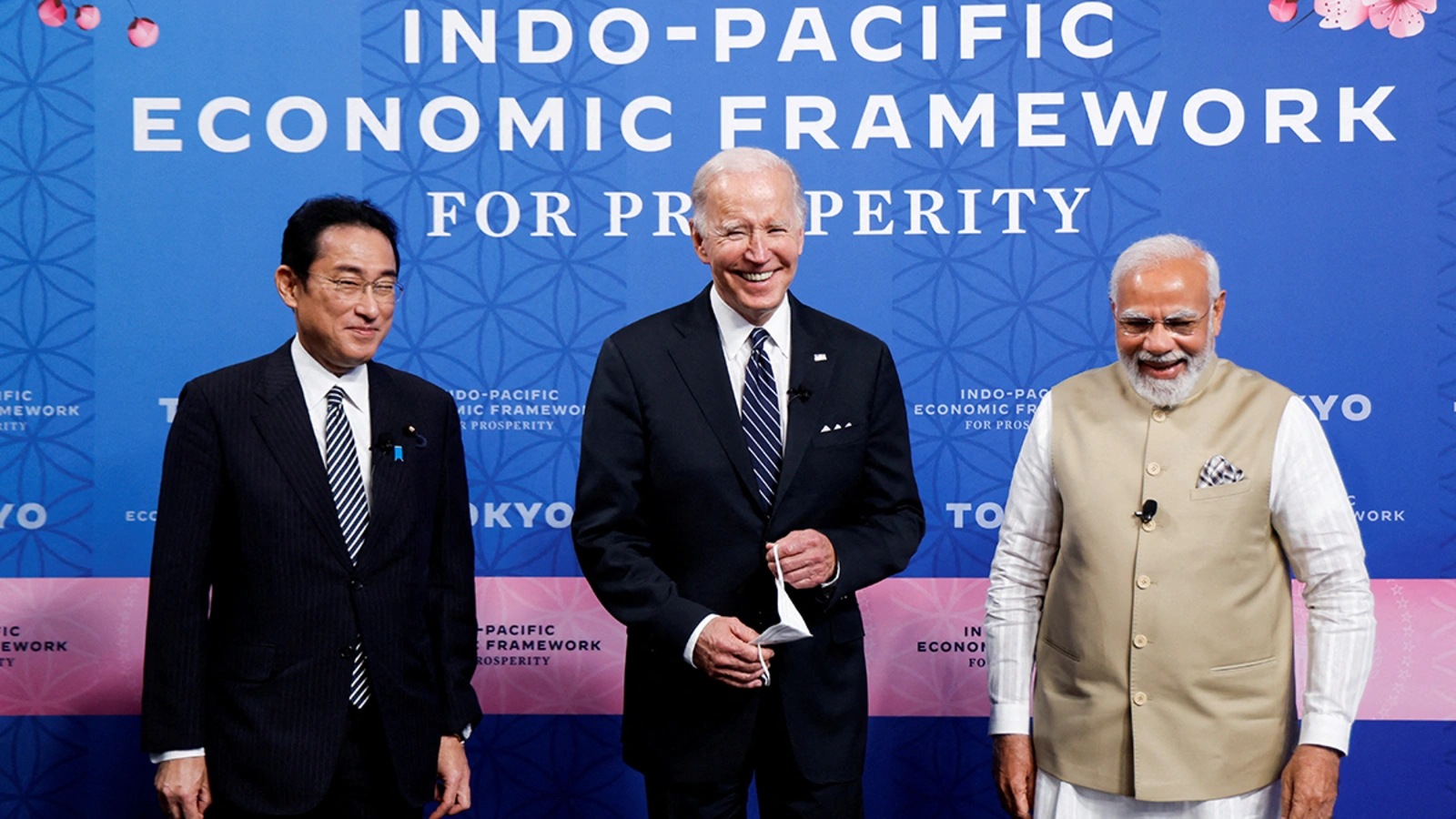
The Joe Biden administration has unveiled its Indo-Pacific Economic Framework, but it doesn’t look like a traditional trade deal and could end up falling short of its ambitions.
From left to right, Japanese Prime Minister Fumio Kishida, U.S. President Joe Biden, and Indian Prime Minister Narendra Modi attend the Indo-Pacific Economic Framework (IPEF) launch event in Tokyo in May 2022. Jonathan Ernst/Reuters
In late May, the Joe Biden administration launched its first major trade initiative: the Indo-Pacific Economic Framework (IPEF). The IPEF is billed as an effort to expand U.S. economic leadership in the Indo-Pacific region. This was also the objective of the Trans-Pacific Partnership (TPP), a trade deal that was negotiated during the Barack Obama administration. But President Donald Trump withdrew from the TPP in 2017, and the Biden administration has made clear that it does not intend to reenter that trade pact, which is now renamed the Comprehensive and Progressive Agreement for Trans-Pacific Partnership, or CPTPP.
Năm 1969, ban Isley Brothers (Anh em Nhà Isley) thêm vào ban nhạc hai em trai là Ernie và Marvin, những người bị các anh trai đặt vào trường nhạc. Ernie đền đáp món nợ Cô em đó với đoạn đơn ghita gợi nhớ đến Jimi Hendrix, sau này là tay guitar số 1 của nước Mỹ trong mọi thời đại, thành viên “bán thời gian” của ban Isley Brothers một thời.
Tham sân si là tam độc (ba độc) giết chết con người – tham lam, sân hận, si mê. Đã là 3 độc thì chúng ta nghĩ rằng đương nhiên mọi người đều cố gắng tránh xa chúng. Nếu nghĩ như vậy thì các bạn quá là ngớ ngẩn. Thiên hạ không những không tránh xa tham sân si mà còn ăn uống hít thở tham sân si, dạy nhau tham sân si, cổ vũ tham sân si, dùng tham sân si để khuyến khích mọi người làm tiền, làm kinh tế, làm kinh doanh, làm tôn giáo, làm chính trị, xây dựng sự nghiệp cá nhân, xây dựng mục đích cho đời sống của chính mình… Nói giản dị là con người là tham sân si, sống với tham sân si, và sống bằng tham sân si… Đó là một sự thật kinh hoàng về tam độc mà rất ít người mường tượng hết sự thật như vậy. Continue reading Tham sân si→
The annual meeting of the World Health Assembly (WHA) concluded on May 28. At the gathering, member states of the World Health Organization (WHO) made many decisions, some of which stood out as potential turning points for global health. The WHA did not ignore COVID-19, but member states primarily grappled with challenges that the pandemic created and that must be addressed beyond COVID-19. However, member states demonstrated as much caution as resolution in some of the most prominent decisions taken. This wariness creates uncertainty about the importance of these decisions as the WHO labors to put global health governance on more solid post-pandemic footing.
June 4, the anniversary of the 1989 Tiananmen Square massacre—in which People’s Liberation Army (PLA) forces killed hundreds and perhaps thousands of protesters as well as crushing demonstrations across the country—is a fraught moment in China. In Hong Kong, the public once freely memorialized the massacre. This year, authorities again used the national security law passed in 2020 to block gatherings; six people were arrested.
In mainland China, the anniversary claimed an unexpected victim: e-commerce influencer Li Jiaqi, widely known as the “Lipstick Brother” or “Lipstick King.” During a livestream on June 3, Li was presented with a cake that resembled a tank. Censors promptly pulled the show offline, and it hasn’t returned, with Li’s team citing “technical difficulties.” Early June is a prime time for online shopping ahead of June 18, China’s second-biggest day for online sales. But Li’s name now returns blank results on search platforms, even on e-commerce sites.
Ca khúc được Giorgio Moroder và Deborah Harry sáng tác; ban nhạc người Mỹ Blondie trình diễn; Moroder sản xuất; phát hành vào tháng 2/1980; thuộc thể loại nhạc lắc-vũ (dance-rock) và làn sóng mới (new wave).
Báo nhạc Rolling Stone xếp Gọi em hạng 289 trong 500 bài hát hay nhất mọi thời đại. Continue reading Gọi em→
Làm việc với chất lượng tốt nhất là một thói quen chủ quan – bạn có thói quen làm việc với chất lượng tốt nhất – nhưng đồng thời chất lượng cũng là một đòi hỏi khách quan của thị trường khi sản phẩm bạn cạnh tranh với các sản phẩm cùng loại trên thị trường. Có nghĩa là chất lượng của sản phẩm của bạn là một kết hợp chất lượng làm việc chủ quan của bạn và chuẩn chất lượng khách quan của các sản phẩm đang cạnh tranh trên thị trường. Nhưng đương nhiên là sản phẩm của bạn thành hình chính vẫn là nhờ thói quen làm việc với chất lượng cao nhất có thể của bạn. Continue reading Tự thắng→
If there was one common challenge to unite the Asia Pacific region, it would be corruption. From campaign pledges to media coverage to civil society forums, corruption dominates discussion. Yet despite all this talk, there’s little sign of action. Between Australia’s slipping scores and North Korea’s predictably disastrous performance, the 2015 index shows no significant improvement. Has Asia Pacific stalled in its efforts to fight corruption?
This year’s poor results demand that leaders revisit the genuineness of their efforts and propel the region beyond stagnation.
The public desire for change is huge. In India, Sri Lanka and elsewhere, we’ve seen a host of governments coming to power on anti-corruption platforms. As corruption continues to dominate media coverage across and beyond the region, increasing interest in the issue has sparked a raft of new research into both public and private sector corruption.
The bad
So why this picture of zero progress? Despite boastful efforts on petty corruption, Malaysia’s 1MBD scandal brought the crux of the challenge into sharp focus: is political leadership genuinely committed to fighting corruption throughout society? The Malaysian prime minister’s inability to answer questions on the US$700 million that made its way into his personal bank account is only the tip of the iceberg.
In India and Sri Lanka leaders are falling short of their bold promises, while governments in Bangladesh and Cambodia are exacerbating corruption by clamping down on civil society. In Afghanistan and Pakistan a failure to tackle corruption is feeding ongoing vicious conflicts, while China’s prosecutorial approach isn’t bringing sustainable remedy to the menace. This inability to tackle root causes holds true across the region – witness, for example, Australia’s dwindling score in recent years.
Malaysia’s 1MBD scandal brought the challenge into sharp focus: is political leadership genuinely committed to fighting corruption throughout society?
Reversing corruption is clearly not solely down to governments, but they’re the ones with the largest role and the power to create enabling environments for others. This year’s poor results demand that leaders revisit the genuineness of their efforts and propel the region beyond stagnation. They must fulfil promises, and ensure efforts aren’t undermined in practice. Anti-corruption commissions are a prime example here: while their creation across the region is commendable, ongoing political interference and inadequate resources has meant many are unable to fulfil their mandate. This has to be addressed.







 Đọt Chuối Non