Tag Archives: trang tiếng Anh
The Bully of the South China Sea
wallstreet journal
China’s broad territorial claims have no legal merit, and the U.S. is the only power strong enough to push back.
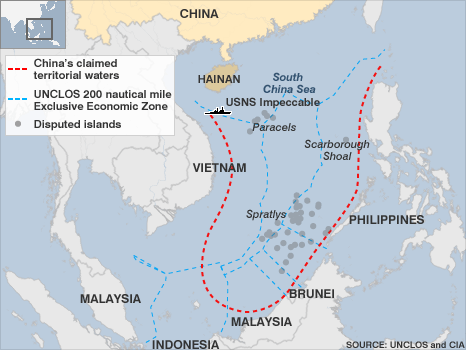
Last Friday, a U.S. State Department spokesman stated that Beijing’s recent decision to upgrade tiny Sansha City in the disputed Paracel Islands to a “prefecture-level city” and establish a military garrison there runs “counter to collaborative diplomatic efforts to resolve differences and risk further escalating tensions in the region.” That muted protest was just the excuse Beijing wanted to play a round of Down With American Imperialism. The Foreign Ministry called in a U.S. Embassy official for a tongue-lashing Saturday. State-run media also went to town, telling the U.S. to “shut up” and stop “instigating” conflict in the region.
Why the irruption of ire? Partly it’s because Beijing’s various factions need to look tough on sovereignty issues ahead of the upcoming Party Congress. The Congress will pick the next generation of Party leaders.
International Friendship Day
The first Sunday in August was chosen as the centre of the largest lull in holiday celebrations.
Friendship Day was promoted by the greetings card National Association during the 1920s but met with consumer resistance – given that it was rather too obviously a commercial gimmick to promote greetings cards.By the 1940s the number of Friendship Day cards available in the US had dwindled and the holiday largely died out there. There is no evidence to date for its uptake in Europe, however it has been kept alive and revitalised in Asia where several countries adopted the tradition of dedicating a day to friends.
Today, Friendship Day is enthusiastically celebrated in a number of countries across the world.
This year, it’s Sunday August 5.
U.S. Moves to Strengthen ASEAN by Boosting the Lower Mekong Initiative

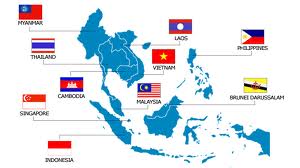
During her visit to Southeast Asia earlier this month, U.S. secretary of state Hillary Clinton revealed an important tactic in the U.S. effort to strengthen its engagement with ASEAN: boosting the Lower Mekong Initiative (LMI). The LMI is part of a larger U.S. strategy that involves locking mainland ASEAN countries—Cambodia, Laos, Myanmar, Thailand, and Vietnam—into patterns of cooperation and capacity building supported by the United States, ASEAN, and other partners who can bring technology, expertise, and financial resources to the table.
Continue reading U.S. Moves to Strengthen ASEAN by Boosting the Lower Mekong Initiative
Senator Webb: China’s Military and Governmental Expansion into South China Sea May Be a “Violation of International Law”
One-way positivity
We often talk about “one-way”, yet perhaps we don’t have the habit of practicing one-way positivity, but usually two-way.
We are not positive towards those we have low opinion of – those we consider bad and awful.
We are not positive towards things that we deem ugly, lousy.
We are not positive towards difficult circumstances.
…
But please don’t forget that the correct positivity is not our mental reaction to external conditions, but rather it is our mind’s constant attitude. People who have positivity in their blood will always be positive.
China’s hardening stance: Beijing creates new municipality to govern disputed waters
New and Reinforced
Image: Japan Coast Guard/AFPChina stepped up its patrols near the Diaoyu Islands.
Beijing creates new municipality to govern disputed waters in hardening stance over South China Sea
BEIJING — In the latest sign that China will not back down on its territorial claims in the South China Sea, the government is creating a new prefecture-level ‘city’ called Sansha to govern the more than 200 islets, sandbanks and reefs there, including disputed areas.
The municipality of Sansha, which will also have a military force, will oversee the three islands of Xisha and Nansha — which are also claimed by Vietnam — as well as Zhongsha. The waters around the islands are also the subject of overlapping territorial claims.
China reveals its hand on ASEAN in Phnom Penh
By Ernest Bower, Senior Adviser and DirectorSoutheast Asia Program
Center for Strategic and International Studies
For the first time in its 45-year history, ASEAN’s foreign ministers failed to issue a joint communiqué following their annual consultations last week in Phnom Penh. It is important to understand this high-profile failure. What happened? And what does it mean for ASEAN and for the strategies of the United States and other countries with strong interests in the Asia Pacific?
What Happened?
The ASEAN foreign ministers spent hours reviewing a substantive agenda that by all accounts represented the growing maturity of ASEAN and its relevance not only to its 10 member countries but to its dialogue partners from around the world. The depth and range of the discussions underlined the conclusion that ASEAN is making progress and maturing to a level where it can address the most pressing issues in the region. Its discussions last week touched on a broad array of concerns—from economic cooperation and integration to political and security alignment to social and cultural cooperation. Even politically sensitive issues such as North Korea, bilateral tensions between ASEAN countries, and the disputes in the South China Sea were fully discussed.
Continue reading China reveals its hand on ASEAN in Phnom Penh
International Monetary Fund: Regional Economic Outlook – Asia and Pacific
World Economic and Financial Surveys
Regional Economic Outlook:
Asia and Pacific
Managing Spillovers and Advancing Economic Rebalancing
April 2012
©2012 International Monetary Fund
Barring the realization of downside risks to the global economy, growth in the Asia and the Pacific region is expected to gain momentum over the course of 2012, according to this report, and now projected at 6 percent in 2012, rising to about 6½ percent in 2013. Stronger economic and policy fundamentals have helped buffer the region’s economies against the global financial crisis, by limiting adverse financial market spillovers and ameliorating the impact of deleveraging by European banks, but a sharp fall in exports to advanced economies and a reversal of foreign capital flows would have a severe impact on the region. The region’s policymakers now face the difficult task of calibrating the amount of insurance needed to support stable, noninflationary growth. Some Asian and Pacific economies can afford to lengthen the pause in the normalization of their macroeconomic policies that was initiated when the global recovery stalled late in 2011; others may need a faster return to more neutral policy stances. Similarly, the pace of fiscal consolidation should be calibrated to country-specific circumstances. Additional chapters in the report discuss whether China is rebalancing and the particular challenges facing Asian low-income and small island economies.
Continue reading International Monetary Fund: Regional Economic Outlook – Asia and Pacific
Speaking fast
Our speaking usually goes at our natural velocity, stemming from our personality – people who think as fast as lightning usually speak fast, those who think more slowly often speak softly, or in contrast, people who do not think tend to speak fast, those who think regularly speak slowly. Speaking velocity also depends on region: Busy areas like New York or Washington DC have more fast speakers than less busy areas such as Alabama or Tennessee.
Yet this is an important point: oftentimes when meeting a slower speaker, the fast speaker may make the other one scared, or annoyed, and lose sympathy. Speaking fast usually makes people with a slow talking habit nervous as they feel that they cannot catch up with the speaker – if we are a fast speaker due to our empty head then they will be annoyed with our empty head, if we speak fast due to our intelligence then they will be scared of our smartness.
Falling prices point to further global slowdown
The slowing global economy is putting downward pressure on costs for businesses and consumers alike. It’s also squeezing profits and incomes.
The weak job market has helped keep wage costs flat since the recession ended three year ago. Now, with widening evidence that the global economy is entering a new slowdown, the cost of a wide range of commodities from oil to copper to coffee is falling rapidly.
While that’s good news for consumers, the across-the-board price drops are further evidence that demand is drying up as the world economy continues to slow. China’s once booming economy has cooled sharply this year. That has driven prices down sharply in the world’s second-largest economy and has raised worries about deflation, which can be as intractable a problem as too much inflation.
Recent data on factory production and job growth point to a further slowing in an already weak U.S. economy. And the ongoing financial turmoil in Europe has sparked a widening recession that shows no signs of easing.
Continue reading Falling prices point to further global slowdown
Ao dai in my heart
There ‘s something you have known very early since you were a child. And there ’s something deep inside your heart when it was a part of your life, your memories. The Ao dai has come to my heart by that way!
I saw people wear Ao dai, but never thought about it ‘till the day when I was in my lovely white uniform for the first time. It was and still is our national custom. Amazing! A beautiful white light color shone on me. I felt a wind of change, something new just blew through my heart. I looked at myself in the mirror. I was thrilled and I was excited awaiting the beginning of the new school year.
Alone in a white world
Hi everyone,
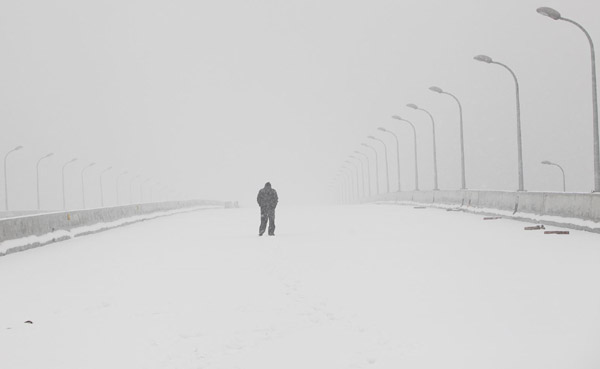
Winter comes to us regularly – frozen and white. And if you have never lived in a snowy area, have you ever felt that the world is merely an immense white space, no tree, no grass, not a single street or house, not a single mountain or river, only this immense whiteness, with your sole presence, sitting silently alone in a cold white universe?
That is a loneliness as vast as the universe.
Anyone of us could sometimes find herself lost in that white universe – for emotional or philosophical reasons.
Happy Planet Index 2012: Vietnam ranks 2nd
For the 2012 ranking, 151 countries were compared, and the best scoring country for the second time in a row was Costa Rica, followed by Vietnam, Colombia, Belize and El Salvador. The lowest ranking countries in 2012 were Botswana, Chad and Qatar.
The Happy Planet Index (HPI) is an index of human well-being and environmental impact that was introduced by the New Economics Foundation (NEF) in July 2006. The index is designed to challenge well-established indices of countries’ development, such as Gross Domestic Product (GDP) and the Human Development Index (HDI), which are seen as not taking sustainability into account. In particular, GDP is seen as inappropriate, as the usual ultimate aim of most people is not to be rich, but to be happy and healthy. Furthermore, it is believed that the notion of sustainable development requires a measure of the environmental costs of pursuing those goals.
Vietnam Sentences Dissident to 5 Years for Distributing Anti-Government Leaflets
Source: Washington Post
Date: June 6, 2012
HANOI, Vietnam — A court in central Vietnam has sentenced a dissident to five years in prison for distributing anti-government leaflets.
The Kien Thuc newspaper says 53-year-old Phan Ngoc Tuan was convicted of collaborating with “reactionary” groups and individuals in exile to spread propaganda against the Communist state. He was convicted at a half-day trial Wednesday in Ninh Thuan province.
Continue reading Vietnam Sentences Dissident to 5 Years for Distributing Anti-Government Leaflets