Category Archives: Biển Đông

China’s Maritime Militia: The ‘Gray Zone’ Force in the South China Sea

Dec 22, 2023 at 9:52 AM EST00:32

Chinese Ships Confronts Philippine Vessels Near Second Thomas Shoal

By Micah McCartney

China News Reporter, Newsweek

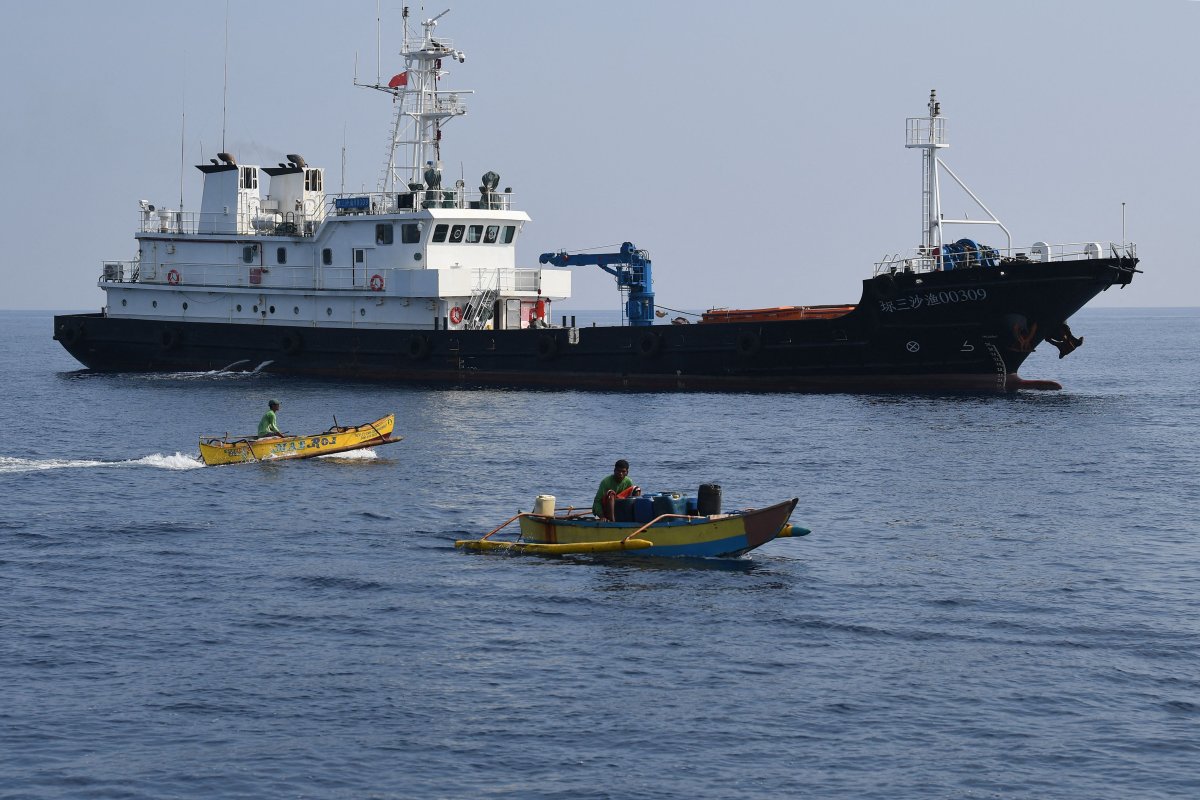
Maritime Militia Ship in South China Sea
This photo taken on September 20, 2023, shows Philippine fishermen aboard their wooden boats sailing past a Chinese maritime militia vessel near the Chinese-controlled Scarborough Shoal in waters of the disputed South China Sea. China, which claims sovereignty over almost the entire South China Sea, snatched control of Scarborough Shoal from the Philippines in 2012. Since then, it has deployed coast guard and other vessels to block or restrict access to the fishing ground that has been tapped by generations of Filipinos.TED ALJIBE/AFP VIA GETTY IMAGES

The maritime militia fleet is the vanguard of Beijing’s strategy to reshape the geopolitical landscape in the region, experts say, with its blue-hulled ships a frequent sight at territorial standoffs in the South China Sea.

The maritime militia is considered by analysts to be China’s third sea force alongside its navy and coast guard. The Chinese government maintains the fleet is little more than a group of patriotic fishermen.

Dubbed “little blue men” by Andrew Erickson, professor of strategy at the U.S. Naval War College’s China Maritime Studies Institute, the ships regularly join China’s coast guard in blockades against supply missions to a Philippine military outpost at the Spratly Islands’ Second Thomas Shoal, including the most recent tense showdown on December 10. A blockading militia ship was involved in a collision with a Philippine coast guard boat in October, and Manila accused another of using a sonic weapon against a fisheries bureau convoy on December 9.

Continue reading China’s Maritime Militia: The ‘Gray Zone’ Force in the South China Sea
Statement of the National Task Force for the West Philippine Sea

9 December 2023
Manila, Philippines

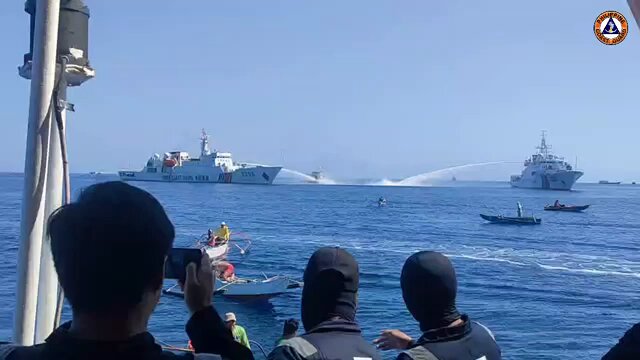
The National Task Force West Philippine Sea (NTFWPS) vehemently condemns the illegal and aggressive actions carried out by the Chinese Coast Guard and Chinese Maritime Militia against the civilian Bureau of Fisheries and Aquatic Resources (BFAR) vessels Datu Sanday, Datu Bankaw, and Datu Tamblot today during a regular BFAR humanitarian and support mission of providing oil subsidy and grocery packs to over 30 Filipino fishing vessels near Bajo De Masinloc in the West Philippine Sea. As of this reporting the mission is on-going. Continue reading Statement of the National Task Force for the West Philippine Sea

China’s ‘predatory’ trawler fleet and the fishing industry’s dirty secret

Nov 17, 2023 at 6:04 AM EST00:46 Newsweek

China’s ‘Predatory’ Trawler Fleet And The Fishing Industry’s Dirty Secret

By Micah McCartney

Freelance China News Reporter

China’s alleged abuse of the world’s oceans was examined in recent studies into its vast fishing fleet, which is accused of destroying maritime ecosystems far from its shores and perpetuating the industry’s forced labor practices.

China-flagged ships on the high seas were involved in “theft on a grand scale, unrestricted warfare on natural resources,” said a report by the SeaLight project, which says it uses “commercially available technology to shed light on the maritime ‘gray zone.'”

Illegal, unregulated and unreported (IUU) fishing by Chinese vessels was happening throughout the Asia-Pacific, including within other countries’ exclusive economic zones (EEZ), according to SeaLight, which is under Stanford’s Gordian Knot Center for National Security Innovation.

Continue reading China’s ‘predatory’ trawler fleet and the fishing industry’s dirty secret

Preparing for Dangerous Storms – 3 Parts

Inside China’s People’s Liberation Army | Preparing For Dangerous Storms – Part 1 | CNA Documentary


CNA Insider
6-5-2023

China’s People’s Liberation Army celebrates its centenary in 2027, what are its goals for this date? The PLA is already the largest army in the world with over 2 million soldiers. It also has the biggest number of warships. But China’s defense budget is still climbing amidst increasing geopolitical tensions. How exactly is the PLA “preparing for Dangerous Storms” as tasked by President Xi?

Continue reading Preparing for Dangerous Storms – 3 Parts

Philippines welcomes more US troops at home: Will it be worth it?

Philippines Welcomes More US Troops At Home: Will It Be Worth It? | Insight | Full Episode

From the COC to a Code of Conduct for Maritime Engagements in Southeast Asia

BY VU HAI DANG | SEPTEMBER 25, 2023
AMTI UPDATE

At the 56th ASEAN Ministerial Meeting and its related meetings in Jakarta in July, it was announced that negotiations for the Code of Conduct of Parties in the South China Sea (COC) had achieved progress on two fronts. First, the second reading of the Single Draft COC Negotiating Text was completed. Second, a set of Guidelines for Accelerating the Early Conclusion of an Effective and Substantive Code of Conduct in the South China Sea was adopted at the Post Ministerial Conference 10+1 Meeting with China. As a matter of fact, these developments are rather more procedural (and perhaps political) than substantive.

Continue reading From the COC to a Code of Conduct for Maritime Engagements in Southeast Asia

What is AIS tracking? A SeaLight primer

This post explains how the AIS vessel tracking system works and how bad actors abuse the system.

Miao Shou, Gaute Friis | AUGUST 21, 2023

What is AIS tracking? A SeaLight primer

Miao Shou

Analyst

Gaute Friis

Analyst

Tracking vessels’ Automatic Information System (AIS) signals is a core means SeaLight and other open-source intelligence collectors use to monitor maritime activity. AIS is a broadcast system that maritime authorities use to identify a vessel’s unique identification number, type, position, course, speed and navigation status. 

The International Maritime Organization (IMO) mandates the use of AIS to ensure maritime safety and direct marine traffic more efficiently. According to the International Maritime Organization’s International Convention for the Safety of Life at Sea (SOLAS) Regulation V/19.2.4, all vessels over 300 gross tons (or 500 tons for those not on international voyages) and passenger ships of any size are required to “carry automatic identification systems capable of providing information about the ship to other ships and to coastal authorities.” 

Continue reading What is AIS tracking? A SeaLight primer

Gray Zone Tactics Playbook: Going Dark

“Going dark” refers to the gray zone tactic of strategically turning off a vessel’s Automatic Information System (AIS) transponder to avoid detection.

Miao Shou | AUGUST 17, 2023

Gray Zone Tactics Playbook: Going Dark
Vessels operating without AIS inside a country’s Exclusive Economic Zone (EEZ). (Credits: Unseenlabs)

Miao Shou

Analyst

“Going dark” refers to the gray zone tactic of turning off a vessel’s Automatic Information System (AIS) transponder to avoid detection. AIS is a signaling system used to identify a vessel’s type, position, course, speed and other navigation safety information, and is required by the International Maritime Organization for larger non-military ships operating in international waters. Read our primer on the AIS system here.
 
Going Dark in the Recent Water Cannon Incident

In a recent incident that involved the blockade and water-cannoning of a small Philippine resupply vessel and its escorts, six of the blockading ships were from the China Coast Guard. Of these, only one ship (CCG 5402) remained AIS-visible during the entire engagement, while two other ships (CCG 4203 and CCG 3302) broadcast AIS only intermittently. 

Continue reading Gray Zone Tactics Playbook: Going Dark

Gray Zone Tactics Playbook: Water Cannoning

This tactic consists of blasting another ship with a powerful stream of water using a high-pressure water cannon.

Gaute Friis | AUGUST 7, 2023

Gray Zone Tactics Playbook: Water Cannoning
CCG 31101 blasts a VCG vessel with water cannon, May 5, 2014. (Source: VCG)

Gaute Friis

Analyst

As of this writing, the Philippines has just produced evidence that its coast guard and resupply vessels were subjected to assault by water cannons from China Coast Guard ships on 5 August 2023. This occurred during the regular rotation and resupply mission to the Philippine Navy’s outpost aboard the grounded BRP Sierra Madre at Second Thomas (Ayungin) Shoal, and is reminiscent of a similar incident in November 2021.

Continue reading Gray Zone Tactics Playbook: Water Cannoning

Gray Zone Tactics Playbook: Spoofing

Spoofing is the act of deceptively and deliberately falsifying a vessel’s AIS identifying information or location.

Gaute Friis | SEPTEMBER 3, 2023

Gray Zone Tactics Playbook: Spoofing
A China Coast Guard (CCG) cutter transmits fraudulent AIS signals to nearby vessels, appearing as a fishing boat on their monitoring equipment (Credit: Gaille Powell).

Gaute Friis

Analyst

Spoofing is a deception tactic meant to disrupt monitoring of maritime activities. It is frequently employed by Chinese gray zone actors in the South China Sea. In contrast to the “going dark” tactic of simply disabling a vessel’s Automatic Information System (AIS) broadcast, the spoofing tactic involves manipulating transmitting signals in order to falsify a vessel’s identity and/or location.

Continue reading Gray Zone Tactics Playbook: Spoofing

Gray Zone Tactics Playbook: Cable-Cutting

Cable-cutting is a sabotage and harassment tactic in which a ship will attempt to sever the cable to another ship’s trailing equipment, such as trawler lines or towed array sonars.

Gaute Friis | JULY 26, 2023

Gray Zone Tactics Playbook: Cable-Cutting
Chinese fisherman using a boat hook pole in an attempt to snag the cable connecting U.S ocean surveillance ship USNS Impeccable’s towed sonar array, March 8, 2009. (Source: USN)

Gaute Friis, analyst

This tactic is an act of sabotage which aim to cut the cables to a ship’s trailing equipment, such as trawler lines or towed array sonars. 

Cable-cutting is most frequently used against commercial research vessels conducting survey operations in disputed maritime zones, such as within China’s huge “nine-dash line” claim in the South China Sea. 

Continue reading Gray Zone Tactics Playbook: Cable-Cutting

Gray Zone Tactics Playbook: Laser Dazzling

Dazzlers are non-lethal laser weapons meant to cause temporary blindness in humans or confound sensors. Recently employed against the Philippine Coast Guard, laser dazzlers have also been employed against U.S. and Australian military helicopters and surveillance planes operating in the region.

Gaute Friis | SEPTEMBER 12, 2023

Gray Zone Tactics Playbook: Laser Dazzling
CCG 5205 firing laser at Philippine Coast Guard cutter BRP Malapascua, February 6, 2023 (Source: Philippine Coast Guard)

Gaute Friis Analyst

Dazzlers are an emerging category of non-lethal but potentially dangerous weapons and a relatively recent addition to China’s gray zone arsenal. They can be used as a harassment tool; for destroying sensitive electro-optical sensors as an electronic warfare component; or as a weapon of psychological warfare. 

Dazzlers are not themselves considered illegal. The U.S. military — which refers to them as “non-lethal optical distractors” — considers them an essential capability to “minimize fatalities,  protect the innocent and limit collateral damage” when the alternative is lethal force, with the caveat that:

“Prior to fielding, all previously and currently fielded lasers or distracter devices have undergone legal reviews to ensure compliance with obligations assumed by the U.S. under applicable treaties, customary international law, and the law of armed conflict.”

China has used dazzlers to temporarily blind the crew of other countries’ ships. Because dazzlers have both physical and psychological effects their use against vessels at sea is hazardous, eroding their crews’ ability to navigate and react to maritime contingencies.

As detailed in our “going dark” playbook entry, a Chinese Coast Guard cutter used a dazzler to harass a Philippine resupply escort mission on February 6th, 2023.

The Philippine Coast Guard later clarified that was the second time this had occurred during a resupply mission.

China has also employed dazzlers against U.S. and Australian aircraft since at least 2018, as documented in incidents over the Pacific Ocean, the South China Sea, the East China Sea, the Arafura Sea, and near the Horn of Africa

Note: Any use of lasers to permanently blind personnel is illegal under Protocol IV (Blinding Laser Weapons) under the Convention on Certain Conventional Weapons, which China joined in 1998.

See the rest of the gray zone playbook here.

Introducing China’s Maritime Gray Zone Tactics Playbook

While China’s use of maritime gray zone tactics is well known, few resources describe the actual tactics in detail. We’ve developed a publicly available systematic examination of these concrete tactics, which we will roll out for you in the coming weeks.

Gaute Friis | JULY 6, 2023

Introducing China's Maritime Gray Zone Tactics Playbook
Chinese fishing vessels leave port in Fujian Province in August 2020 (Source: US Naval Institute)
Continue reading Introducing China’s Maritime Gray Zone Tactics Playbook