Council on Foreign Relations, James M. Lindsay A woman casts her vote at a polling station during the 2018 general election in Rawalpindi, Pakistan. Faisal Mahmood/Reuters
Millions of people around the world voted in 2022. South Koreans narrowly elected conservative candidate Yoon Suk-Yoel president.
Viktor Orbán remained Hungary’s prime minister as his far-right Fidesz Party dominated a heavily gerrymandered election.
Emmanuel Macron won reelection in France, making him the first French president in two decades to win reelection.
Voters in the Philippines elected Ferdinand “Bongbong” Marcos, Jr., the son of the dictator ousted from power in 1986, president.
Anthony Albanese and the Australian Labour Party won Australia’s parliamentary elections, ending nine years of Liberal Party control.
Colombians elected their first leftist president, Gustavo Petro, a former guerilla fighter. Continue reading Five Elections to Watch in 2023→
The Indo-Pacific region is of significant importance to Canada. Home to more than two thirds of the global population, it is the fastest-growing economic region in the world.
As a Pacific nation, Canada recognizes that the Indo-Pacific region is critically important for the long-term prosperity, health and security of Canadians. Beyond our 25,000 km of Pacific Ocean coastline, Canadians share history, culture, and long-standing trade and development ties with the people of the Indo-Pacific.
BALTIC SEA — Standing NATO Maritime Group 1 (SNMG1) and Standing NATO Mine Countermeasures Group 1 (SNMCMG1) joined 12 nations for Finnish Navy exercise Freezing Winds in the Baltic Sea from Nov. 22 to Dec. 2.
One of NATO partner nation Finland’s largest maritime exercises, Freezing Winds offered both the Finnish Navy, as well as participating nations and NATO, valuable training opportunities that contribute to increased maritime safety and security in the Baltic Sea region.
The exercise focused on interoperability between the multinational joint forces.
“Cooperation with the Finnish Navy remains strong,” Royal Netherlands Navy Commodore Jeanette Morang, commander SNMG1 said. “Of course there are always challenges when it comes to communication, but that is exactly why we train – to improve. From our perspective, we wanted not only to contribute, but we also wanted to learn in this exercise to develop a deeper understanding of regional maritime issues specific to Finland.”
AChinese man strikes at a banner saying “Chinese Communist Party Step Down!” in New York City. He is challenged briefly, then disappears in the crowd at a Columbia University protest against China’s “Zero COVID” policy.
Another man pummels a female student after she shouts that Chinese authorities must be held accountable for the deaths of 10 people in a fire in an apartment complex under lockdown in Urumqi, sparking a rare wave of demonstrations in China. In Berkeley, California, a suspected Communist Party supporter sets ablaze a memorial placed by protesters mourning the dead in Urumqi.
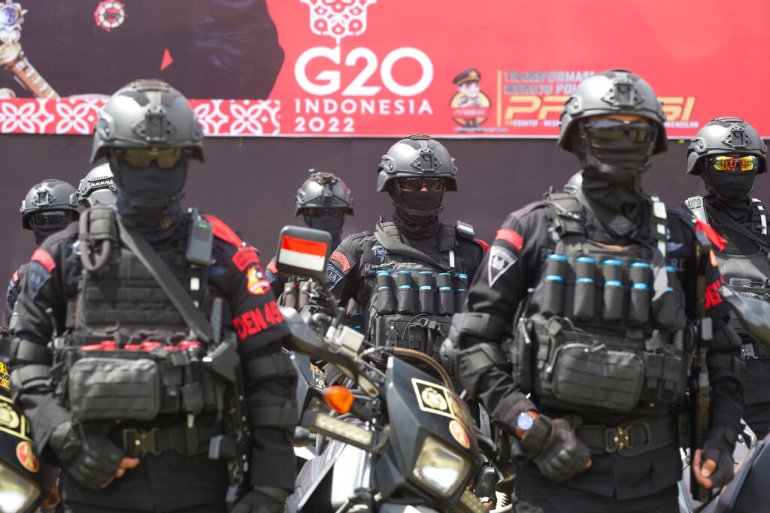
Aljazeera – Vladimir Putin’s absence from the G20 Summit in Bali also undermines talk of a Russian pivot to the Asia-Pacific region.
Indonesian police line up during a security parade on November 7, 2022, in preparation for the G20 meeting in Bali, Indonesia [File: Firdia Lisnawati/AP] (AP Photo)
By Al Jazeera Staff
Published On 15 Nov 202215 Nov 2022
Russian President Vladimir Putin has oozed a casual resentment when describing the “irreversible and even tectonic changes” that he says have led the West to become a spent force in the world.
“Western countries are striving to maintain a former world order that is beneficial only to them,” he told attendees at the Eastern Economic Forum in the Russian city of Vladivostok in September.
All the versions of this article: [English] [Español] [français]
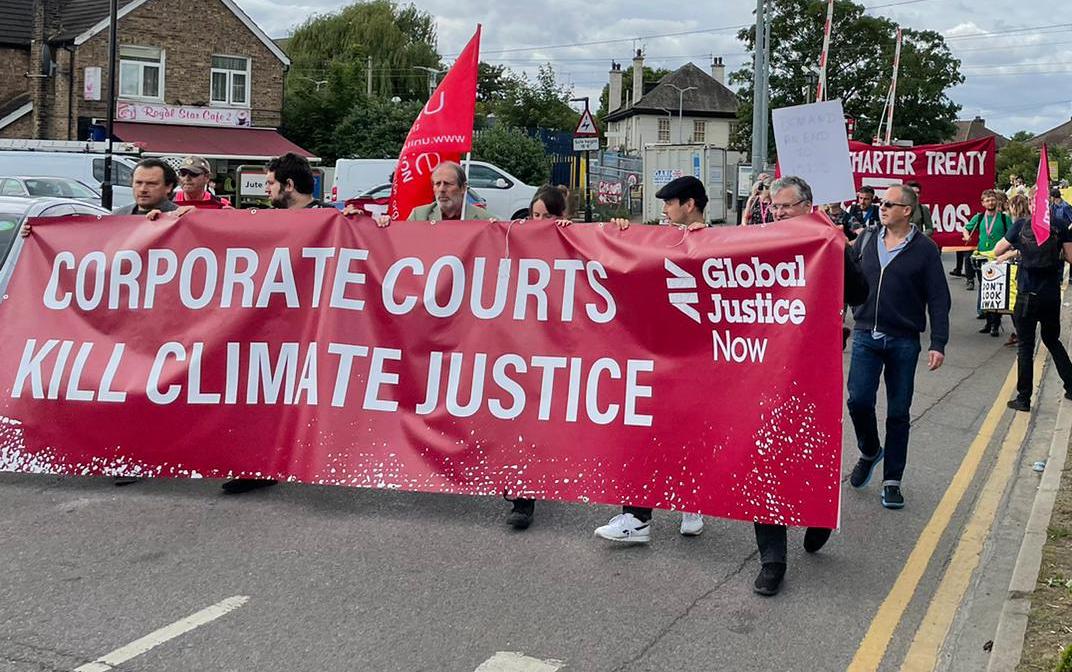
Photo: Global Justice Now
14 November 2022
Statement on ISDS and climate
Civil society organisations are calling on governments to remove the threat that ISDS (investor state dispute settlement) poses to the climate. The following statement outlines our primary concerns and demands. We seek to put pressure on our governments as they meet at COP 27 in November 2022.
Please read it and consider signing on using the form at the bottom
Aljazeera – Soviet-era nostalgia and anti-Western sentiment fuel online support for Russia’s Vladimir Putin and his war on Ukraine.
Russian President Vladimir Putin looks through a scope as he shoots a Chukavin sniper rifle (SVCh-380) during a visit to the military Patriot Park in Kubinka, outside Moscow, in September 2018 [File: Alexey Nilkolsky/Sputnik/ AFP]
By Al Jazeera Staff
Published On 18 Nov 202218 Nov 2022
While the West has united in condemnation of Russia’s invasion of Ukraine, opinions differ markedly in parts of the developing world where Russia is not reviled but revered for what some see as its stance against the West and its hypocrisies.
In Southeast Asia, a region dominated for decades by “strongman” political leaders and where nostalgia for the Soviet Union persists in some quarters, Russian President Vladimir Putin has a strong following among social media users who are sympathetic to his invasion of Ukraine and find his macho self-image appealing.
Outrage Over COVID-19 Restrictions Prompts Rare Protests in China
Tens of thousands of people joined demonstrations (FT) in at least ten cities across China over the weekend, at times clashing with security forces. In addition to objecting to harsh restrictions under the country’s zero-COVID policy, many protesters denounced limitations on freedom of speech and some called for Chinese President Xi Jinping to step down (NYT). The protests were sparked by a deadly fire in a locked-down area of the Xinjiang region on Friday. Demonstrators marched in urban centers and at universities, and today police patrolled areas of Beijing and Shanghai (Reuters) where the demonstrations occurred. Authorities eased some pandemic restrictions (AP) in Beijing and Guangzhou today, but did not mention the demonstrations.
The Chinese entrepreneurs chasing an Afghan ‘gold rush’ | 101 East Documentary
Al Jazeera English – 24 thg 11, 2022
When the Taliban returned to power in August 2021, most foreigners and multinational companies had already packed up and left Afghanistan.
Going against the stream of foreigners fleeing the country was a group looking for “once-in-a-lifetime” opportunities: Chinese entrepreneurs.
Despite the ongoing unrest, an economic crisis and United Nations’ concerns over human rights, more Chinese citizens are joining the country’s “gold rush”. Once a small minority, Chinese nationals now make up Afghanistan’s biggest group of expatriates.
With exclusive access to leading Chinese investors, 101 East investigates their growing influence across Afghanistan’s business and media sectors.
The administration of Taiwan’s President Tsai Ing-wen is wary of a Chinese attack launched from the nearby provinces of Fujian and Guangdong. This September photo shows piles to prevent Chinese ships from landing on the island of Kinmen, just off the mainland.
With the Chinese Communist Party’s 20th National Congress now finished, President Xi Jinping is closer than ever to becoming a leader on a par with founding father Mao Zedong. His third term as party leader will be the final stage of the “Great China” project, an initiative fraught with contradictions. This series will examine the next five years by unpacking China’s perspective and logic.
By Raphael S. Cohen, the director of the Strategy and Doctrine Program at the Rand Corporation’s Project Air Force, and Gian Gentile, the deputy director of the Rand Corporation’s Army Research Division.
Russian President Vladimir Putin chairs a commission on military-technical cooperation with foreign states in 2017.
NOVEMBER 22, 2022, 1:36 PM
“Give diplomacy a chance.” This phrase gets repeated in almost every conflict, and the war in Ukraine is no exception. A chorus of commentators, experts, and former policymakers have pushed for a negotiated peace at every turn on the battlefield: after the successful defense of Kyiv, once Russia withdrew to the east, during the summer of Russia’s ploddingprogress in the Donbas, after Russia’s rout in Kharkiv oblast, and now, in the aftermath of Russia’s retreat from Kherson. The better the Ukrainian military has done, the louder the calls for Ukraine to negotiate have become.
And today, it’s no longer just pundits pushing for a negotiated settlement. The U.S. House of Representatives’ progressive caucus penned a letter to President Joe Biden calling for a diplomatic solution, only to retract it a short time later. Republican House leader Kevin McCarthy has promised to scrutinize military aid to Ukraine and push for an end to the war. Even Joint Chiefs of Staff Chairman Mark Milley has reportedly pushed for Ukraine to negotiate, although he subsequently made clear that the decision should be Kyiv’s alone.
And why not negotiate? Isn’t a diplomatic solution the best—indeed, the only—option for any kind of long-term settlement between Russia and Ukraine? And if so, what could possibly be the harm in exploring those options? Quite a lot, actually: Despite the way it is commonly portrayed, diplomacy is not intrinsically and always good, nor is it cost-free. In the Ukraine conflict, the problems with a push for diplomacy are especially apparent. The likely benefits of negotiations are minimal, and the prospective costs could be significant.
First, the argument that most wars end with diplomacy and so, therefore, will the war in Ukraine is misleading at best. Some wars—such as the U.S. Civil War and World War II—were fought to the bitter end. Others—like the American Revolution, the Spanish-American War, World War I, or the First Gulf War—were won on the battlefield before the sides headed to the negotiating table. Still others—like the Korean War—ended in an armistice, but only after the sides had fought to a standstill. By contrast, attempts at a diplomatic settlement while the military situation remained fluid—as the United States tried during the Vietnam War and, more recently, in Afghanistan—have ended in disaster. Even if most wars ultimately end in diplomatic settlements, that’s not in lieu of victory.
Pushing Ukraine to negotiate now sends a series of signals, none of them good.
At this particular moment, diplomacy cannot end the war in Ukraine, simply because Russian and Ukrainian interests do not yet overlap. The Ukrainians, understandably, want their country back. They wantreparations for the damage Russia has done and accountability for Russian war crimes. Russia, by contrast, has made it clear that it still intends to bend Ukraine to its will. It has officially annexed several regions in eastern and southern Ukraine, so withdrawing would now be tantamount, for them, to ceding parts of Russia. Russia’s economy is in ruins, so it cannot pay reparations. And full accountability for Russian war crimes may lead to Russian President Vladimir Putin and other top officials getting led to the dock. As much as Western observers might wish otherwise, such contrasts offer no viable diplomatic way forward right now.
Nor is diplomacy likely to forestall future escalation. One of the more common refrains as to why the United States should give diplomacy a chance is to avert Russia making good on its threats to use nuclear weapons. But what is causing Russia to threaten nuclear use in the first place? Presumably, it is because Russia is losing on the battlefield and lacks other options. Assuming that “diplomatic solution” is not a euphemism for Ukrainian capitulation, as its proponents insist, Russia’s calculations about whether and how to escalate would not change. Russia would still be losing the war and looking for a way to reverse its fortunes.
Diplomacy can moderate human suffering, but only on the margins. Throughout the conflict, Ukraine and Russia have negotiated prisoner swaps and a deal to allow grain exports. This kind of tactical diplomacy on a narrow issue was certainly welcome news for the captured troops and those parts of the world that depend on Ukrainian food exports. But it’s not at all clear how to ramp up from these relatively small diplomatic victories. Russia, for example, won’t abandon its attacks on Ukrainian infrastructure heading into the winter as it attempts to freeze Ukraine into submission, because that’s one of the few tactics Russia has left.
At the same time, more expansive diplomacy comes at a cost. Pushing Ukraine to negotiate now sends a series of signals, none of them good: It signals to the Russians that they can simply wait out Ukraine’s Western supporters, thereby protracting the conflict; it signals to the Ukrainians—not to mention other allies and partners around the world—that the United States might put up a good fight for a while but will, in the end, abandon them; and it tells the U.S. public that its leaders are not invested in seeing this war through, which in turn could increase domestic impatience with it.
Starting negotiations prematurely carries other costs. As Biden remarked in June: “Every negotiation reflects the facts on the ground.” Biden is right. Ukraine now is in a stronger negotiating position because it fought rather than talked. The question today is whether Ukraine will ultimately regain control over Donbas and Crimea, not Kharkiv and Kherson. This would not have been the case had anyone listened to the “give diplomacy a chance” crowd back in the spring or summer.
READ MORE
Joe Biden and Vladimir Putin meet during the U.S.-Russia summit at Villa La Grange on June 16, 2021 in Geneva, Switzerland.
There are plenty of reasons to believe that Kyiv will be in an even stronger bargaining position as time passes. The Ukrainians are coming off a string of successes—most recently retaking Kherson—so they have operational momentum. While Ukraine has suffered losses, Western military aid continues to flow in. Despite Russia’s missile strikes on civilian infrastructure, Ukrainian morale remains strong. By contrast, Russia is on the back foot. Its military inventories have been decimated, and it is struggling to acquire alternative supplies. Its mobilization effort prompted as many Russian men to flee the country as were eventually mobilized to fight in Ukraine. Moreover, as the Institute for the Study of War has assessed, “Russian mobilized servicemen have shown themselves to be inadequately trained, poorly equipped, and very reluctant to fight.”
By contrast, a negotiated settlement—even if it successfully freezes a conflict—comes with a host of moral, operational, and strategic risks. It leaves millions of Ukrainians to suffer under Russian occupation. It gives the Russian military a chance to rebuild, retrain, and restart the war at a later date. Above all, a pause gives time for the diverse international coalition supporting Ukraine to fracture, either on its own accord or because of Russian efforts to drive a wedge into the coalition.
Eventually, there will come a time for negotiations. That will be when Russia admits it has lost and wants to end the war. Or it will come when Ukraine says that the restoration of its territory isn’t worth the continued pain of the Russian bombardment. So far, neither scenario has come to pass. Indeed, the only softening of Russia’s position was Putin’s statement last month seemingly ruling out nuclear use—at least for the time being. Apart from that, the Kremlin seems intent on doubling down, even as its military continues to be slowly pushed out of Ukraine. That’s hardly an invitation to negotiate.
Might these arguments against the reflexive call for negotiations mean that war continues for months and possibly even years? Perhaps. But it’s not yet clear that there is a viable diplomatic alternative. And even if there was, it should be Ukraine’s choice whether or not to pursue it. Ukraine and its people, after all, are paying the price in blood. If the United States and its allies are sending tens of billions of dollars in military and economic aid to Ukraine, this is only a tiny fraction of what Washington has recently spent on defense and otherwars. Thanks to the Ukrainians’ excellent use of this aid, the military threat from the United States’ second-most importantadversary has been dealt a serious blow. The cold, if cruel, reality is that the West’s return on its investment in Ukraine seems high.
The harshness of these realities, however, does not make current calls for a negotiated settlement intrinsically moral. If diplomacy means ramming through a settlement when the battlefield circumstances dictate otherwise, it is not necessarily the morally more justifiable or strategically wiser approach. Sometimes fighting—not talking—is indeed the better option.
“To everything there is a season,” Ecclesiastes says, including “a time of war, and a time of peace.” There will come a time for diplomacy in Ukraine. Hopefully, it will come soon. But it doesn’t seem to be today.
Raphael S. Cohen is the director of the Strategy and Doctrine Program at the Rand Corporation’s Project Air Force.
Gian Gentile is the deputy director of the Rand Corporation’s Army Research Division.
Join the Conversation
Commenting on this and other recent articles is just one benefit of a Foreign Policy subscription.
The final deal of this year’s UN climate conference, COP27, included two historic firsts (Bloomberg): an agreement to establish a fund to help poor countries cope with climate damages, and a call for multilateral lenders such as the World Bank and International Monetary Fund to implement reforms ensuring that more of their funding addresses the climate crisis. The details of the loss and damage fund were left for future talks. Meanwhile, the communiqué left out proposed text on phasing down use of all fossil fuels, mentioning only coal. Negotiators were given an unusually short period of time to review the draft text on several major aspects of the communiqué, the Financial Times reported. After some delegates criticized the lack of transparency in negotiations, UN climate chief Simon Steill said he would review the summit process before next year’s conference to make it “as effective as possible.”
Analysis “The loss and damage deal agreed is a positive step, but it risks becoming a ‘fund for the end of the world’ if countries don’t move faster to slash emissions,” the World Wide Fund for Nature’s Manuel Pulgar Vidal tells the New York Times. “[The loss and damage agreement] tees up a big fight for next year’s Cop28 over who pays into and who benefits from the fund. Rich countries are pushing for China to chip in and finance to be targeted at ‘vulnerable’ countries,” Climate Home News’ Megan Darby, Joe Lo, and Chloé Farand write. This Backgrounder looks at the successes and failures of global climate agreements.
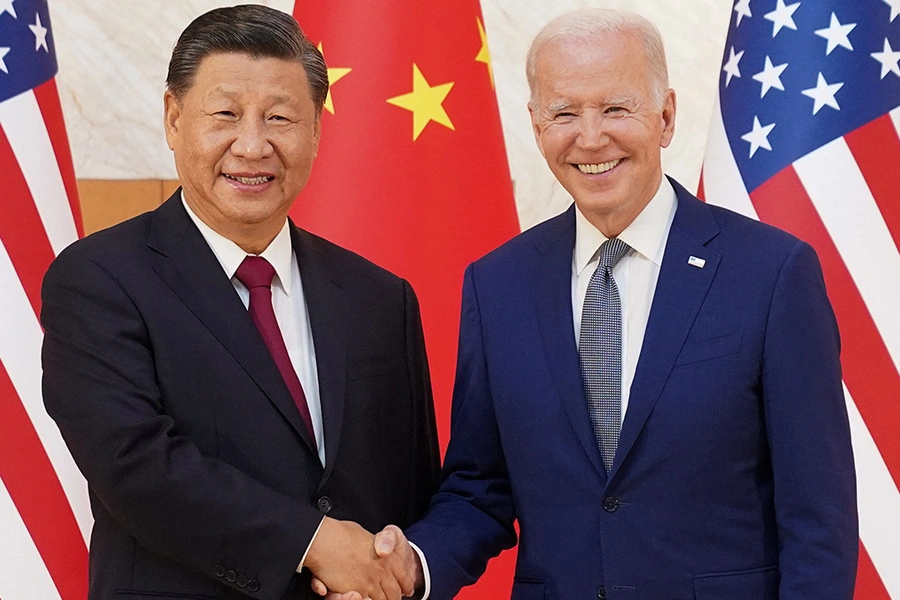
The meeting between U.S. President Joe Biden and Chinese leader Xi Jinping did not resolve major disagreements, but it could start the process of building guardrails to prevent competition from turning into conflict.
U.S. President Joe Biden and Chinese leader Xi Jinping meet on the sidelines of the Group of Twenty summit in Bali, Indonesia. Kevin Lamarque/Reuters
On the margins of the Group of Twenty (G20) gathering in Bali, Indonesia, U.S. President Joe Biden and Chinese leader Xi Jinping met for the first time in person as leaders of their respective nations. Their three-and-a-half-hour meeting came against the backdrop of heightened tensions over Taiwan, unprecedented U.S. export controls on advanced technologies levied against China, ramped up North Korean missile tests, and the ongoing war in Ukraine.
The World This Week will not be sent next week due to the holiday.
Explore the Biden-Xi Meeting David Sacks U.S. President Joe Biden and Chinese leader Xi Jinping meet on the sidelines of the Group of Twenty summit in Bali, Indonesia. Kevin Lamarque/ReutersThe meeting between U.S. President Joe Biden and Chinese leader Xi Jinping did not resolve major disagreements, but it could start the process of building guardrails to prevent competition from turning into conflict. Read more on Asia Unbound
The COP27 climate conference in Sharm el-Sheikh, Egypt, closes out another year of disasters: record-breaking floods, deadly heat waves, and devastating droughts. The urgency for the world’s leaders to make progress at this conference has never been higher, but many obstacles remain. The Council on Foreign Relations explains the issues and lays out what’s at stake in the world’s fight against climate change.




![Russian President Vladimir Putin looks through the scope as he shoots a Chukavin sniper rifle (SVC-380) during a visit to the military Patriot Park in Kubinka, outside Moscow, in September 2018 [File: Alexey Nilkolsky/Sputnik/ AFP]](https://www.aljazeera.com/wp-content/uploads/2022/11/000_1995N2.jpg?resize=770%2C513)


 Đọt Chuối Non