

Why Green School?
“Tell me, and I’ll forget. Show me, and I may not remember. Involve me, and I’ll understand.” [a]
The idea of this saying is the vital principle of a distinctive building called the Green School, located in Bali, Indonesia. The idea of this green school is no longer brand new yet there are only a few that exist in the world. It is not the lack of awareness but the lack of in-depth understanding about a green building.
Here are some facts: Buildings represent about 40% of primary energy consumed globally and also contribute a significant portion of green house gas emissions (GHGs) which are believed to be the main cause of climate change [1]. The school buildings, without exception, play a large part in the energy consumption. About 85% of the total energy consumption comes from heating, cooling, ventilation, and hot water use. But at least 25% of energy usage goes to waste in the conventional buildings. In fact, combining existing technologies with innovative designs, we can still increase the energy efficiency by 35% and reduce the heating costs by 80% of an average building.
In recent years, more and more schools at different levels are aware of the need to foster sustainable education through greener practices among their students. That is, the effective way to transform behavior is by educating, motivating and involving their students and staff into the real green school practices, and to let the people appreciate more about their responsibility for a sustainable future.
Building green school by making the best of local conditions
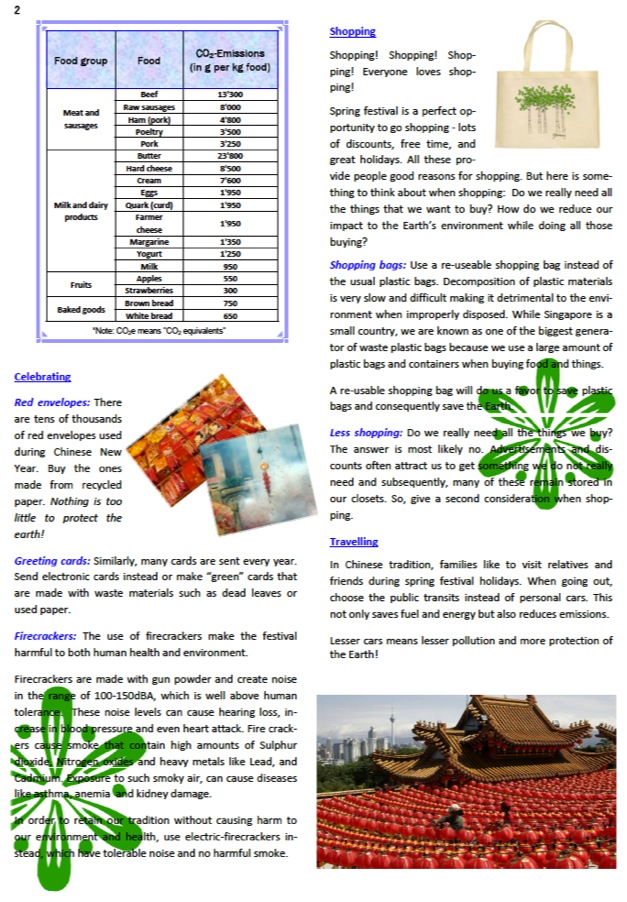
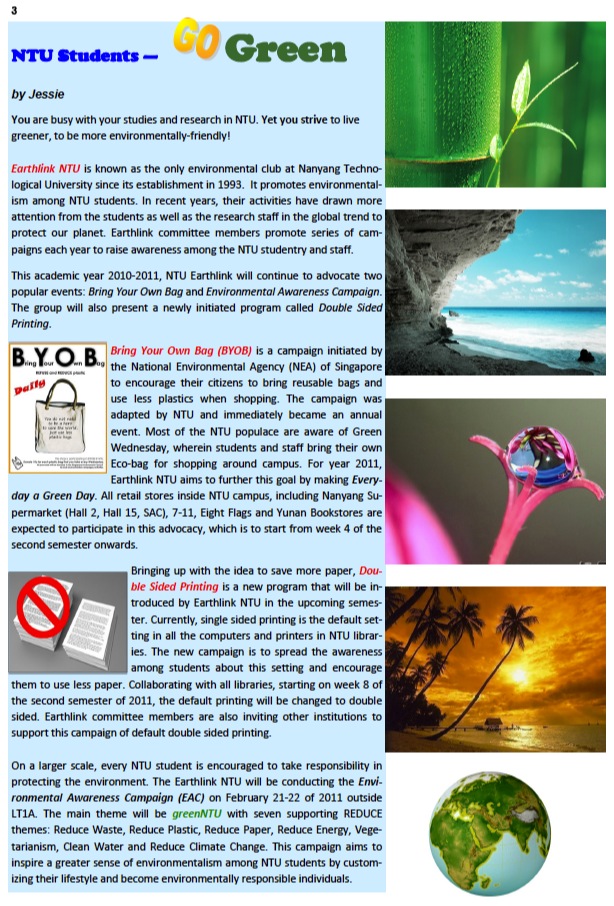
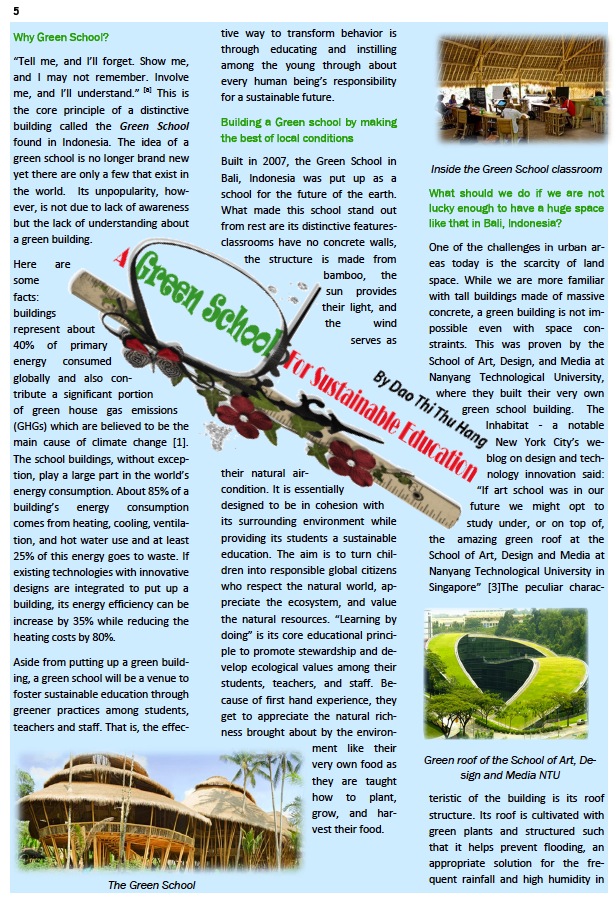
The Green School was built in 2007 in one of the most beautiful islands in Indonesia. What made this school stand out from others are its distinctive features – classrooms have no brick walls, the structure is made from bamboo, the sun provides their light, and the wind serves as their natural air-condition. The idea is to let the children learn to appreciate the ecosystem, to preserve the environment and to value the resources in the dramatically depleting of natural resources today. Frankly, “it is hard to teach the students about sustainability while we are using the last pieces of rain forest for their chair and their table” the school’s president said [2]. Learning by doing, the principle of Green studies subject in the school, in which students learn planting, harvesting, cooking from the product made by themselves. By this practical experience, children more appreciate food they have because they understand how hard food is made.
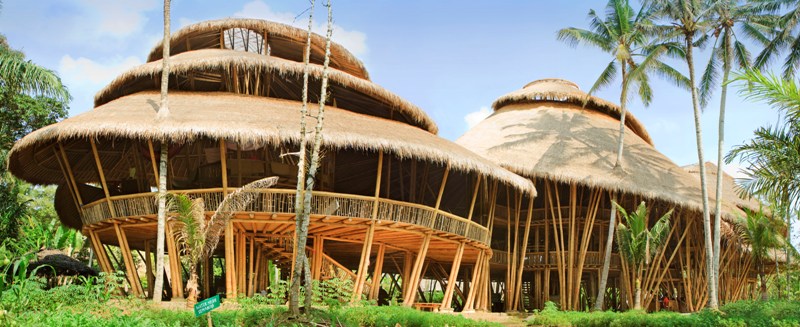
Photo 1: The bamboo structure of Green School
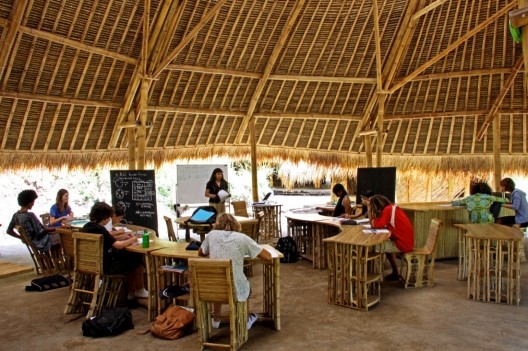
What should we do if we are not lucky enough to have a huge space like that in Bali, Indonesia?
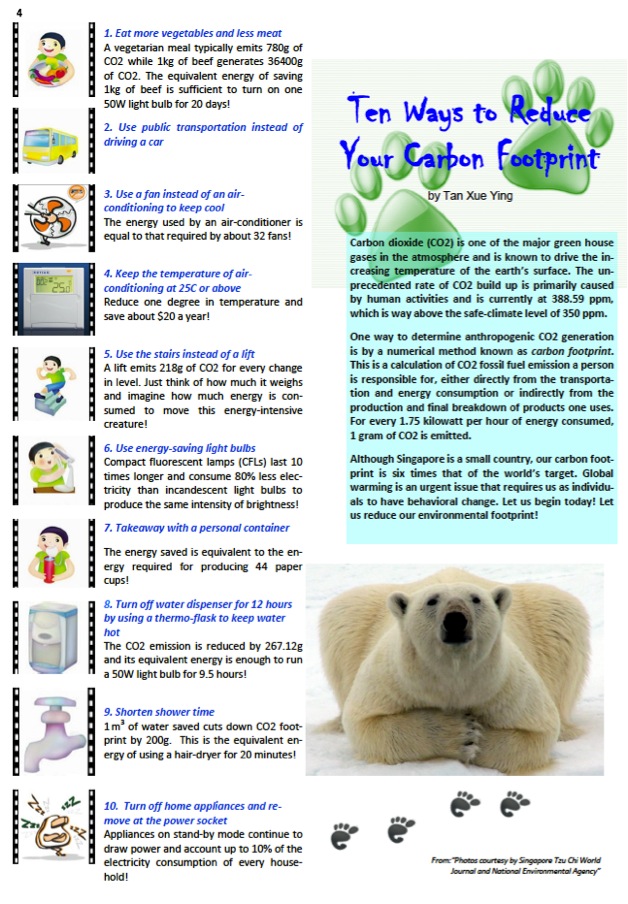
One of the challenges in urban areas today is the scarcity of land space. While we are more familiar with tall buildings made of massive concrete, a green building is not impossible even with space constraints. This was proven by the School of Art, Design, and Media at Nanyang Technological University, where they built their very own green school building. The Inhabitat – a notable New York City’s weblog on design and technology innovation said: “If art school was in our future we might opt to study under, or on top of, the amazing green roof at the School of Art, Design and Media at Nanyang Technological University in Singapore” [3]
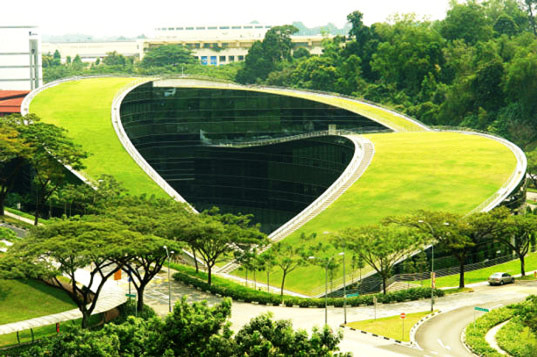
The distinctive feature of the green building is its roof structure. Its roof is cultivated with green plants and structured such that it helps prevent flooding, an appropriate solution for the frequent rainfall and high humidity in Singapore. The green roof also reduces surface temperatures and lessens the energy consumption of the building. It also lengthens the life span of the roof by at least two times longer compared to roofs without greening [4]. In terms of urban planning, green roofs can improve ecological balance and the condition of the atmosphere as well as mitigate environmental problems brought about by the excessive urbanization such as urban heat island problem (in which the temperature in urban area is significantly higher than the surrounding rural areas). The green roof structure can be done not only in schools but also in other buildings with limited space. A green roof structure is also one way to bring nature back to an urban environment.
Obviously, a green school is not merely for the benefit of reducing energy consumption but also for the sustainable education development at different levels. A green roof can be a “natural laboratory” in which teachers can use it as a starting point of a lesson how trees can grow from the concrete, the technique is maybe unusual in children’ mindset that the trees only can grow from the soil. Green roof can also be a real model for college students to learn how the waterproof roofs are made, to understand the way of forming the urban wildlife habitat, and for those who want to learn the amazing mutual relationship of the ecosystem
Green does not have to be primitive or to be surrounded with bamboos, trees, rivers, or mountains. There are many ways in making our surroundings more environmentally sound and sustainable. Green can be the green roofs on concrete buildings, the use of recycled building materials, the use of reclaimed water, and/or the use of renewable energy. Adopt a holistic approach is essential to integrate technologies and innovations, to educate and motivate. However to make all these happen, we should start among the young and motivate behaviorial change until the terms like “green” and “sustainable” are no longer fashionable words. Since, all the schools should be green; all human activities should be sustainable. Sustainable education is the way to pay back the environment, to not harm our future generation as “we do not inherit the Earth from our Ancestors; we borrow it from our Children” [b]
- World Business Council for Sustainable Development. (2008) Energy Efficiency in Buildings Business realities and opportunities. Washington, DC.
- The Green School: [available] http://www.greenschool.org/
- Inhabitat: [available] http://www.inhabitat.com/amazing-green-roof-art-school-in-singapore/
- Green Roofs – Bringing Nature Back to Town: [available] http://www.greenroofworld.com
- Paths of Learning: [available] http://www.pathsoflearning.net/
[a] [b] : Native American saying
See page 5 to page 6
 Đọt Chuối Non
Cám ơn Hằng đã chia sẻ.
Mình rất thích Green School ở Bali, Indonesia. Một không gian giao hòa với thiên nhiên thật tuyệt.
Mình cũng thích sau này chúng ta cũng có một không gian như vậy cho con em chúng ta. 🙂
LikeLike