Tag Archives: trà đàm

Unlearning

Dear Brothers and Sisters,

Life has a lot of roughness – people cheating, backstabbing, betraying, badmouthing, oppressing, hitting each other on the head – so the older we are, the more we become rough as everyone else in the world.

That is a big problem: There is a natural tendency for all of us to become rougher with time.

That is why Jesus said: “If you want to enter the Kingdom of Heaven, be like children.” And Siddhartha taught that we are born with a Buddha heart, which becomes sinful as we grow up in an ignorant world. Continue reading Unlearning

Dyslexia và hành trình để có đầu óc khỏe mạnh

Chào các bạn,

Những năm đầu tiểu học, mình luôn bị đau đầu khi học, chẳng hiểu tại sao, thế nên mẹ đưa mình đi khám bệnh.

Mẹ đạp xe đạp từ đầu này thành phố đến đầu kia thành phố (Đà Nẵng lúc đó là thành phố thuộc tỉnh Quảng Nam – Đà Nẵng). Dù phải cố gắng ngồi yên sau xe đạp (xe đạp lúc đó không có lắp ghế sau chở bé), không được ngọ nguậy làm mẹ té, phải luôn chú ý hai chân, không để hai chân lọt vào bánh xe làm đứt chân, với em bé 7 tuổi học lớp Hai, được ra ngoài đi chơi là vui rồi, nhằm nhò gì mấy chuyện đó. Continue reading Dyslexia và hành trình để có đầu óc khỏe mạnh

Thăm lại Xa lộ 61 – Highway 61 revisited

500 Greatest Songs of All Times

Chào các bạn,

Xa lộ 61 là con đường chạy từ quê nhà của Bob Dylan ở Minnesota đến New Orleans, Louisiana. Anh ấy nói trong cuốn sách “Biên niên sử” của mình, “Xa lộ 61 bắt đầu từ nơi tôi đến, Duluth, chính xác.” Anh ấy nói thêm, “Tôi luôn cảm thấy như mình đã bắt đầu trên con đường này, luôn ở trên con đường này và có thể đi đến bất cứ đâu từ con đường này.” Continue reading Thăm lại Xa lộ 61 – Highway 61 revisited

Leisure living is not good

Dear Brothers and Sisters,

Nhàn cư vi bất thiện – Leisure living is not good. It means if you have a leisure life, you are not busy with working, then it is not good for you.

Why?

When we have so much time in our hand because we are not working on anything, we become couch potato. Our health is on the way downhill – we are overweight, our muscles weaken from lacking physical activities, cholesterol builds up everywhere in our body from the veins to the heart, and we will start having all kinds of diseases due to the deterioration of the body and the immune system. In addition, when we have too much idle time, our mind goes down because it is inactive so much, and the mind may often wander off into negative thinking, unhealthy thoughts, ailing attitude. Continue reading Leisure living is not good

Theory and practice

Dear Brothers and Sisters,

One of the biggest differences between a winner and a loser is their focus – loser focuses on theory, winner on practice.

I am not even sure I am using correct language when I say, “Loser focuses on theory.” I don’t think you can focus on theory – people who read theory all the time only read like they do Internet surfing, glancing over everything very quickly and not really focusing on anything. Continue reading Theory and practice

Add your culture into your handshake

Dear Brothers and Sisters,

You are Vietnamese. You may have a degree from the US or Europe, and you may wear a suit with a tie every day, but you are basically still a Vietnamese – you look Vietnamese and maybe your English speaking has a tint of Vietnamese accent in it.

Don’t try to act 100% like a Westerner, because you won’t be a Westerner, and because of an important thing: You have Vietnamese cultural capital in your pocket; take it out and use it for your advantage.

Let’s talk about your handshake. Handshake is important because it is the first and also the last thing that happens when people meet. First impression and last impression, both are ultra-important in communication and etiquette.

The Western handshake is your right hand gripping and shaking the other man’s right hand, while your body standing straight and your eyes looking at his eyes. It is formal and… cold.

handshakewest

Let’s add some Asian culture into the handshake to make it warmer, friendlier, and more respectful.

First, the hands. If you grip the other man’s hand with both of your hands, then that a show of great respect, usually used when you shake an elder’s hand in the Vietnamese culture.

handshake

However, in business and diplomacy, this way of handholding may be misunderstood as kowtowing, which is sign of weakness.

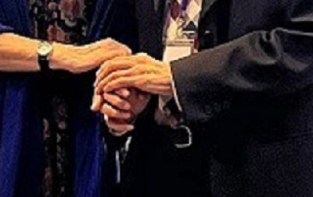
So, we change a little: Your right hand grips the other man’s right hand as usual, but you place your left hand on top of both gripping right hands, as in the picture below.

HandshakeOrg

In this way, the handshake is warm and shows respect but with great confidence.

The head. While handshaking, bow down you head just a little, as if you are nodding your head.

Now you have a very Asian handshake, warm, friendly, respectful, and confident, which will win heart and mind of most people.

The great thing about this is that this handshake may make the other person feel so warm and respected, but he doesn’t know how to return the favour to you, because he has only his Western handshake. So, he feels like he owes you something. And he will love you for that.

If after a good-bye handshake, you top it off with putting both your palms together in front of your chest – chắp tay búp sen – as in a temple, and slightly bow to the other person, Thai style. Then he will be blown away.

Two Thai women in Sawasdee action.

The most important thing we are trying to achieve here is that you show yourself as a Vietnamese, and Asian, with respect and confidence toward others, and you respect them enough to act to them as who you truly are.

I guess in Vietnam today, people call it bamboo diplomacy. I like this term: Bamboo diplomacy.

tre

Be respect and confident to show your true self in your communication.

Wish you all be confident in our bamboo diplomacy.

With compassion,

Hoành

© copyright 2023
Trần Đình Hoành
Permitted for non-commercial use
www.dotchuoinon.com

Learning

Dear Brothers and Sisters,

What is learning? How do we learn?

Most people think that you learn by listening to what your teacher says, understand it, and keep it in your memory. Probably this way of learning is true to almost everything we learn, but that is only the outward appearance of learning. Inside, in our head and our heart, true learning is a process of thinking, of questioning, of reflecting on what we see, hear, smell and touch outside.

racoon

Say, the first time you see a racoon, you immediately have a series of questions: What animal is this? What do they call it? Where is it from? Where is its normal habitat? What does it do? What does it eat? Is it gentle or mean? Will it jump up and attack me if I get close? Does it carry diseases that it may pass on to human?… Continue reading Learning

Liên hệ giữa chúng ta và môi trường sống

Chào các bạn,

Nói đến môi trường, chúng ta nghĩ ngay đế sông núi cầu đường. Nhưng phần chính và quan trọng nhất của môi trường là những người sống trong môi trường đó – họ chính là một phần, và là phần lớn nhất, của môi trường.

Các bạn có chạy xe lên một thành phố lớn trên núi bao giờ chưa? Bạn chạy đường núi cả nửa ngày chỉ thấy núi rừng sông suối, chim chóc, nai mễn, trời mây… Đến thành phố cũng ngay trên dãy núi đó thì hoàn toàn khác – đường xá xe cộ ì đùng, nhà cửa buildings cao tầng san sát, người qua lại đầy hai lề đi bộ, thùng rác đứng dọc hè phố…

Hai môi trường – đường núi và thành phố núi – khác nhau 180 độ như thế, chỉ vì một bên thì ít người và một bên thì người san sát. Continue reading Liên hệ giữa chúng ta và môi trường sống

How to talk effectively

Dear Brothers and Sisters,

Talking is the most important part of human communication. Unless you are a student in the Speechless Zen tradition (Thiền Vô Ngôn), talking is a major part of your daily communication.

How to talk effectively?

“Talking effectively” means talking in a way that (1) draws your listeners’ attention and interest and (2) by the end, convinces your listeners of your points. Continue reading How to talk effectively

Expand your horizon

Dear Brothers and Sisters

“Expand your horizon” means “Have a broader view of the world around you.” I have talked about this very often here in ĐCN.

Your generation is way different from your parents’generation. Today the world is a village – countries and people connecting togerther in a network called global village. Everything happens to one person in the village also affects others in the village. Say, some accident happens in Coca Cola USA may affect all the Coca Cola branches around the world and the pockets of billions of consumers. Continue reading Expand your horizon

How do you feel about the world?

Dear Brothers and Sisters,

The world curently have so many on-going wars that one can hardly keep us with the count: Russia-Ukraine, Israel-Palestinians, Columbia, Somali, Yemen, Afghanistan, Sudan, India, Philippines, Myanmar, Syria, Iraq… and almost every country of the world. In addition, today war is more sophisticated – beside biologial and chemical warfares (which are outlawed by international law), some rogue states – Russia, North Korea, Iran – constantly hold up the nuclear scepter. And there are psychologial warfare, misinformation warfare, hacking warfare, economic warfare – starving your opponent to death…

Map of ongoing armed conflicts (number of combat-related deaths in current or past year):  Brown: Major wars (10,000 or more) , Red: Wars (1,000–9,999), Orange:  Minor conflicts (100–999); Yellow Skirmishes and clashes (1–99)

So, how do you feel about the world today?

Have you ever thought about the world you are living in at all?

If you have been blissfully ignorant of the world’s woeful condition, then you are in deed ignorant, though ignorant in happiness.

Ignorance is bad – it is one of the Three Poisons in Buddhist philosophy – Greed, Anger, Ignorance (Tam độc: than, sân, si).

You live in a home, you need to always be aware of its state, physical and spiritual – where it needs to be fixed. Otherwise, the home will collapse on your head some day.

We have only one world to live in, we need to pay attention to our world.

It is an environmental matter, my friends. We need to pay attention to where we live: our house, village, city, country, world…

Many people have no idea about the world outside their family. For them, the world is too far, they don’t need to care, there are many world leaders working on world issues, why should the lowly me worry about the moon?

That would be like the attitude of some students: Why should I care about the school? I can’t do anything about its problems. That is the job of the principal and the teachers.

Well, we all know that a school with many students with such attitude will become a gangster hub very soon. Or it is already a gangster hub.

The environment we live in, be it village, city, nation or world, needs the attention and care from everyone of us. That is a natural matter, a logical matter, and a self-evident truth we all know by intuition, observation, and experience.

But what can I do for the world?

At the least, you can pray: “God/Buddha, please help our world be better.” That takes 2 seconds of your precious time. (“Oh My Lord, 2 looo…ng seconds of my ultra-busy time! I’ll be late for my meeting!” Busy Sir, can you pray for 2 seconds when you drive, to save you some precious time?)

If you don’t like praying. Then concentrate and say quietly: “I wish a better world.” That also takes 2 seconds.

Do that everyday, right after waking up in the morning is the best time.

That would be enough to be a relatively strong energy source to help save the world.

Don’t, never, ever, underestimate the power of your positive thinking, on yourself and on the world, at the same time.

Wish you all be positive to our world.

With compassion,

Hoành

© copyright 2023
Trần Đình Hoành
Permitted for non-commercial use
www.dotchuoinon.com

Humility

Dear Brothers and Sisters

In primary school, I was taught: “You should be humble. When you see the poor, the disabled, you must lower yourself to their level to be equal to them.” I practiced that faithfully for many years, at least probably till I was in my 40s, but I always found it so hard to be humble. I couldn’t understand why.

Today, I have found the culprit. That is: The teaching I was taught contained these premises: (1) You are higher than many people, (2) Many people, including the poor and the disabled, are lower than you, (3) So, when you meet them, you humble yourself by lowering yourself to their level. Continue reading Humility