Tag Archives: Thế giới

Counci on Foreign Relations – Daily news brief Jan. 9, 2023

Daily News BriefJanuary 9, 2023
Top of the Agenda

Bolsonaro Supporters Attack Government Buildings in Brazil

Brazilian police arrested at least three hundred people after thousands of supporters of former President Jair Bolsonaro stormed and vandalized (AP) Brazil’s Congress, Supreme Court, and presidential palace yesterday in scenes reminiscent of the January 6, 2021, attack on the U.S. Capitol. The rioters protested the results of last year’s presidential election, which Bolsonaro lost to left-wing former President Luiz Inácio Lula da Silva. Bolsonaro has for years pushed false claims about the credibility of Brazil’s election system, and many of his supporters say the 2022 election was stolen from him.
Multiple world leaders condemned the events (NYT) and voiced support for Lula, who said there was “incompetence or bad faith” on behalf of police who allowed the events to unfold. Bolsonaro, believed to be in Florida, tweeted a condemnation (NYT) of the attack several hours after it began.
Continue reading Counci on Foreign Relations – Daily news brief Jan. 9, 2023

Taking the US-India relationship to the next level

By David Santoro and Akhil Ramesh

David Santoro (david@pacforum.org) is President and CEO of the Pacific Forum. Follow him on Twitter @DavidSantoro1
Akhil Ramesh (akhil@pacforum.org) is Senior Resident Fellow at Pacific Forum.

The relationship with India is “the most important for the United States in the 21st century,” said Kurt Campbell, the Biden administration’s National Security Council Coordinator for the Indo-Pacific, last month. President Biden made similar comments earlier in 2022, and the recently published US strategic reviews also talk about the importance of India. The US National Security Strategy, for instance, states that, “As India is the world’s largest democracy and a Major Defense Partner, the United States and India will work together, bilaterally and multilaterally, to support our shared vision for a free and open Indo-Pacific.”
 
Numerous reasons explain this enthusiasm for US-India rapprochement. Even though differences between the two countries are many (notably development level), similarities also abound. Both are big countries with a large and diverse population, both are democracies and both have vibrant civil societies and incredibly innovative communities, especially in technology.
  Continue reading Taking the US-India relationship to the next level

The Consequences of Divided Government for U.S. Foreign Policy

The Water’s Edge January 4, 2023, Council on Foreign Relations

by James M. Lindsay


President Joe Biden delivers his first State of the Union address to a joint session of Congress in March 2022.
Chip Somodevilla/REUTERS


Council on Foreign Relations
58 East 68th Street – New York, NY 10065  |  |  |  |  Forward This Email Manage Your Email Preferences

Divided government is back! After two years of Democratic control of the presidency and both houses of Congress—just barely in the case of the Senate—the 118th Congress that opened yesterday puts Republicans in charge of the U.S. House of Representatives. A single party has controlled the White House and Congress only three times in the last three decades.

So what will divided government mean for U.S. foreign policy? Here are three things to watch. Continue reading The Consequences of Divided Government for U.S. Foreign Policy

10 Conflicts to Watch in 2023

Russia’s invasion of Ukraine is still reverberating around the world—and setting the stage for more large-scale violence to come.

JANUARY 1, 2023, 7:00 AM Foreign Policy

Ukrainian soldiers fire toward Russian positions in the Donbas region of eastern Ukraine.

By Comfort Ero, the president and CEO of the International Crisis Group, and Richard Atwood, executive vice president of the International Crisis Group.

Will he, or won’t he? This time last year, that was the question. Russian President Vladimir Putin had massed almost two hundred thousand troops on Ukraine’s borders. U.S. intelligence warned that Russia was preparing for all-out war. All the signs pointed to an assault, bar one: It seemed unthinkable.

True, Russia had attacked Ukraine in 2014, and in the spring of 2021 had staged a dress rehearsal for an invasion, building up forces on the frontier before sending them home. Putin seemed ever angrier at Kyiv’s refusal to bow to his will. He openly derided Ukrainian national identity and sovereignty. Still, it was shocking, when Russian forces did roll in, that a nuclear-armed power in 2022 would seek to conquer a neighbor in an act of unprovoked aggression.

Continue reading 10 Conflicts to Watch in 2023

Council on Foreign Relations – Daily News Brief Jan. 3, 2023

Top of the Agenda

IMF Director Warns One-Third of World Could Face Recession This Year

For most of the global economy, 2023 will be “tougher than the year we leave behind,” International Monetary Fund (IMF) Managing Director Kristalina Georgieva said in a CBS interview. She said the economies of the United States, China, and the European Union (EU) are all slowing down. While Georgieva said the United States “may avoid a recession,” the Wall Street Journal found that more than two-thirds of economists at twenty-three large financial institutions are projecting a U.S. recession this year. Georgieva also said that the war in Ukraine and COVID-19 will continue to strain the economies of the EU and China, respectively. She added that countries should work to secure their supply chains but warned that dividing the global economy into U.S. and Chinese blocs could “chop $1.5 trillion” from global gross domestic product (GDP) each year. 
Continue reading Council on Foreign Relations – Daily News Brief Jan. 3, 2023

Council on Foreign Relations – Daily news brief Dec. 29, 2022

Editor’s note: There will be no Daily Brief until Tuesday, January 3, in observance of New Year’s Day.
Top of the Agenda

Russia Rejects Ukraine’s Peace Conditions, Bombards Its Power Grid

Russia fired nearly seventy missiles (WaPo) at Kyiv and other Ukrainian cities today in what appeared to be one of its biggest strikes on Ukraine’s energy grid. Ukraine’s military said it shot down fifty-four of the missiles. The attack came hours after Russian Foreign Minister Sergei Lavrov reiterated Moscow’s rejection (Al Jazeera) of Ukrainian President Volodymyr Zelenskyy’s conditions for peace. 
In recent weeks, Zelenskyy has promoted a peace plan in which Russia would face a war crimes tribunal and give up occupied territories in eastern Ukraine. A Kremlin spokesperson yesterday rejected the possibility (NYT) of ceding the territories, while Lavrov said today that Kyiv’s plans to drive Russia out of eastern Ukraine were an “illusion.” 
Continue reading Council on Foreign Relations – Daily news brief Dec. 29, 2022

Council on Foreign relations – Daily News Brief Dec. 21 2022

Top of the Agenda

Zelenskyy Visits Washington in First Foreign Trip Since Russia’s Invasion

Ukrainian President Volodymyr Zelenskyy is scheduled to meet with U.S. President Joe Biden (WaPo) and address Congress today in his first trip outside of Ukraine since Russia invaded in February. During the meeting, Biden is expected to announce a $2 billion military aid package for Ukraine that will reportedly include the Patriot missile system, the most advanced air defense system in the U.S. arsenal.
Zelenskyy’s visit comes as U.S. lawmakers consider a spending package (NYT) that includes $45 billion in emergency and economic aid to Ukraine. If approved, it would bring the total U.S. aid to Ukraine to more than $100 billion. Some lawmakers from the Republican Party, which will soon take control of the House of Representatives, have objected to the new funding. 

5 takeaways from Volodymyr Zelensky’s historic visit to Washington

Kevin Liptak

By Kevin Liptak, CNN

Updated 9:01 PM

volodymyr zelensky

Watch Zelensky unveil flag during historic speech to Congress

CNN —  Three-hundred days after his country was invaded by Russia, Ukrainian President Volodymyr Zelensky jetted to Washington, DC, for talks on what the next 300 days might bring.

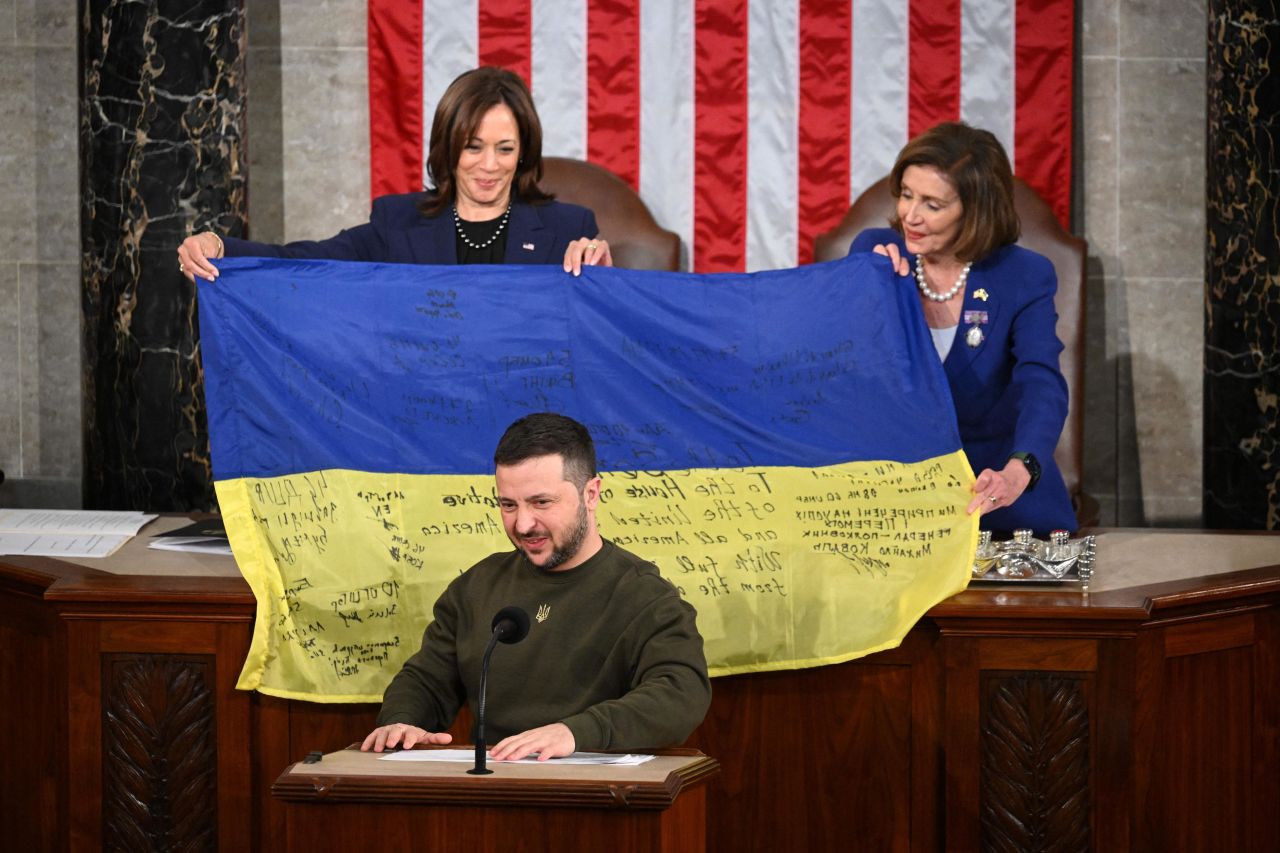
Shrouded in secrecy until the last minute, the historic visit was heavy with symbolism, from Zelensky’s drab green sweatshirt to President Joe Biden’s blue-and-yellow striped tie to the Ukrainian battle flag unfurled on the House floor.

But the trip was about far more than symbols. Biden wouldn’t invite Zelensky to Washington – and endure a risky trip outside Ukraine for the first time since the war began – if he did not believe something real could be accomplished meeting face-to-face instead of over the phone.

Emerging from their talks, both men made clear they see the war entering a new phase. As Russia sends more troops to the frontlines and wages a brutal air campaign against civilian targets, fears of a stalemate are growing.

Yet as Zelensky departed Washington for a lengthy and similarly risky return trip to Ukraine, it wasn’t clear that a pathway to ending the conflict was any clearer.

Biden shakes hands with Zelensky as he arrives at the White House.
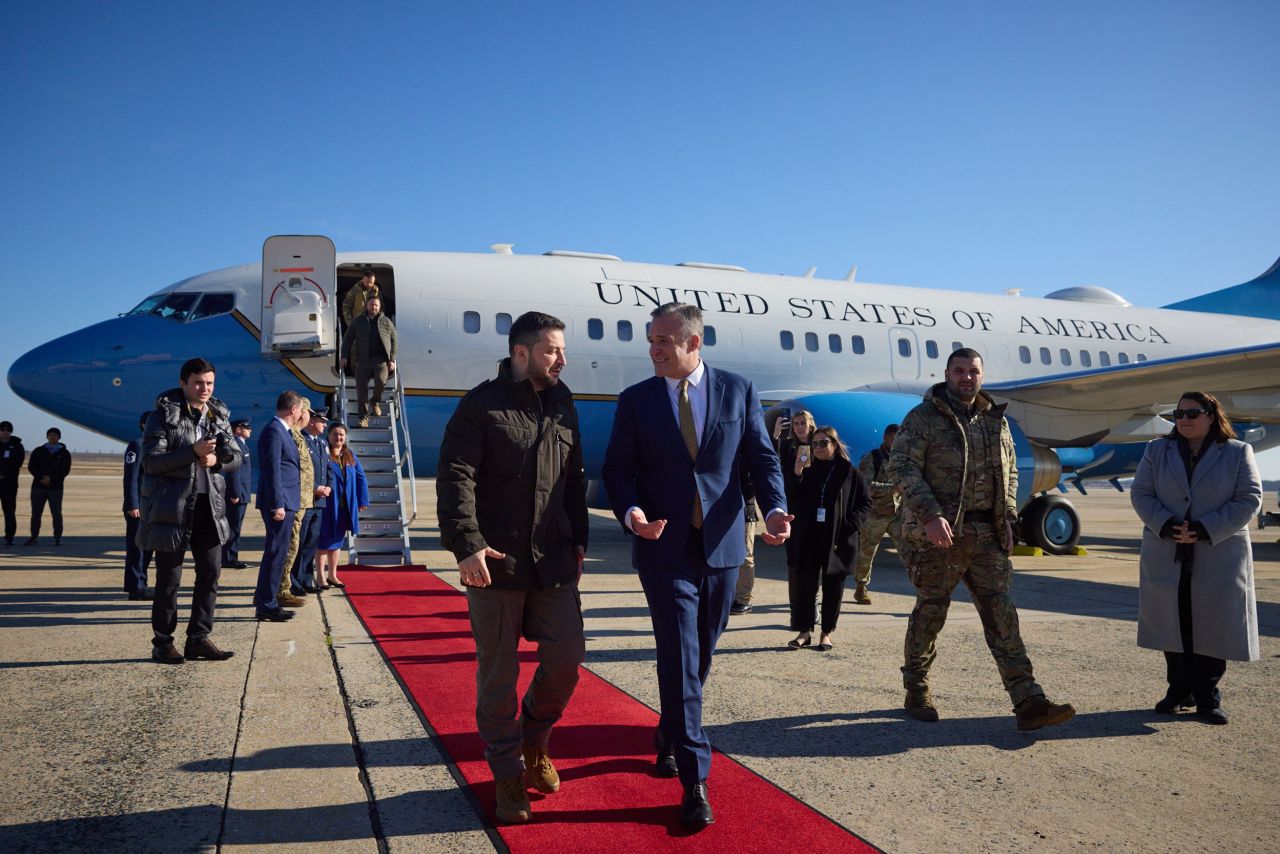
Zelensky, left, is greeted by Rufus Gifford, chief of protocol for the state department, after landing in the United States on Wednesday.
President Volodymyr Zelensky addresses Congress as Rep. Nancy Pelosi and Vice President Kamala Harris hold up a Ukrainian national flag signed by Ukrainian soldiers at the Capitol in Washington on Wednesday, December 21.

President Volodymyr Zelensky addresses Congress as Rep. Nancy Pelosi and Vice President Kamala Harris hold up a Ukrainian national flag signed by Ukrainian soldiers at the Capitol in Washington on Wednesday, December 21.Mandel Ngan/AFP/Getty Images

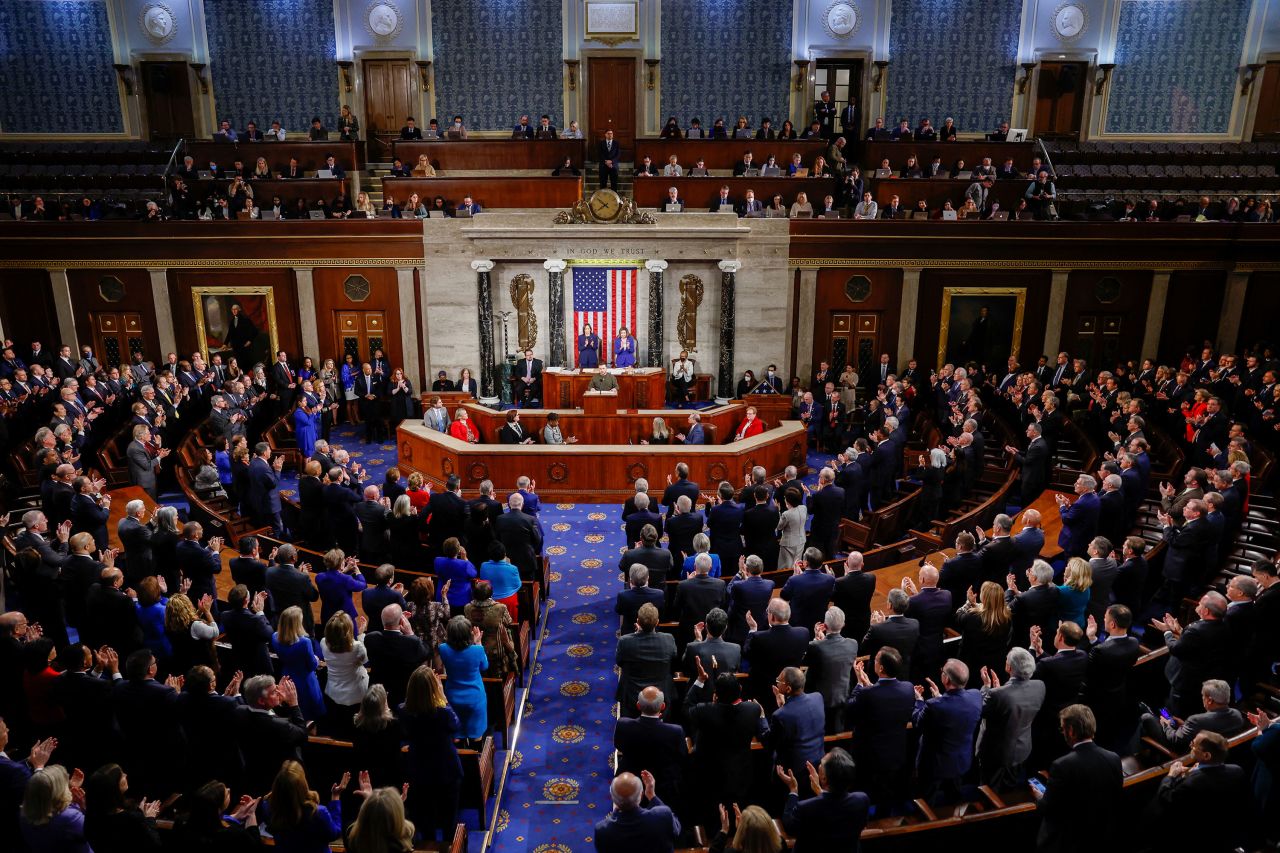
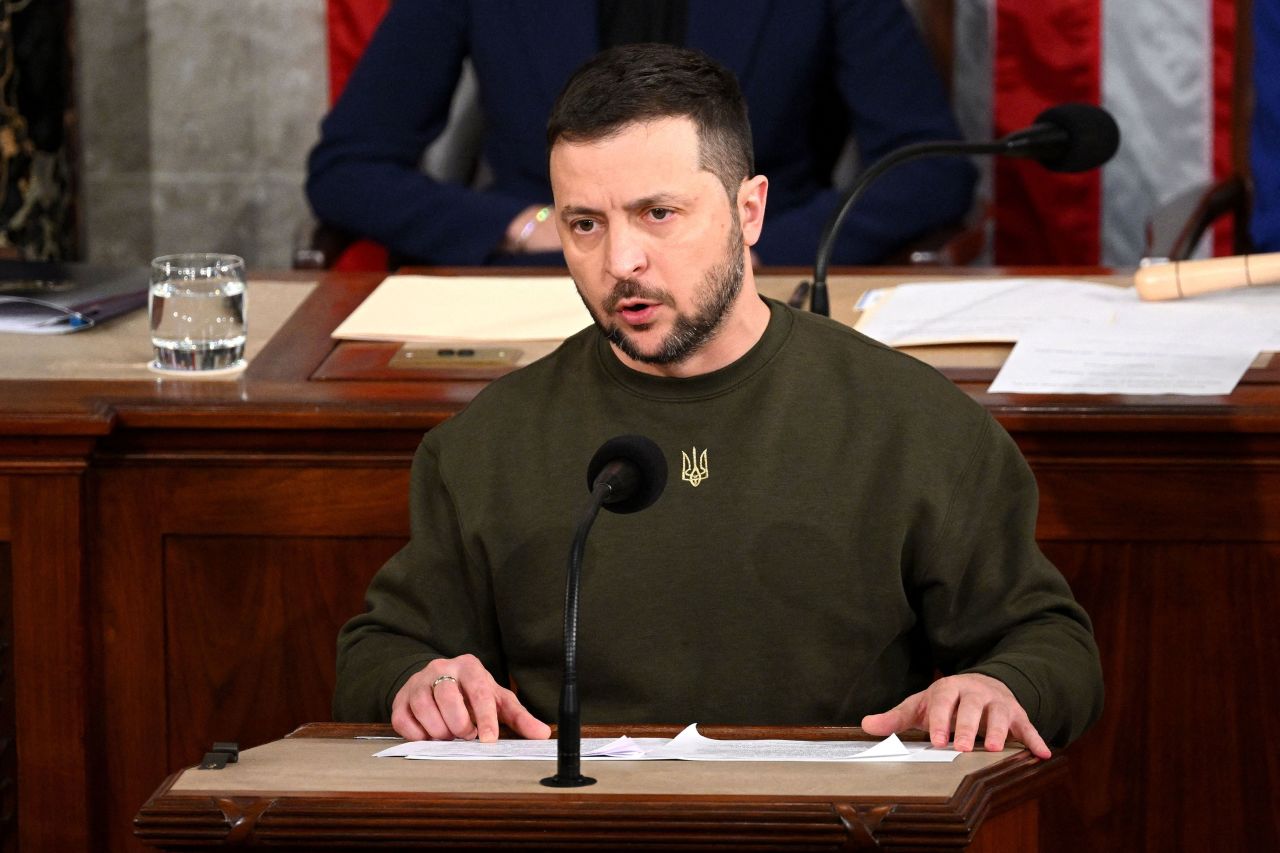
Zelensky addresses the joint meeting of Congress.
Zelensky holds an American flag that was gifted to him by Pelosi. The flag was flown over the Capitol earlier in the day.
Zelensky addresses Congress.
Zelensky addresses the joint meeting.
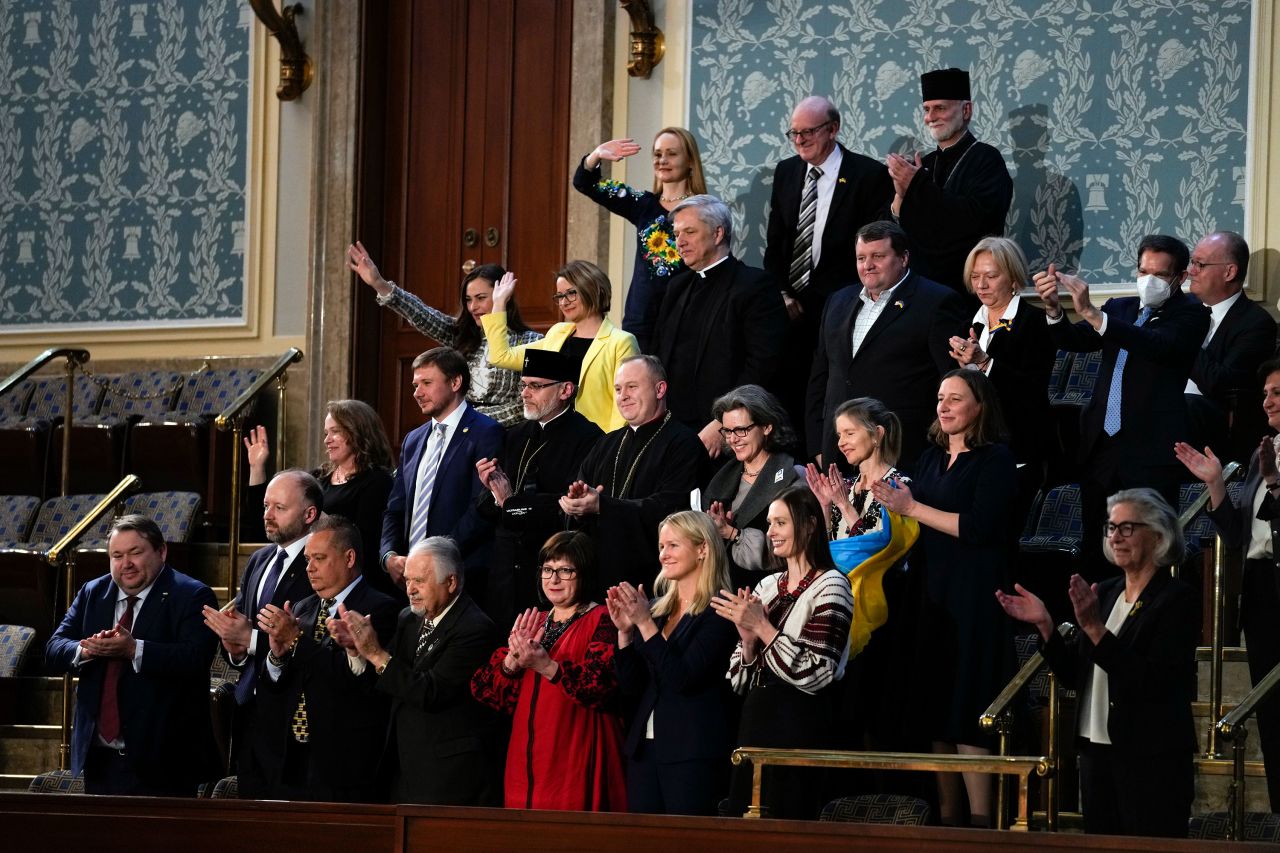
Guests of the the Ukrainian delegation wave as Zelensky acknowledges them during his address.
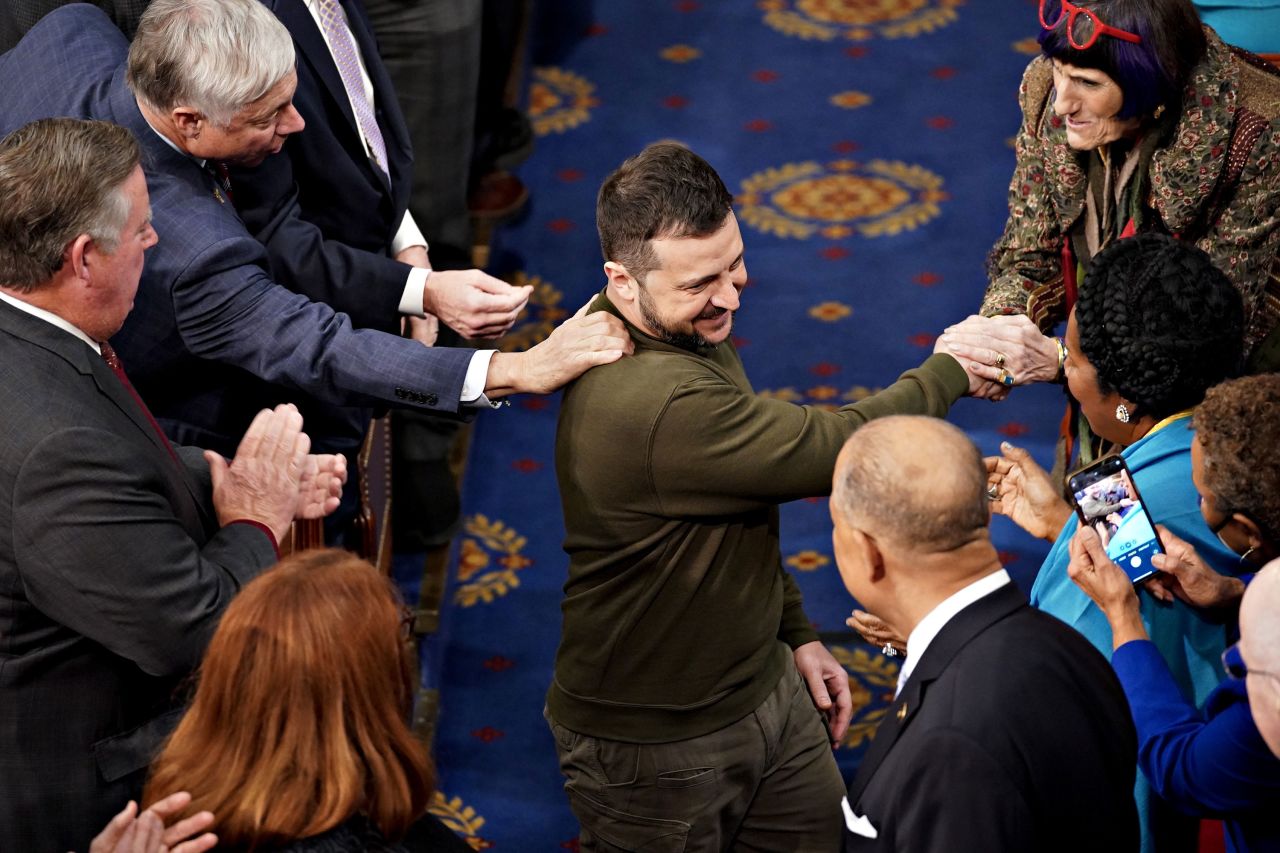
Zelensky is greeted as he arrives to address Congress.
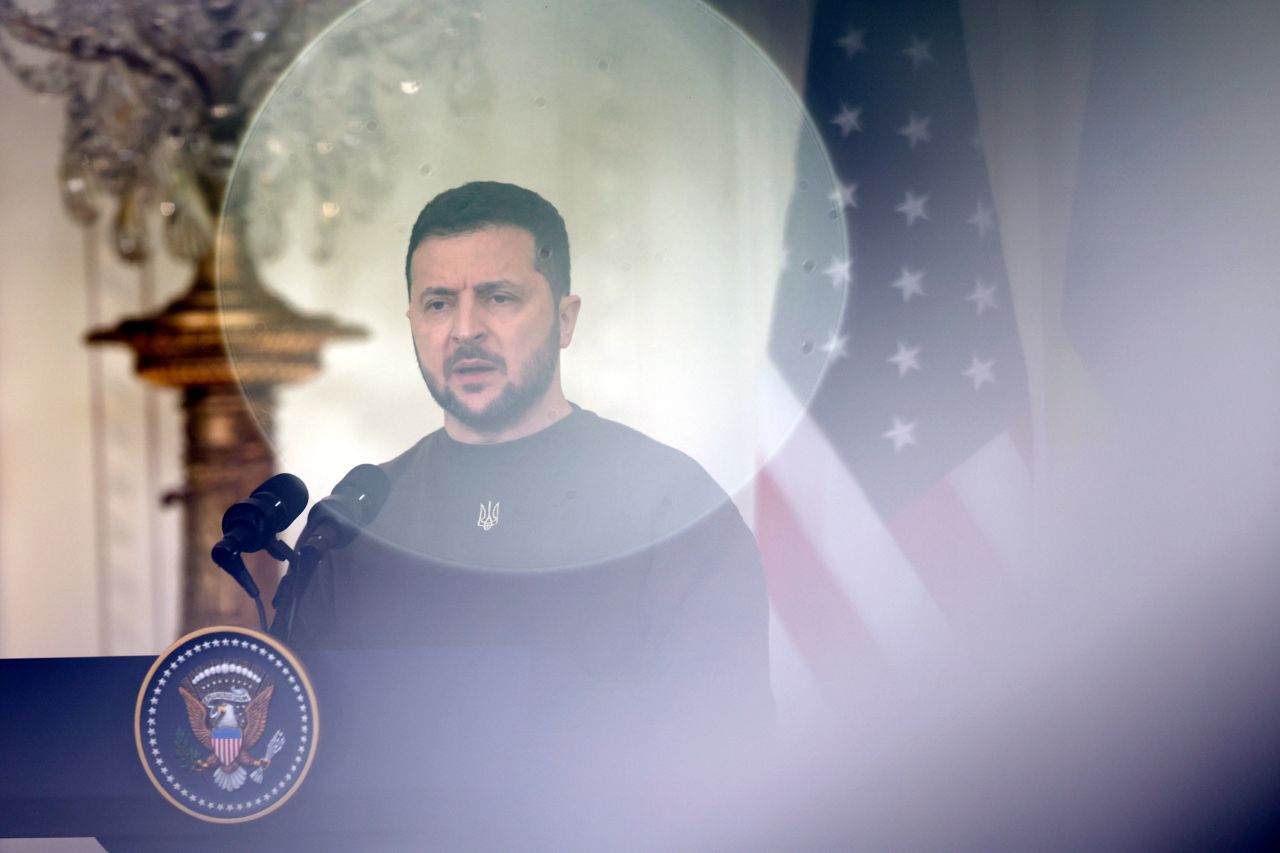
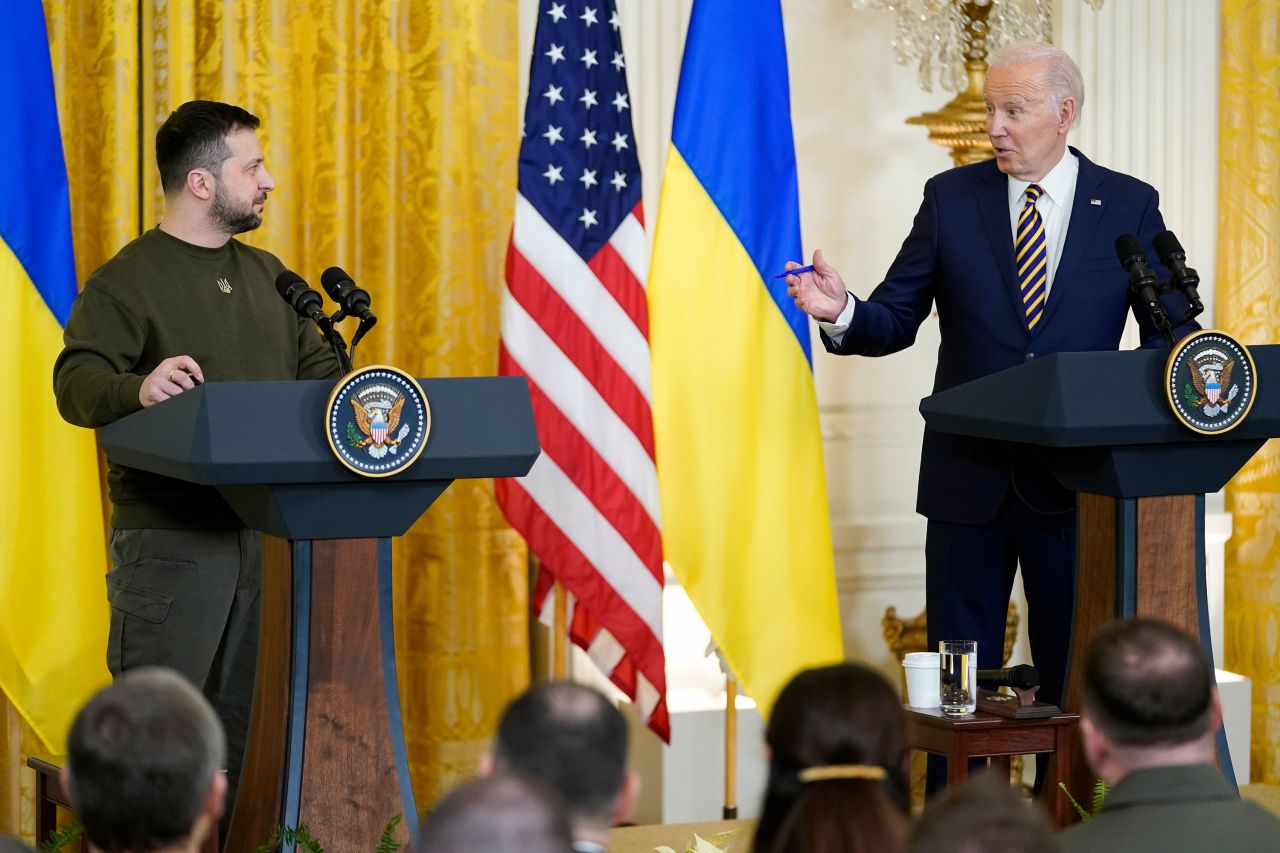
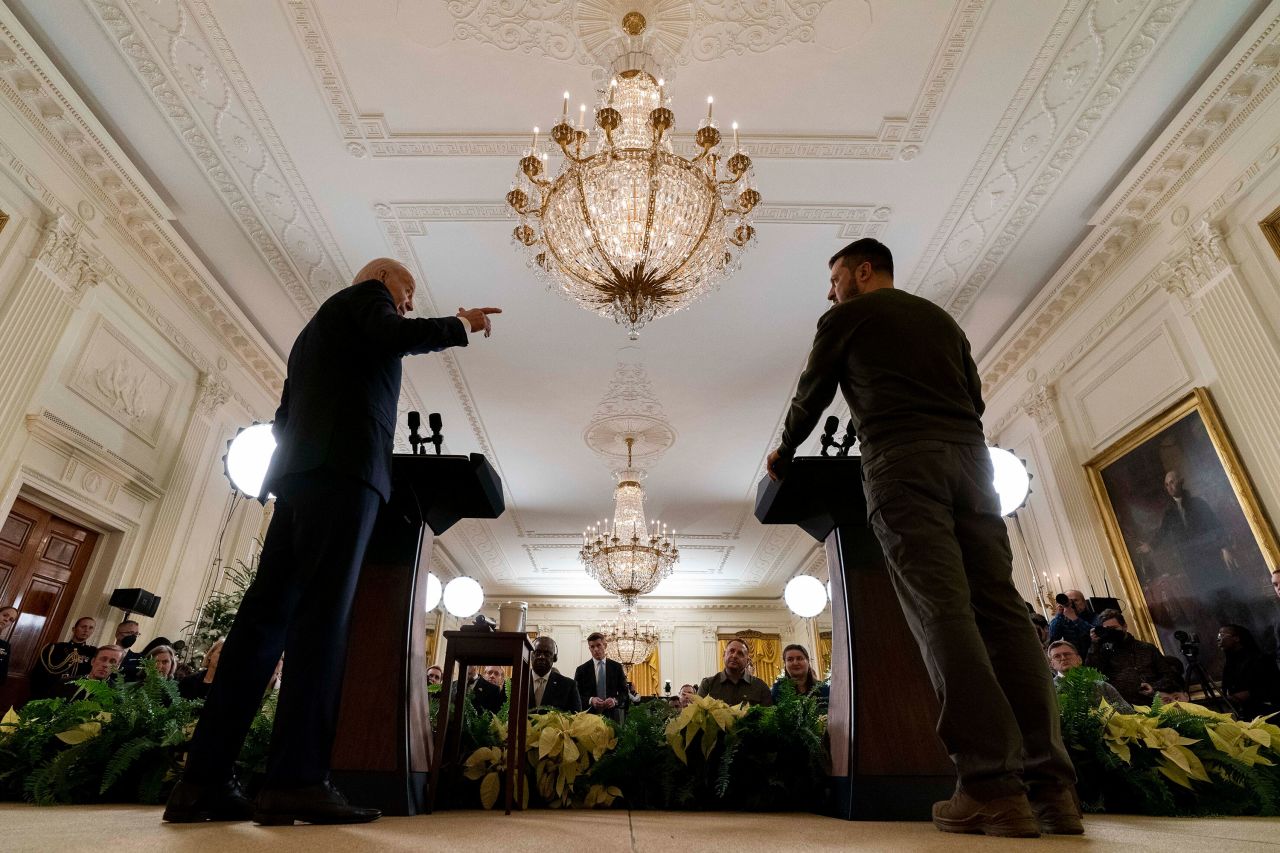
Zelensky speaks during a news conference with Biden in the East Room of the White House.
Biden speaks during the news conference.
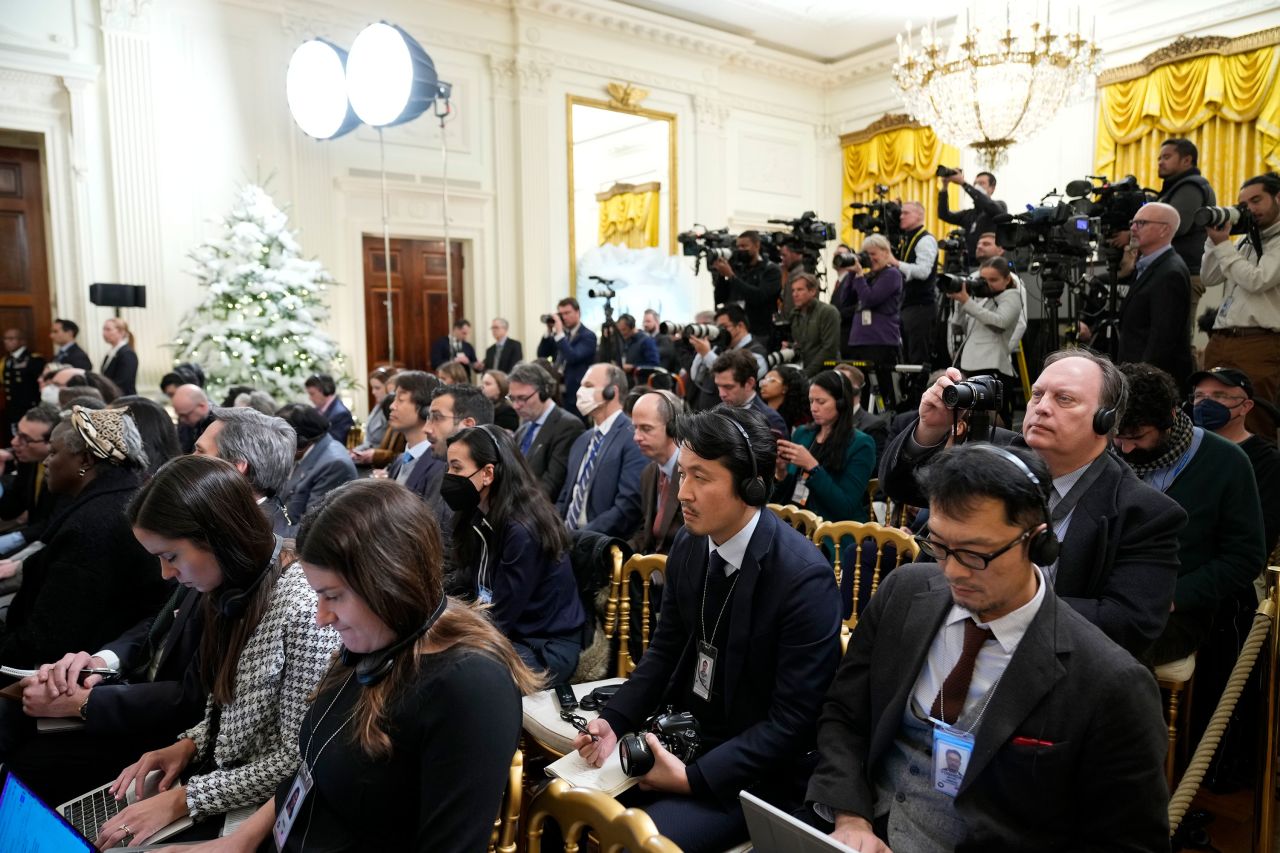
Members of the media listen during the news conference in the East Room of the White House.
Biden speaks during the news conference.
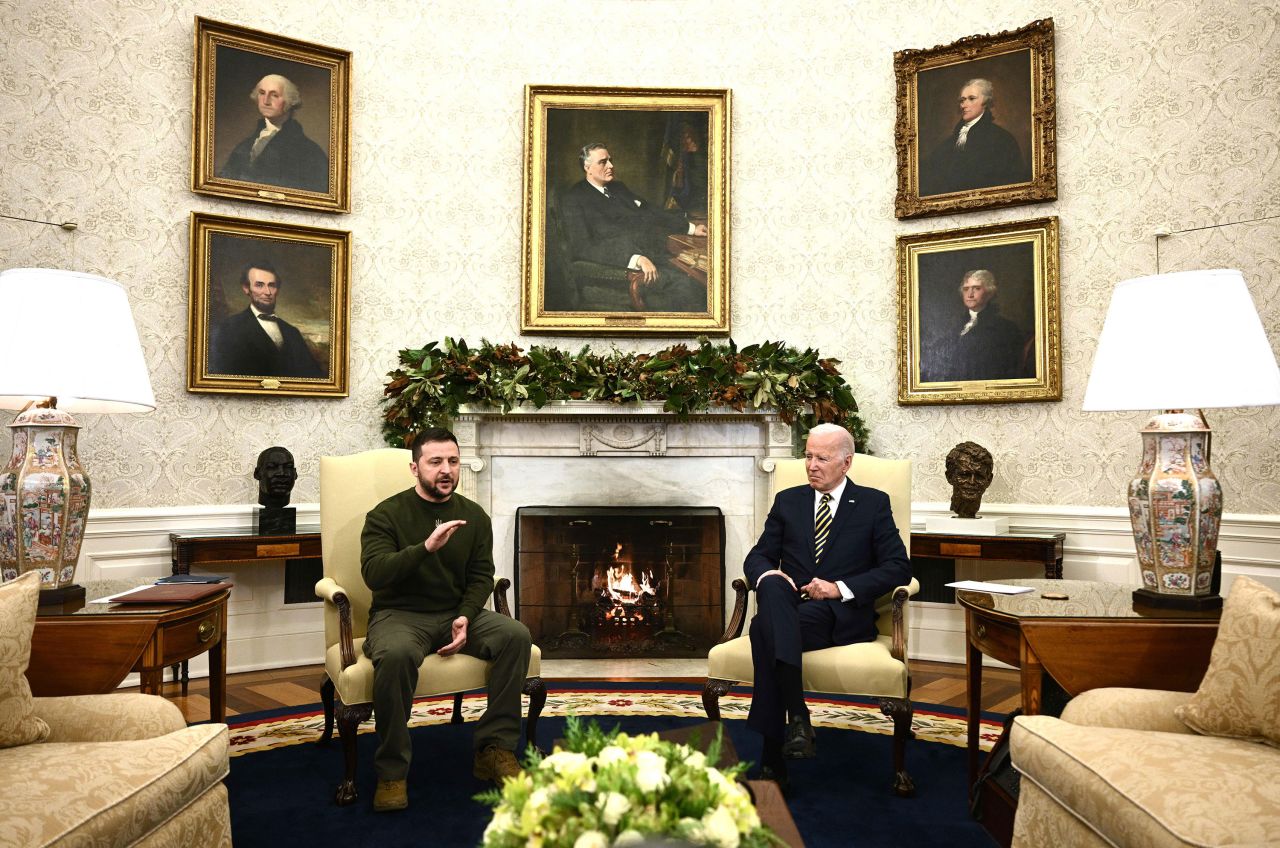
Zelensky meets with Biden in the Oval Office of the White House.

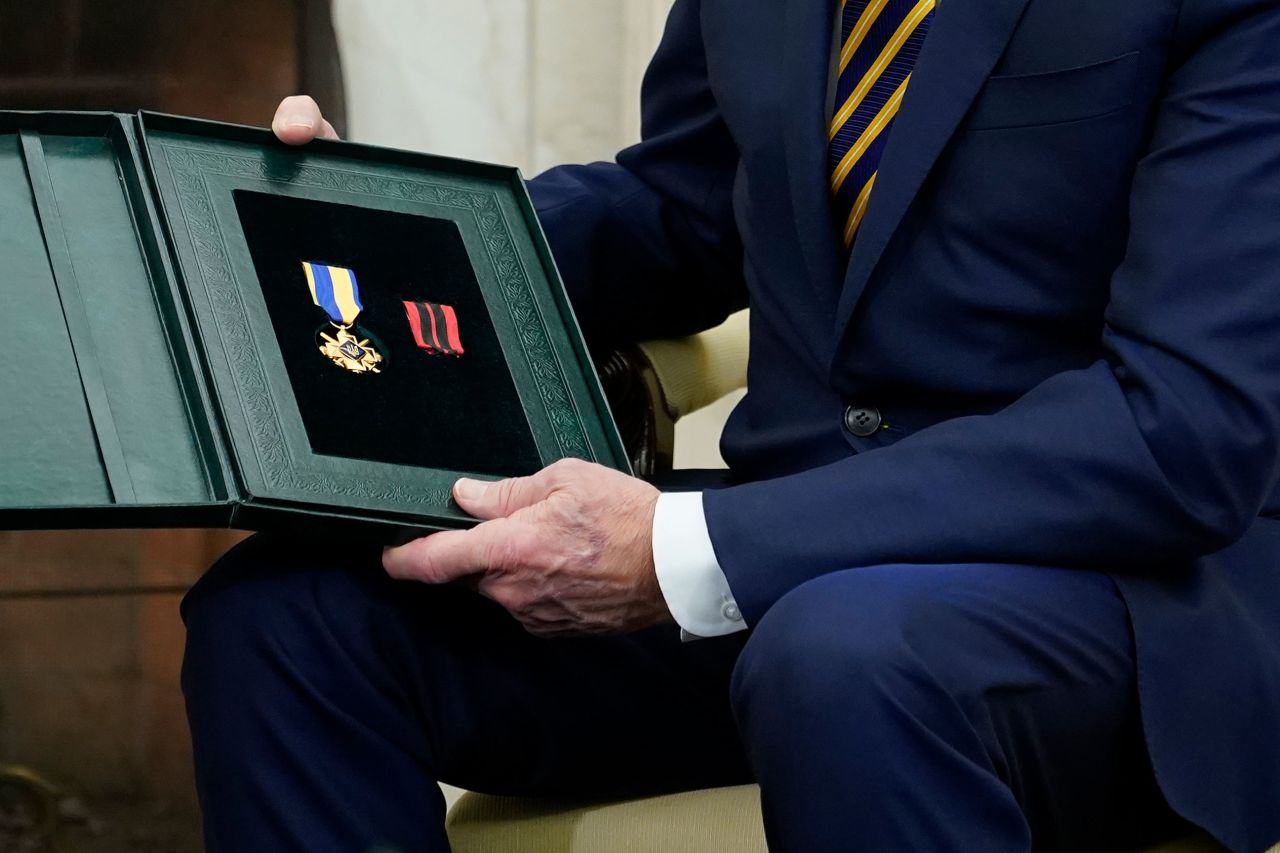
Biden holds the Cross of Combat Merit. "He's very brave," Zelensky said of the soldier. "And he said give it to very brave President, and I want to give you, that is a cross for military merit."
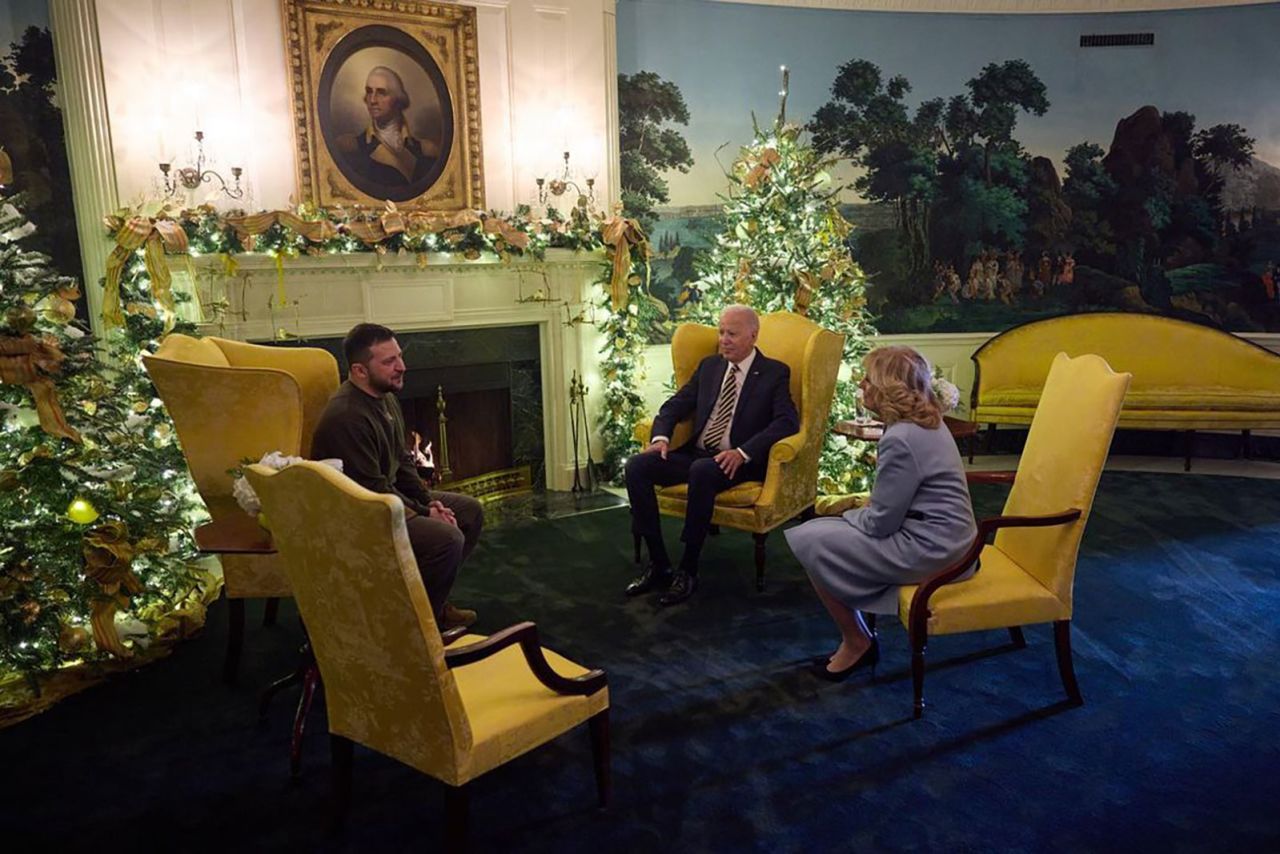
Zelensky sits with Biden and first lady Jill Biden inside the White House.
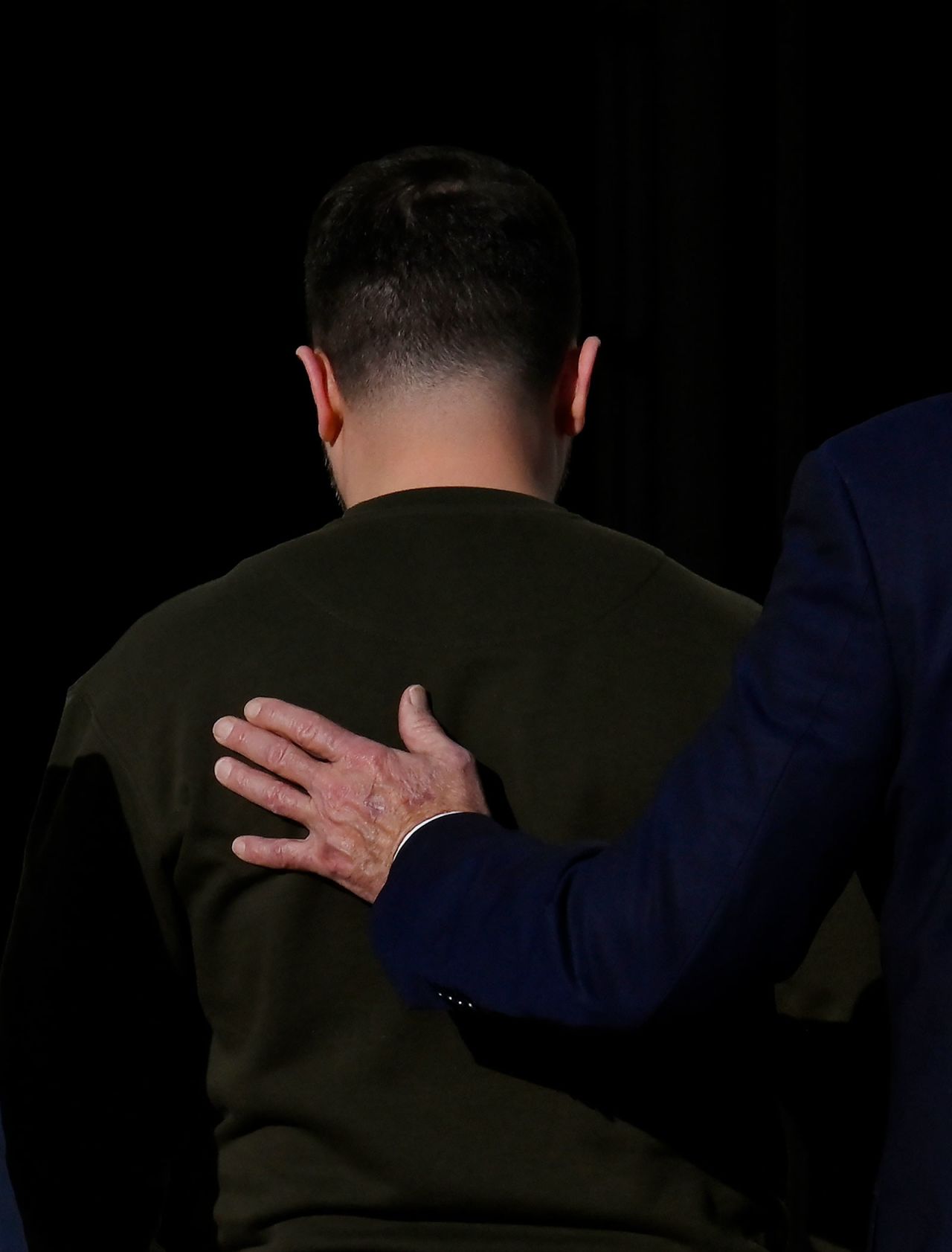
Biden and Zelensky walk down the Colonnade of the White House as they make their way to the Oval Office.
Biden and Zelensky walk into the White House after Zelensky's arrival.
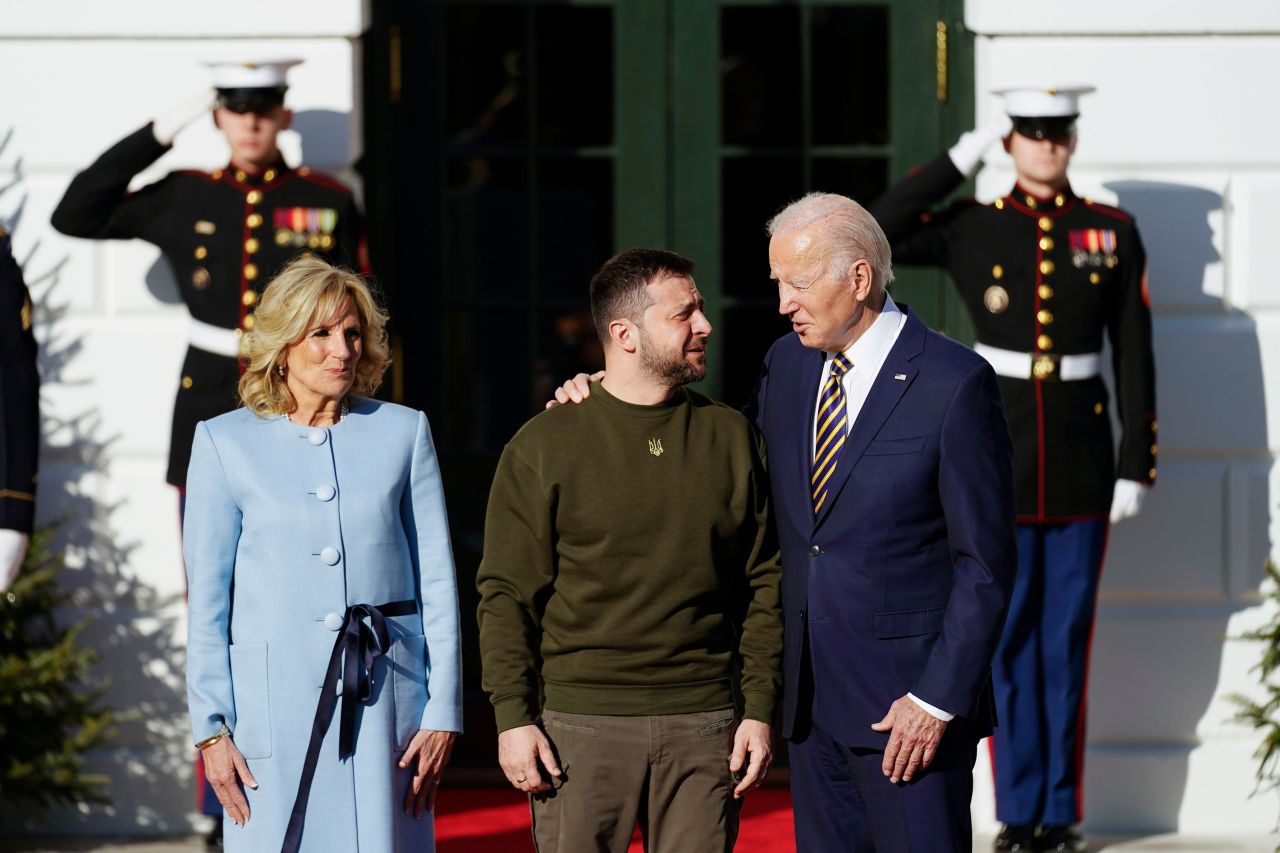
Biden and first lady Jill Biden welcome Zelensky at the White House on Wednesday.
Biden shakes hands with Zelensky as he arrives at the White House.
Zelensky, left, is greeted by Rufus Gifford, chief of protocol for the state department, after landing in the United States on Wednesday.
President Volodymyr Zelensky addresses Congress as Rep. Nancy Pelosi and Vice President Kamala Harris hold up a Ukrainian national flag signed by Ukrainian soldiers at the Capitol in Washington on Wednesday, December 21.
Zelensky addresses the joint meeting of Congress.
In pictures: Zelensky’s wartime visit to US
Continue reading 5 takeaways from Volodymyr Zelensky’s historic visit to Washington

Council on Foreign relations – Daily news brief Dec. 19, 2022

Top of the Agenda

Countries Reach Landmark Deal on Protecting Biodiversity

At a UN biodiversity summit in Canada, nearly two hundred countries agreed to extend protected status (AP) to more than 30 percent of the world’s land and water by 2030, a goal known as 30×30. Currently, about 17 percent of all land and 10 percent of marine areas are protected. 
China held the presidency of the conference and pushed for the final deal (The Guardian) despite objections from African countries that sought a new fund for biodiversity. The deal calls on rich countries to provide $20 billion per year by 2025 and $30 billion per year by the end of the decade to prevent biodiversity loss in poor countries. It also mandates reform of $500 billion in environmentally damaging subsidies in areas such as food and fuel and emphasizes that Indigenous communities should lead conservation efforts.

Continue reading Council on Foreign relations – Daily news brief Dec. 19, 2022

Council on Foreign relations – Daily news brief Dec. 19, 2022

Top of the Agenda

Countries Reach Landmark Deal on Protecting Biodiversity

At a UN biodiversity summit in Canada, nearly two hundred countries agreed to extend protected status (AP) to more than 30 percent of the world’s land and water by 2030, a goal known as 30×30. Currently, about 17 percent of all land and 10 percent of marine areas are protected. 
China held the presidency of the conference and pushed for the final deal (The Guardian) despite objections from African countries that sought a new fund for biodiversity. The deal calls on rich countries to provide $20 billion per year by 2025 and $30 billion per year by the end of the decade to prevent biodiversity loss in poor countries. It also mandates reform of $500 billion in environmentally damaging subsidies in areas such as food and fuel and emphasizes that Indigenous communities should lead conservation efforts.

Continue reading Council on Foreign relations – Daily news brief Dec. 19, 2022

Council on Foreign Relations – The World This Week, Dec. 16, 2022

Biden’s Economic Policy Threatens Rift With Europe Edward Alden

French President Emmanuel Macron and U.S. President Joe Biden stand together onstage during an official state arrival ceremony on the South Lawn of the White House on December 1, 2022. Elizabeth Frantz/ReutersEuropeans consider vast U.S. subsidies for cars, clean energy, and semiconductors a danger to their economies. Read the analysis
Europe Has to Step Up on Ukraine Liana Fix and Jeffrey Mankoff

Europeans need a more substantial plan to support Ukraine, not just to ensure their own security, but also to signal their long-term commitment and head off U.S. criticism of European free-riding on Ukraine ahead of the 2024 U.S. elections. Read the opinion
Continue reading Council on Foreign Relations – The World This Week, Dec. 16, 2022

Cuộc chiến tranh hạ tầng

TƯỜNG ANH 04/12/2022 09:37 GMT+7

TTCTTrên mạng Internet những ngày này lan truyền hình ảnh vệ tinh cho thấy hầu hết các thành phố lớn của Ukraine chìm trong bóng tối. Các cuộc tấn công của Matxcơva vào hạ tầng năng lượng Kiev đang ảnh hưởng thế nào tới cục diện chiến sự?

Cuộc chiến tranh hạ tầng - Ảnh 1.

Ekaterina Martynyuk thắp nến trong căn hộ của bà ở Kherson, Ukraine, ngày 15-11, cả thành phố đã cúp điện và nước từ khi quân Nga rút đi năm ngày trước. Ảnh: Getty Images

Từ 23-11, lần đầu tiên trong lịch sử Ukraine, ba nhà máy điện hạt nhân còn lại của nước này (Rivne, Khmelnytsky và Nam Ukraine) được đặt ở chế độ khẩn cấp, hầu hết các nhà máy nhiệt điện tạm thời cúp điện, 11 khu vực chìm trong bóng tối, bao gồm Kiev, Lvov và Odessa. 

Hệ thống nước và sưởi ấm đã ngừng hoạt động ở nhiều thành phố. Kiev mất điện 70%. Thông tin liên lạc và giao thông một số nơi cũng gián đoạn. Thị trưởng Kiev Vitaly Klitschko kêu gọi người dân, những ai có thể, tạm thời sơ tán về vùng quê để trụ qua mùa đông 2022 này.

Continue reading Cuộc chiến tranh hạ tầng

Council on Foreign Affairs – Daily news brief, Dec. 14, 2022

Top of the Agenda

International Backers Plan New Infrastructure, Military Aid for Ukraine

At a conference in Paris yesterday, donor nations pledged to provide Ukraine (AP) more than $1 billion worth of financial aid and donations of health, food, and other supplies. The support aims to meet Ukraine’s humanitarian needs and help repair infrastructure damaged by Russia’s ongoing bombardment. The conference was attended (NYT) by representatives of multinational organizations and some fifty countries.
In a video address, Ukrainian President Volodymyr Zelenskyy told attendees that power outages are affecting around twelve million Ukrainians as winter arrives. Separately, U.S. officials said Washington is preparing to send Ukraine a Patriot missile defense system, while European Union (EU) finance ministers are set to approve around $19 billion in loans to Ukraine today.  
Continue reading Council on Foreign Affairs – Daily news brief, Dec. 14, 2022

Chuyện dài cải cách Liên Hiệp Quốc

DANH ĐỨC 05/12/2022 09:58 GMT+7

TTCTLại một kỳ họp cải cách Hội đồng Bảo an Liên Hiệp Quốc (HĐBA LHQ) kết thúc mà không có tiến triển gì ở cái “tháp Babel” đã lừng lững 71 năm tại New York.

Chuyện dài cải cách Liên Hiệp Quốc - Ảnh 1.

Tháp Babel, tranh của Pieter Bruegel Cha, 1563. Ảnh: Wikipedia

Mong muốn, không chỉ của đại sứ Việt Nam tại LHQ, mà còn của nhiều nước khác, là HĐBA nên được mở rộng ở cả hai nhóm thường trực và không thường trực, dành thêm chỗ cho các nước đang phát triển hơn, đúng với tỉ lệ của tổ chức, hạn chế quyền phủ quyết vô tội vạ… đã được nêu ra suốt 14 “mùa” thảo luận, nhưng vẫn chưa thấy có kết quả gì.

Continue reading Chuyện dài cải cách Liên Hiệp Quốc

Five Elections to Watch in 2023

The Water’s EdgeDecember 12, 2022

Council on Foreign Relations, James M. Lindsay
A woman casts her vote at a polling station during the 2018 general election in Rawalpindi, Pakistan. Faisal Mahmood/Reuters

Millions of people around the world voted in 2022. South Koreans narrowly elected conservative candidate Yoon Suk-Yoel president.
Viktor Orbán remained Hungary’s prime minister as his far-right Fidesz Party dominated a heavily gerrymandered election.
Emmanuel Macron won reelection in France, making him the first French president in two decades to win reelection.
Voters in the Philippines elected Ferdinand “Bongbong” Marcos, Jr., the son of the dictator ousted from power in 1986, president.
Anthony Albanese and the Australian Labour Party won Australia’s parliamentary elections, ending nine years of Liberal Party control.
Colombians elected their first leftist president, Gustavo Petro, a former guerilla fighter. Continue reading Five Elections to Watch in 2023