TTCT – Gần như ngay khi Thủ tướng Việt Nam Phạm Minh Chính rời Nhật Bản, kết thúc tốt đẹp chuyến thăm chính thức nước này, chuyên cơ chở Chủ tịch nước Nguyễn Xuân Phúc đã hạ cánh xuống Geneva, Thụy Sĩ vào sáng 26-11, mở đầu một vòng ngoại giao quan trọng khác.
Giống như nhiều lĩnh vực khác, công tác ngoại giao cũng gặp nhiều trở ngại trong năm 2021 vừa qua vì đại dịch COVID-19, nhưng càng về cuối năm, hoạt động đối ngoại của VN lại càng tấp nập.
Chủ tịch nước Nguyễn Xuân Phúc trong chuyến thăm Thụy Sĩ. Ảnh: VNA
(KTSG) – Hiệp định Thương mại tự do giữa Việt Nam và EU (EVFTA) là một trong số các FTA thế hệ mới có tầm ảnh hưởng lớn đối với Việt Nam, vì EU là một trong những đối tác thương mại hàng đầu của ta và vì đó được xem là cái gạch nối giữa quá khứ với hiện tại giữa hai bên, được đặt nền móng từ nhiều thế kỷ trước bởi các đoàn tàu buôn của châu Âu tới các thương cảng Vân Đồn, Phố Hiến, Hội An, Bến Nghé của ta. Có lẽ vậy, dù mới khởi động EVFTA đã tạo nhiều dấu ấn.
ZN – Tu nghiệp sinh làm việc cả ngày lẫn đêm. Thêm vào đó, rào cản ngôn ngữ và áp lực phải hòa nhập vào văn hóa Nhật cũng là những trở ngại không hề nhỏ.
Giáo sư Dennis McCornac, Đại học Georgetown, Doha, Qatar
Giáo sư Dennis McCornac hiện là giảng viên kinh tế tại ĐH Georgetown (Doha, Qatar). Ông vốn là học giả Fulbright tại Việt Nam, từng giảng dạy trên 10 năm ở Nhật Bản và 8 năm tại Việt Nam. Ông có nhiều năm nghiên cứu giáo dục Việt Nam, đặc biệt là đề tài tham nhũng trong giáo dục. Hiện, đề tài nghiên cứu chính của giáo sư McCornac tập trung vào công nhân di trú tại Nhật Bản và giáo dục ở các nước đang phát triển.
Giáo sư Dennis McCornac hiện là giảng viên kinh tế tại ĐH Georgetown (Doha, Qatar). Ông vốn là học giả Fulbright tại Việt Nam, từng giảng dạy trên 10 năm ở Nhật Bản và 8 năm tại Việt Nam. Ông có nhiều năm nghiên cứu giáo dục Việt Nam, đặc biệt là đề tài tham nhũng trong giáo dục. Hiện, đề tài nghiên cứu chính của giáo sư McCornac tập trung vào công nhân di trú tại Nhật Bản và giáo dục ở các nước đang phát triển.
Đến Nhật Bản tu nghiệp với khát vọng hoàn thiện các kỹ năng xây dựng cho các công trình, sau 3 năm, một nam tu nghiệp sinh người Việt nhận ra giấc mơ ấy có lẽ sẽ chẳng bao giờ thành sự thật.
Dù được làm trong một công ty xây dựng ở tỉnh Fukushima nhưng thay vì xử lý cốt thép và tạo khuôn đóng bê tông, người này chủ yếu của dọn dẹp hậu quả còn sót lại từ sự cố hạt nhân tại Nhà máy Fukushima số 1, thuộc sở hữu của Tập đoàn Điện lực Tokyo.
A Boeing 787-9 aircraft of Vietnam Airlines. Photo courtesy of Vietnam AirlinesNational flag carrier Vietnam Airlines will operate its first regular direct flight to the U.S. on November 28, achieving a dream conceived nearly two decades ago.
The flight will depart from HCMC in the evening and arrive at San Francisco 13 hours and 50 minutes later, CEO Le Hong Ha said at a press briefing Tuesday.
The return flight will leave San Francisco on the evening of November 29 (U.S. time) and arrive in HCMC on December 1, 16 hours and 40 minutes later.
HÀ NỘI – Minister of Foreign Affairs Bùi Thanh Sơn has highlighted the significance of Ambassador Nguyễn Hồng Thao’s re-election to the International Law Commission (ILC) for the 2023-2027 tenure.
Talking with the press, Sơn said following the Party and State’s policy of promoting multilateral diplomacy, Việt Nam not only successfully performed important duties as ASEAN Chair 2020 and a non-permanent member of the United Nations Security Council for 2020-2021 but also actively and proactively sent officers to work in prestigious international organisations.
Ambassador Thao’s re-election to the ILC with 145 approval votes was evidence of the sound external policy of the Party and the State, and reflected the international community’s support and trust of Việt Nam, affirming the country’s enhanced stature and prestige on international arena.
In common parlance today, the word “tragedy” is used to describe any ill fortune that befalls a person or group: a destructive earthquake, a fatal shooting, the death of a family member from disease. But to the ancient Greeks, tragedy involved an element of human error (hamartia), not just external circumstance. On this measure, the saga of the United States and the Trans-Pacific Partnership (TPP) would have given Sophocles enough material for an epic to rival Oedipus Rex.
As of August 2021, Vietnam has officially joined 15 FTAs, including six ASEAN FTAs with regional partners (China, South Korea, Japan, India, Australia, and New Zealand) and the Regional Comprehensive Economic Partnership. In this photo, Vietnam’s Prime Minister Nguyen Xuan Phuc (R) is pictured on a TV monitor clapping next to other country signatories during the signing ceremony for the Regional Comprehensive Economic Partnership (RCEP) trade pact at the ASEAN summit that is being held online in Hanoi on 15 November 2020. Photo: Nhac NGUYEN, AFP.
EXECUTIVE SUMMARY
Vietnam’s trade deficit with China has grown rapidly since 2001. Its heavy dependence on Chinese intermediate and capital goods creates vulnerabilities in its entire production chain.
China has a history of using trade as a weapon to punish countries with which it has disputes. Escalating tensions in the South China Sea have served as a wake-up call for Hanoi to reduce its trade dependence on Beijing.
Towards this end, Vietnam, has over the past few years, signed a number of new-generation free trade agreements (FTAs), including the Comprehensive and Progressive Agreement for Trans-Pacific Partnership (CPTPP), which excludes China, and the European Union-Vietnam Free Trade Agreement (EVFTA).
However, Vietnam’s efforts to reduce its trade dependence on China through these FTAs have not produced desired outcomes. Both the CPTPP and the EVFTA have come into force in Vietnam for a short while, and it may take more time for Vietnam to fully benefit from them.
In the meantime, Vietnam will need to take proactive measures to increase the utilization rate of these agreements and push forward economic and institutional reforms to strengthen its overall economic resilience. If Vietnam is successful in these efforts, its trade reliance on China, which is likely to persist in the short to medium term, will be less of a concern.
* Bich T. Tran is a Ph.D. Candidate at the University of Antwerp, a Fellow at Verve Research, and an Adjunct Fellow at the Center for Strategic & International Studies (CSIS). Her research interests include Vietnam’s grand strategy, Southeast Asian states’ relations with major powers, and political leadership.
Hiệp định Đối tác tăng cường an ninh ba bên giữa Mỹ, Anh và Australia (AUKUS) có phiên âm khá thú vị (ô kis) – “Hôn nhau cái nào” – đến mức Tổng thống Biden cũng cảm thấy thích thú khi phát âm tên liên minh mới trong bài diễn văn đánh dấu sự ra đời của AUKUS.
Tuy nhiên, việc thành lập AUKUS thì hoàn toàn nghiêm túc, chẳng “lãng mạn” chút nào, và là kết quả của những nỗ lực thương lượng không ngừng nghỉ trong nhiều tháng trước đó của quan chức cấp cao 3 nước, trước khi AUKUS chính thức ra đời ngày 15/9/2021 vừa qua.
Tạm thời có thể rút ra 10 nhận xét nhanh từ sự ra đời của AUKUS như sau:
HANOI, Aug 25 (Reuters) – U.S. Vice President Kamala Harris on Wednesday again charged China with bullying its Southeast Asian neighbours, the second time in two days she has attacked Beijing during a regional visit, as Washington tries to rally regional partners to take on China’s growing economic and military influence.
The Chinese foreign ministry shot back on Wednesday and accused the U.S. of meddling in regional affairs and disrupting peace. Earlier in the day, Chinese state media accused Harris of seeking to drive a wedge between China and Southeast Asian nations with comments in Singapore that Beijing used coercion and intimidation to back its unlawful South China Sea claims.
Last year, the United States and Vietnam celebrated our 25th anniversary of diplomatic relations. Over the past several decades, the bilateral relationship between our countries has made significant strides, to the point where our nations now cooperate on a wide range of issues, including fighting COVID-19 and preparing for future health security threats, combatting climate change, and addressing shared legacies of war. We have deepened our economic ties as Vietnam’s second largest trading partner and its top export market worldwide, and our support for one another is mutually reinforcing: a vibrant Vietnamese economy is critical to the supply chains Americans depend on, a point that COVID-19 has made clear when production shutdowns abroad have led to difficulties in shipping goods at hom10e. Our security relationship has dramatically expanded as we support Vietnam’s independence and sovereignty, particularly in the maritime domain. The United States and Vietnam have also advanced capacities to prevent, detect, and respond to infectious disease threats through our partnership on the Global Health Security Agenda. The already-robust and growing partnership between our peoples has resulted in nearly 30,000 Vietnamese studying in the United States, contributing nearly $1 billion to the U.S. economy, and the opening of a Peace Corps office in Hanoi.
The Vice President’s travel to Vietnam signifies the United States’ deep commitment not only to the region, but also to the U.S. – Vietnam relationship. In bilateral meetings with Vietnamese leaders, Vice President Harris reaffirmed the U.S. commitment to a strong, prosperous, and independent Vietnam, as well a free, open, healthy, and resilient Indo-Pacific region.
COVID-19 and Health Security: The Vice President reinforced the United States’ commitment to leading the world in ending the COVID-19 pandemic. She announced new COVID-19 vaccine donations to Vietnam, critical support for vaccine distribution, and the opening of a new regional CDC office to enhance health security cooperation.
Vaccine donation: Recognizing the critical toll that the COVID-19 has taken on both our countries, and the Biden-Harris Administration’s effort to serve as an arsenal of vaccines for the world, the Vice President announced that the U.S. is donating an additional one million doses of Pfizer vaccine to Vietnam, bringing our total donation to Vietnam to 6 million doses.
COVID-19 technical and programmatic assistance: Through the American Rescue Plan Act (ARPA) and other emergency assistance funding to date, USAID and CDC are supporting Vietnam’s response to COVID-19 with an additional $23 million in technical assistance and programmatic support, bringing the total assistance provided since the start of the pandemic to nearly $44 million. This assistance will accelerate equitable access to and delivery of safe and effective COVID-19 vaccines, strengthen Vietnam’s health system to respond to COVID-19, and build capacity to detect and monitor COVID-19 and future disease threats. USAID also provided the Vietnam Red Cross $1 million to reduce the impacts and prevent the spread of COVID-19 in vulnerable communities.
Support for vaccine distribution: The Department of Defense has committed to provide 77 ultra-low temperature vaccine freezers to assist vaccination distribution efforts in all 63 provinces. These freezers are specially designed to accommodate the most extreme vaccine storage requirements, significantly enhancing Vietnam’s national vaccine distribution network.
Emergency Operations: Through the Defense Threat Reduction agency, the U.S. provided two Regional Public Health Emergency Operations Centers, which are now operating 24/7 to collect and share COVID-19 surveillance information through the Ministry of Health.
Launch of the new CDC Southeast Asia Regional Office: The Vice President launched the U.S. Centers for Disease Control and Prevention (CDC) Southeast Asia Regional Office in Hanoi alongside Vietnam’s Deputy Prime Minister and Health Ministers from ASEAN and Papua New Guinea. The CDC office will advance global health security by maintaining a sustainable presence in the region, enabling a rapid and effective response to health threats—wherever they occur—and reinforcing CDC’s core mission of protecting Americans.
Combatting Climate Change: The Vice President and Vietnamese government and civil society leaders agreed on the importance of combatting the climate crisis, increasing resilience, and collaborating towards a clean energy future.
Leveraging the Private Sector in Climate Action: USAID and the Vietnam Chamber of Commerce and Industry (VCCI) signed a Memorandum of Understanding (MOU) to boost Vietnam’s competitiveness, expand market opportunities for U.S. companies, and strengthen Vietnam’s environmental policy. This MOU with VCCI will improve VCCI’s focus on sustainability, green technology and climate change. USAID also intends to support VCCI in developing a Green Index to help U.S. businesses select provinces that are investing in green operations.
Expanding Clean Energy and Electric Vehicles: The U.S. government announced the Vietnam Low Emission Energy Program II (V-LEEP II), a five-year, $36 million USAID project which aims to accelerate Vietnam’s transition to a clean, secure, and market-driven energy system. The project will work to improve government energy planning, increase competition to encourage U.S. private sector involvement in energy service provision, and increase clean energy systems. The project will help Vietnam scale up adoption of electric motorbikes and implement the Direct Power Purchase Agreement (DPPA) mechanism to allow businesses to procure electricity directly from private firms producing renewable energy.
Protecting the Mekong Delta region: Through USAID, the U.S. government launched the Mekong Coastal Habitat Conservation project, a new three-year, $2.9 million project with the International Union for Conservation of Nature (IUCN). This project aims to protect key coastal habitats in the Mekong Delta region for sustainable fisheries, climate change adaptation and biodiversity conservation.
Accelerating Climate-Smart Agriculture: The United States welcomed Vietnam joining the Agricultural Innovation Mission for Climate (AIM4C), an initiative announced at President Biden’s Leaders’ Summit on Climate that will be launched at COP-26 in November 2021. AIM4C participants will work together to accelerate global agricultural innovation and the adoption of climate smart technologies. Together the United States and Vietnam, along with our global partners, can address shared climate challenges and create innovative solutions to improve food security and drive economic growth around the world.
Development Assistance and Market Access: The Vice President emphasized the Biden-Harris Administration’s efforts to promote economic growth and opportunity.
Promoting women and ethnic-minority owned enterprises: The U.S. government announced the Improving Private Sector Competitiveness (IPSC) project, a $36 million USAID flagship effort to grow women and ethnic minority-owned businesses and promote job-growth in rural areas through the adoption of new U.S. technology.
Support for Vietnam’s transition to a digital economy: The U.S. government announced the Workforce for an Innovation and Startup Ecosystem (WISE), a USAID project providing up to $2 million to support Vietnam’s effort to transition from an economy dominated by labor intensive, low-skilled industry to a workforce better equipped to participate in the global digital economy. Building Vietnam’s digital skills will increase opportunities for trade between the United States and Vietnam and will promote U.S. technologies.
Lower tariffs on U.S. exports: U.S. farmers and pork producers will have greater access to markets in Vietnam — the United States’ seventh largest agricultural export market — as a result of Vietnam’s positive consideration of our proposal to eliminate or reduce MFN import duties on corn, wheat, and pork products. These tariff cuts allow U.S. farmers to provide Vietnam with quality and competitively-priced products while also helping reduce the U.S. trade deficit with Vietnam
Human Rights & Civil Society: The Biden-Harris Administration is putting human rights at the center of our foreign policy and, while in Vietnam, Vice President Harris emphasized the essential role that civil society plays in global development.
Promoting civil society and grassroots advocacy: The United States supports Vietnam’s civil society and advocates for freedom of expression, belief, and association in Vietnam—as raised by the Vice President in her government meetings. Additionally, the Vice President will hold a meeting on August 26th with representatives of grassroots advocacy groups, in which she will emphasize the critical role of civil society as a driver of sustainable development and inclusive prosperity.
Addressing Legacy of War Issues: The United States and Vietnam have overcome a difficult past to become trusted partners. Vice President Harris committed to Vietnamese government leaders our resolve to continue addressing shared war legacy issues.
Addressing shared war legacies: The United States commits to provide an additional $17.5 million for surveying and clearing unexploded ordnance (UXO), demonstrating our continued pledge to addressing war legacy issues. The State Department commits to continue extensive UXO survey and clearance projects, build capacity for the national mine action center, and implement risk education initiatives to save lives and create economic opportunities.
Support for persons with disabilities: The U.S. government, through USAID, announced two new awards to local Vietnamese organizations, in support of persons with disabilities: Raising Voices, Creating Opportunities II and Hold My Hand II. These projects, with a total budget of approximately $4 million, will support persons with disabilities by improving their quality of life and promoting their social inclusion. As one of our oldest war legacy initiatives, under Senator Leahy’s War Victims Fund since 1989, disability programming has long served as a core element of bilateral cooperation.
Security Cooperation: The United States supports Vietnam’s enhancement of its maritime security and law enforcement capabilities.
Commitment to a Security Partnership: The United States and Vietnam affirmed our commitment to continuing our high-level security cooperation in support of a strong, prosperous and independent Vietnam, including humanitarian engagements like Pacific Partnership and visits by U.S. ships, including aircraft carriers.
Increasing our Coast Guard Partnership: The Vice President discussed the deep ties between the Vietnam and U.S. Coast Guards, including the possible provision of a third U.S. Coast Guard high-endurance cutter, subject to the will of Congress. This cutter would complement two other U.S.-provided cutters, a fleet of 24 patrol boats, base facilities, piers, law enforcement training, and other joint activities that bolster Vietnam’s capacity to contribute to maritime security in the South China Sea.
Expanding humanitarian and disaster response cooperation: The U.S. and Vietnam committed to establish a medical trauma exchange between the Vietnam Military and the Department of Defense to expand humanitarian and disaster response capacity, while cooperatively advancing critical patient care for soldiers, veterans, and the people of Vietnam.
Investments in the Bilateral Relationship: Vice President Harris and Vietnamese government leaders reaffirmed the strength of U.S.-Vietnam Comprehensive Partnership, as signified by the signing of a new U.S. Embassy compound and the opening of Peace Corps Vietnam.
Opening of Peace Corps Vietnam: The Vice President is announcing the launch of Peace Corps Vietnam, which marks the conclusion of 17 years of negotiations, and opens a new era of opportunities for young Americans to serve abroad and foster people-to-people ties between our two countries. Peace Corps Vietnam will welcome its inaugural cohort of Peace Corps Volunteers in 2022.
New U.S. Embassy Compound Signing: The Vice President will be witnessing the signing of the lease for the new U.S. Embassy Compound in Hanoi, Vietnam to symbolize the future of our partnership. The U.S. Embassy celebrated the 25th anniversary of normalization in 2020, and formalizing the lease agreement allows us to look ahead to the next 25 years and beyond of U.S. engagement in Vietnam.
Reinforcing International Norms on the Peaceful Exploration of Space: The United States and Vietnam support efforts to ensure space activities are conducted in a responsible and sustainable manner.
The United States and Vietnam recognize the growing importance of space in providing benefits to all humanity, to tackling climate challenges and ensuring development on Earth. We also exchanged views on the Artemis Accords during the visit and acknowledge the pivotal role international cooperation plays in sustaining the outer space environment to maximize the benefits space offers. In this regard, the United States and Vietnam are committed to a civil space dialogue, to take place in the first quarter of 2022 which would serve to align our goals of ensuring space activities are conducted in a responsible and sustainable manner.
Support for Higher Education: Vice President Harris underscored the United States’ commitment to the future of Vietnam and the enduring nature of the U.S.-Vietnam partnership. Partnering on education reform: USAID announced the Partnership for Higher Education Reform, a five-year project providing up to $14.2 million to strengthen teaching, research, innovation, and governance within the three largest national universities in Vietnam. With U.S. university and private sector partners, the project will support inclusive economic opportunities for nearly 150,000 Vietnamese students in support of a strong, prosperous, and independent Vietnam as a vital U.S. partner.
TTCT – Hai quốc gia đạt được sự đồng thuận về chính sách tiền tệ đánh dấu cột mốc quan trọng trong xu thế tăng cường quan hệ dưới thời chính quyền Tổng thống Joe Biden và thực ra, đây là một sự dàn xếp mà chính các doanh nghiệp Mỹ hưởng lợi không nhỏ.
Nike – thương hiệu giày nổi tiếng của Mỹ – mấy năm qua đẩy mạnh quá trình dịch chuyển các hợp đồng cung ứng từ Trung Quốc sang các đối tác ở Việt Nam để tránh cuộc chiến thương mại Mỹ – Trung bùng phát từ năm 2018. Kết quả là năm 2020, Việt Nam cung ứng đến 50% lượng giày trên toàn cầu cho tập đoàn này.
Việt Nam là một trung tâm sản xuất quan trọng của Hãng Nike. Ảnh: CNBC
Nike đã hưởng lợi lớn khi tận dụng được nguồn nhân lực dồi dào và chi phí rẻ của Việt Nam. Bên cạnh đó, trong bối cảnh Việt Nam tham gia nhiều hiệp định thương mại tự do rộng lớn như CPTPP, RCEP hay EV-FTA, các đôi giày của Nike sẽ tiếp cận thuận tiện hơn nhiều thị trường quan trọng.
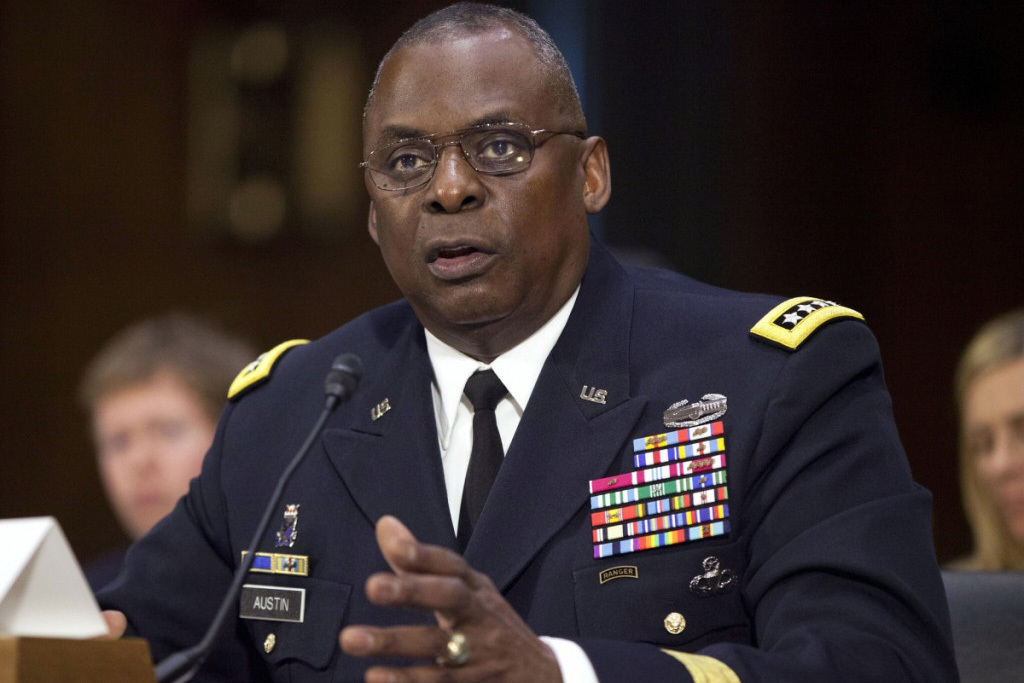
As the first trip by a Biden administration cabinet official, Defense Secretary Lloyd Austin’s visit to Southeast Asia last week held considerable symbolic significance. His speech in Singapore marked a clear distinction between the administration’s approach to the region and that of the Trump team. Austin delivered a message consistent with the U.S. intention to compete with China while tailoring the tone to reflect the concerns of Southeast Asians. In his remarks, Austin clarified that the United States will not force countries to “choose” between Washington and Beijing—addressing a strongly held, and unpopular, perception in the region based on the Trump administration’s sharp rhetoric.
Đại tá Thomas M.Stevenson, Tùy viên Quốc phòng Hoa Kỳ tại Việt Nam:
28/07/2021 23:06
QĐND – Nhân chuyến thăm chính thức Việt Nam từ ngày 28 đến 29-7 của Bộ trưởng Quốc phòng Hoa Kỳ Lloyd Austin, phóng viên Báo Quân đội nhân dân có cuộc phỏng vấn Đại tá Thomas M. Stevenson, Tùy viên Quốc phòng Hoa Kỳ về kết quả hợp tác giữa hai nước cũng như cơ hội tăng cường hợp tác trong tương lai.
Đại tá Thomas M.Stevenson.
Phóng viên (PV):Ông cho biết những kết quả nổi bật trong hợp tác quốc phòng giữa Việt Nam và Hoa Kỳ những năm gần đây?
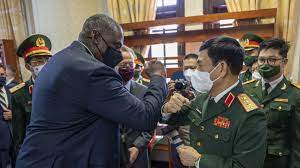
Bộ trưởng Quốc phòng Mỹ đang thực hiện chuyến công du Singapore, Việt Nam và Philippines. Đây là chuyến thăm đầu tiên đến Đông Nam Á của một quan chức hàng đầu trong chính quyền Biden.
Bộ trưởng Quốc phòng Mỹ Lloyd Austin. Ảnh: Reuters
Tại Singapore, ông Lloyd Austin đã phát biểu trong một sự kiện do Viện Nghiên cứu chiến lược quốc tế (IISS) tổ chức. Chuyến thăm của lãnh đạo Lầu Năm Góc thể hiện rằng, chính quyền Biden-Harris coi Đông Nam Á như một phần quan trọng của khu vực Ấn Độ Dương – Thái Bình Dương.
Chiều qua, chuyên cơ chở phái đoàn của Bộ trưởng Quốc phòng Mỹ đã hạ cánh xuống Hà Nội, bắt đầu chuyến thăm chính thức Việt Nam trong hai ngày.
Trung tướng Lương Tam Quang, Thứ trưởng Bộ Công an phát biểu nhấn mạnh như vậy tại buổi tiếp ngài Christopher Klein, Đại biện Hoa Kỳ tại Việt Nam, diễn ra chiều 26/7, tại Hà Nội.
Phát biểu tại buổi tiếp, Thứ trưởng Lương Tam Quang cảm ơn Đại biện Christopher Klein và Đại sứ quán Hoa Kỳ tại Việt Nam trong thời gian qua đã có nhiều đóng góp thiết thực, thúc đẩy quan hệ Đối tác toàn diện Việt Nam Hoa Kỳ, cũng như quan hệ hợp tác giữa Bộ Công an Việt Nam và các cơ quan đối tác Hoa Kỳ phát triển tốt đẹp, đi vào chiều sâu, hiệu quả, thiết thực.
Thứ trưởng Lương Tam Quang phát biểu tại buổi tiếp.



 A Boeing 787-9 aircraft of Vietnam Airlines. Photo courtesy of Vietnam AirlinesNational flag carrier Vietnam Airlines will operate its first regular direct flight to the U.S. on November 28, achieving a dream conceived nearly two decades ago.





 Đọt Chuối Non