Me? Me? Me?... Yeah yeah yeah amigo... What can me say about me-self?... me-self...me-self... Ole ole ole... me me me... I'm a young banana shoot... My dad is Banana Pa... My mom is Banana Ma... I am happy happy happy... I run around... oops... I can't run... I sing aloud... all day long... I sing in the rain... I sing in the shine... I sing day and night... I sing all the time...
I watch the butterflies and the bees... and the cranes and the geese...
Aha aha aha... here we go again... this little swallow circling on my head... the little swallow on my head... is about to poop on me... Hey, little fella, don't cha know where to unload ya poopa?... But, that's alright... I can swallow my pride to befriend a swallow... Yup yup yup... swallow my pride to befriend a swallow...
(Dân trí) – “Tôi rơi vào trạng thái trầm cảm khi đến công ty và không dám nói chuyện bị quấy rối với chồng. Tôi chỉ xóa nhanh những tin nhắn tục tĩu vì sợ bị hiểu lầm” – chị Đ.T.H. chia sẻ.
Phải chăng chỉ là… đùa vô hại?
Chị Đ.T.H (28 tuổi, trú tại Hà Nội) đang là nhân viên của một công ty trong lĩnh vực truyền thông. Chị đã kết hôn và có con gái hơn 3 tuổi.
Môi trường làm việc của chị khá thoải mái, cởi mở, thậm chí những chủ đề “nhạy cảm” cũng hay được mọi người đem ra bàn tán trong giờ nghỉ giải lao.
Vì đã lập gia đình nên chị Đ.T.H không quá lo lắng và chưa từng nghĩ sẽ trở thành nạn nhân bị quấy rối tình dục. Cho đến cuối năm ngoái, trưởng phòng nhân sự thường xuyên gửi những bức ảnh và đường link clip nhạy cảm vào Zalo của chị. Người này còn hứa hẹn nếu “chiều” anh ta, chị sẽ sớm được thăng chức, tăng lương.
Nhiều nữ nhân viên bị quấy rối tình dục chọn im lặng thay vì lên tiếng (Ảnh minh họa).
SYDNEY: Take a walk around Sydney’s city centre and chances are, it won’t take long before you find a recycling bin or a product made from recycled material.
While it may seem insignificant, it is a sign of how Australia’s packaging landscape is changing.
(CNN)This was the week when the war in Ukraine truly transitioned from one nation’s bloody fight for liberation against Russia’s vicious onslaught to a potentially years-long great power struggle.
Every day brought a sense of grave, historic events and decisions that will not just decide who wins the biggest land war between two countries in Europe since World War II, but will shape the course of the rest of the 21st century.
Tôi gặp vũng nước đọng bên rìa đám ruộng, rộng chừng chiếc đệm, khi đi ngang cánh đồng lúa chín ở miệt Láng Linh (huyện Châu Phú, An Giang) vài hôm trước.
Trước đây, vũng nước trên ruộng lúa sắp thu hoạch sẽ nhung nhúc cá – những con cá đã sống mấy tháng trời trên mảnh ruộng, lúc người ta xả nước để chuẩn bị thu hoạch lúa, chúng sẽ bị lùa lại trong các vũng nước đọng. Đa phần là cá rô đồng, cá sặc, cá lóc; móc sâu xuống bùn một chút là có cá chạch, lươn.
Nguyễn Đình Bin: Hàn gắn vết thương huynh đệ tương tàn vẫn còn rỉ máu! Thực hiện hòa giải, hòa hợp, đại đoàn kết dân tộc!
LGT: Chúng tôi nhận được bài viết của ông Nguyễn Đình Bin từ một thân hữu gửi tới, bàn về “hòa giải hòa hợp” nhân dịp 30-4. Ông Nguyễn Đình Bin từng giữ chức thứ trưởng Bộ Ngoại giao Việt Nam, kiêm Chủ nhiệm Ủy ban về người Việt Nam ở nước ngoài. Ngoài ra, ông từng là Đại sứ Việt Nam tại Nicaragua kiêm nhiệm Ecuador và Đại sứ Việt Nam tại Pháp kiêm nhiệm Bồ Đào Nha. Bài viết sau đây thể hiện quan điểm của ông Đình Bin, cựu Ủy viên BCH Trung ương Đảng Cộng sản.
Hôm nay, 30 tháng 4, một ngày kỷ niệm cho đến nay mỗi lần đến thì “CÓ HÀNG TRIỆU NGƯỜI VUI MÀ CŨNG CÓ HÀNG TRIỆU NGƯỜI BUỒN ”, như cố Ủy viên Bộ Chính trị, Thủ tướng Võ Văn Kiệt đã nói. Vì sao lại như vậy?
Là con dân Việt, chúng ta phải nhìn thẳng vào sự thật lịch sử, cùng nhau suy ngẫm, tìm ra nguyên nhân và giải pháp khắc phục.
Tôi cho rằng: cần phấn đấu đạt được nhận thức đồng thuận và thực hiện những việc cơ bản sau đây:
1) Đánh giá bản chất 30 năm chiến tranh chống thực dân Pháp rồi đế quốc Mỹ (1946-1975)
Chính sử và công luận đều đã nhất trí là CUỘC CHIẾN TRANH VỆ QUỐC VĨ ĐẠI! Song, tôi nghĩ đồng thời cũng là CUỘC CHIẾN HUYNH ĐỆ TƯƠNG TÀN! Tại sao lại như vậy?
Có hai nguyên nhân đã làm cho dân tộc ta rơi vào cuộc nội chiến này.
Theo luật sư Phan Vũ Tuấn, ‘nếu nói trình độ xâm phạm bản quyền trên mạng Việt Nam đứng thứ nhì, thì không ai dám đứng thứ nhất’.
Siêu vi phạm
Ông Lê Quang Tự Do, Phó cục trưởng Cục Phát thanh truyền hình và thông tin điện tử (Bộ TT-TT), nhắc lại câu chuyện bài Quốc ca Việt Nam đã bị tắt đi trong chương trình truyền hình trực tiếp trận đấu bóng đá giữa hai đội Việt Nam – Lào hồi cuối năm 2021. Trong buổi tọa đàm Thế hệ trẻ với bản quyền trên không gian mạng, do Bộ VH-TT-DL tổ chức chiều qua 26.4 tại Hà Nội, ông Do nhớ lại: “Mới đầu tôi giật mình, tôi gọi ngay cho bà Giám đốc Google Đông Nam Á để hỏi tại sao lại tắt tiếng Quốc ca. Bà ấy nói không, chúng tôi không tắt, các anh kiểm tra đơn vị tường thuật. Đấy là đơn vị từng bị đánh bản quyền, chuyện vì sao đánh thì không chia sẻ ở đây. Sau khi bị đánh thì họ có ý thức về việc bản quyền đó cao đến nỗi thà tắt luôn tiếng Quốc ca còn hơn bị đánh bản quyền tiếp”.
We are raiding the Audio Long Reads archives and bringing you some classic pieces from years past, with new introductions from the authors.
This week: In a special tribute to Martin Woollacott, the Guardian’s former foreign correspondent and foreign editor, who has died at the age of 81, Alan Rusbridger reflects on his fondest memories of Martin and how this ‘giant of journalism’ should be remembered.
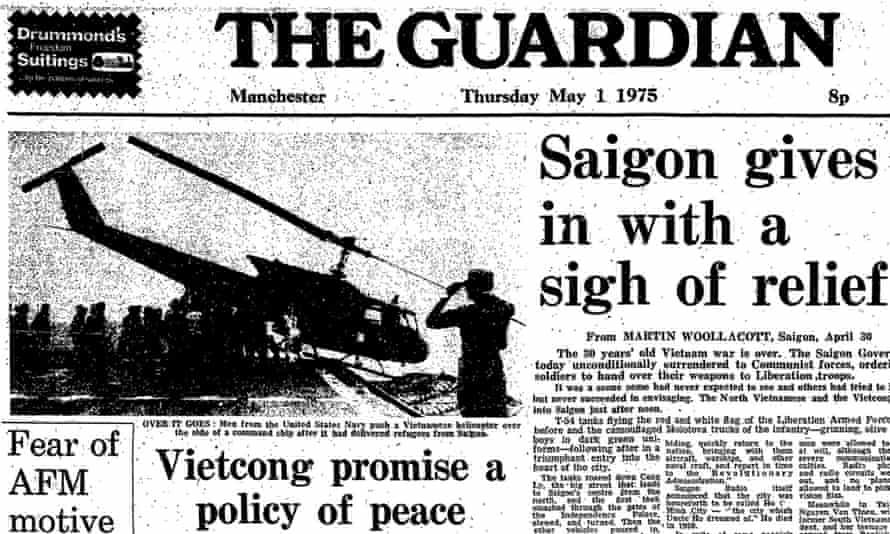
From 2015: North Vietnamese troops who marched into the capital on 30 April 1975. It marked the most crushing defeat in US military history. Four decades after he reported on these events for the Guardian, Martin Woollacott reflects upon what it meant for the future of both nations
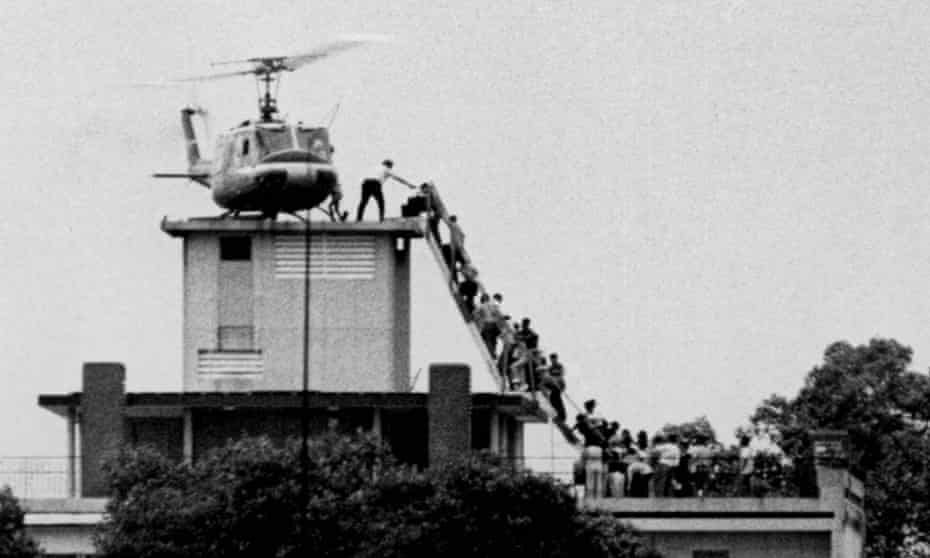
Evacuees are helped aboard an Air America helicopter perched on top of a building in Saigon. Photograph: Hugh van Es/REUTERS
***
Forty years on from the fall of Saigon: witnessing the end of the Vietnam war
Evacuees are helped aboard an Air America helicopter perched on top of a building in Saigon. Photograph: Hugh van Es/REUTERS
When North Vietnamese troops marched into the capital on 30 April 1975, it marked the most crushing defeat in US military history. Four decades after he reported on these events for the Guardian, Martin Woollacott reflects upon what it meant for the future of both nations
The day after the North Vietnamese took Saigon, the city was woken by triumphal song. During the night the engineers of the victorious army had rigged up loudspeakers, and from about 5am the same tinny liberation melodies were incessantly played. It was 30 April 1975, and sharp early sunlight illuminated Saigon’s largely empty streets, at a time when the city’s frenetic traffic would normally have already begun to buzz. But hardly anybody knew what to do – whether to go to work or not, whether there would be anything to buy in the market, whether there would be petrol, or whether new fighting might break out. It was, of course, not just Saigon’s daily routine that had been utterly disrupted. Its established role as the capital of non-communist Vietnam had vanished overnight, its soldiers had disappeared, and many of its generals, politicians and civil servants were at that moment bobbing up and down on the decks of warships in the South China Sea, with US Navy blankets pulled round their shoulders.
Through all the years of conflict, war had not often touched Saigon, with the exceptions of the occasional rocket attack, some restaurant bombings and the dramatic but limited incursion into the city – indeed, into the grounds of the US embassy itself – during the Tet offensive in 1968. Saigon shuddered, but felt it had escaped the worst. And in fact, as the liberation music echoed down the streets, it had just escaped again. Although few knew it, the North Vietnamese had been prepared to batter the city with heavy artillery and to fight their way in, block by block, if the defence they met had been stronger. Had the last South Vietnamese president, General Duong Van Minh, not ordered the army to lay down its arms, Saigon would have fared very badly indeed. Vietnamese joked that the communists took Saigon “without breaking a light bulb”. That was not true either: casualties were heavy on both sides, but the fighting stopped just short of the city limits. In the centre, there was potentially more to fear from lawlessness and looters. Stewart Dalby of the Financial Times and I were walking along Tu Do, one of Saigon’s main streets, when a hard-looking man with his shirt out over his trousers stood in our way. He touched his waistband to indicate a gun, and then casually lifted Dalby’s expensive camera off his neck. Incidents like that were enough to convince most people that the sooner the communists took full control, the better.
There were, on that first day of the new era, no Americans in the fort-like embassy on Thong Nhat Boulevard, just the detritus of the previous day’s chaotic evacuation and the looting that followed. There was nobody in the ornate little town hall. There were no deputies in the old French opera house where the National Assembly used to meet. And there was no president in the presidential palace. Nguyen Van Thieu had left the country. His immediate successor lasted a week before handing over to Minh. Minh told the first North Vietnamese officers who entered the palace that he was ready to hand over power. “You cannot give up what you do not have,” they replied, and took him away. He had been president for just two days.
Minh’s power was indeed a fantasy, but Saigon had lived on fantasy for weeks. In the city’s botanical gardens, where citizens used to promenade at weekends with their children, you could hear a dozen rumours in as many steps. “The French are coming back in with two divisions,” said one. “The Americans will soon bomb,” said another. “There’s going to be a coalition government,” said a third. As the end approached, the most common sentiment seemed to be “We are all Vietnamese”, pronounced in a manner somewhere between hope and resignation. That was a comforting thought for many, but not for those of rank, or those with close connections to the government or the Americans. They feared vengeance or, at least, that they would be marked for ever by the disgrace of their former allegiance. Some, it seemed to us, had no real reason for such anxieties, but were just caught up in the madness of the moment. “Fear of the Vietcong had made Saigon lose its wits,” wrote one reporter. But they wanted to leave, and many did, on transport aircraft at first, and, at the last moment, on helicopters – the first of the huge diaspora of nearly a million Vietnamese who were to leave the country after 1975.
The US officers managing the evacuation had to make agonising choices. In order not to undermine what was left of the defence of South Vietnam, they had to limit the earlier departures, but they also had to make increasingly firm promises to those who remained that, “if it came to it” (for the idea that South Vietnam might survive in some form was still officially alive), they would all be got out at the last minute. This was a promise they could not keep. “Their cries of panic over CIA radios on the last day still tear at my conscience,” Frank Snepp, one of the agency’s team in Saigon, wrote many years later. The day before the fall, from the vantage point of the roof of the Caravelle, one of the city’s two smart hotels, I and other correspondents watched one queue waiting in increasing despair at a pickup point on the top of a nearby building. A slow, mute tragedy, as the beat of the rotors faded away, and the realisation gradually dawned that there were not going to be any more US helicopters – ever. At the US embassy, the desperation was anything but mute. Wailing crowds besieged the place, pleading for entry, as marines pulled in those who had the right credentials – a white face helped – and pushed out those who did not.
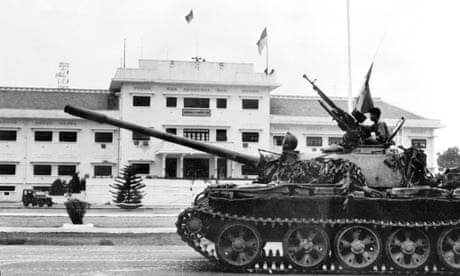
The next day, the tanks came in first, their long-barrelled guns sticking out like Pinocchio’s nose, heading for the centre of the city and the presidential palace. Since war is always a muddle, some got lost. We saw one backing up and turning, its gears grating, and then advancing on the old French hospital, hardly a military objective. But soon enough the tanks were at the palace gates and then through them, the lead tank bearing a jubilant but nervous James Fenton, the poet and journalist who had improbably become the last Washington Post correspondent in Saigon. As the new soldiers came in, the old soldiers faded away, sometimes with a final, bitter flourish. We saw one column deliberately firing off all its signal flares as it marched in formation – green, red, white, green again – before dispersing.
The new soldiers, who we soon learned to call bo doi (“foot soldiers”), wore plain, slightly floppy green uniforms and old-fashioned pith helmets. They looked relieved: the war was over, they had not died, and they had played their part in a great victory. Some days later, there was a parade, after which many left Saigon. Those who stayed were polite, and almost hesitant. They assumed white foreigners were Russians. Some seemed wide-eyed at Saigon’s prosperity, or were fascinated by watches, issued in the North Vietnamese army only to those of the rank of major and above, particularly those showing the date. They called these “watches with windows.” If in pairs, they held hands, a curiously touching sight. But they appeared formidably well trained. When a few diehards opened fire on North Vietnamese troops near the park between the presidential palace and Saigon’s red‑brick cathedral, journalists saw an instantaneous and almost balletic rearrangement. Soldiers who had been lounging and smoking a minute before were suddenly prone and judiciously returning fire, as outflanking squads rapidly closed in on the attackers. It was a reminder that the time when the war had been about under-equipped guerrillas taking on big, conventional forces was long gone. The North Vietnamese rolled into Saigon with everything a modern army could want. They had ample armour and artillery – everything except air power. But by then the South Vietnamese had hardly any air power left either.
Vietnam had been a political, military, and moral cockpit for years. The war was so much at the centre of everybody’s consciousness that it sometimes seemed as if all that was wrong with the world and all that might be made right in it was here. So many important things would be decided here: which side would prevail in the international contest between communists and non-communists; whether western countries would continue to dominate the ex-colonial world; whether small countries could stand up to big ones; whether guerrillas could defeat modern armies. And also, whether a popular movement – a peace movement in the very heart of the war-making country itself – could turn around the policies of a great power. These questions, simple in outline, remain almost as hard to answer today as they were on the day Saigon fell. The plain fact that the American war in Vietnam was a mistake and a crime – because it was undertaken so lightly, pursued so brutally and abandoned so perfidiously – is about the only plain fact there is.
The story of the collapse of South Vietnam is notoriously a chronicle of a defeat foretold. Richard Nixon and Henry Kissinger, knowing the war was no longer politically sustainable, had agreed to withdraw US troops, as stipulated by the Paris Peace Agreement in 1973. They knew that meant the North would probably win, but wanted, in Kissinger’s words, a “decent interval” between their departure and the likely defeat of South Vietnam. Although it seems they occasionally entertained the idea that South Vietnam, given help, could perhaps survive, what this really meant was that they expected the South Vietnamese to fight on after the American soldiers slipped away, with the result that the US would not look too bad internationally. This insidious design was compounded by the general slippage in Nixon’s political position, with his expansion of the war into Cambodia attracting widespread opposition, the 1973 oil-price shock taking its toll and the huge costs of the war coming home in the shape of rising inflation – and all of this capped by the unfolding Watergate scandal. A disillusioned and mutinous Congress bolted, particularly on the war, imposing cut after cut on the military aid that Saigon had been promised.
Inexorably and, to the South Vietnamese, inexplicably, the number of shells their guns were allowed to fire, the number of missions their aircraft could fly and the spare parts available to keep equipment working diminished month by month. In late August 1974, Major General John E Murray, whose job it was to maintain the supplies the South Vietnamese army needed to function, wrote flatly that “without proper support the RVNAF (Republic of Vietnam Armed Forces) are going lose, maybe not next week, or next month, but after the year they are going to”. As a technical, military problem, the war really was quite simple. South Vietnam was a long, thin country that was, by its geographical nature, permanently outflanked. It had to defend itself at every point, and could not do so without the mobility and firepower that was provided by US aid. But the tap supplying that aid was now being turned off.
President Thieu, who never had much legitimacy, now had even less. The southern economy was falling apart, he had lost the support even of the Catholic parties that were normally with him, and the Buddhists were more and more estranged, as were the moderates and neutralists in the so called “Third Force”. But if the South Vietnamese were in a parlous state, the North Vietnamese had deep anxieties of their own. Although party and government maintained an outward show of absolute confidence that victory and reunification would come, inwardly they were not so sure. They, too, had equipment and ordnance problems, since the Russians and Chinese had also cut supplies after the Paris Peace Agreement. And, just like the South Vietnamese, they worried about the reliability and motives of their allies. As George J Veith wrote in Black April, his military history of the final years of the war, Hanoi felt that it had only “had a small window of opportunity to win”.
We watched a slow, mute tragedy, as the rotors faded and the realisation dawned that there would be no more helicopters
The plan was for a two-year campaign that would bring victory in 1976. But the opening moves in the central highlands were so successful that they went for broke in 1975. It was all over within two months. Mistakes of generalship by Thieu and some of his commanders made things worse, but the early defeats were essentially caused by the South’s lack of reserves and reduced firepower. The North Vietnamese then closed in on Saigon. In the central highlands, Hue, Danang and elsewhere, there were terrible scenes of panic and disorder, of disobedience and desertion, but also hard-fought battles and acts of heroism and sacrifice. But South Vietnam – “puppet entity”, real country, or whatever it was – had disappeared in a puff of battle smoke. The world gasped.
The reporters who had chosen to stay in Saigon were mainly French and Japanese, plus a few British and one or two Americans vaguely pretending to be Canadians. We had reported a war that, while not without its dangers, was in some ways an easy one for journalists. We were ferried around efficiently by US planes and helicopters, and fed, accommodated and protected by US and (to a lesser extent) South Vietnamese soldiers. You could be on the edge of a battle in the north, near the ironically named Demilitarised Zone, in the morning, and back in Saigon having a drink after a shower in the early evening. Now we suddenly found ourselves in limbo. Our life-support system of American pilots and protectors, analysts, Australian embassy military attaches and the like had vanished. Many Vietnamese contacts had left or gone to ground. Our fixers, assistants, drivers and translators had, too. (Some who turned out to have been communist agents did remain, but they had moved up in the world, naturally.)
The North Vietnamese had a few sophisticated English- and French-speaking officers who were sometimes helpful, but that was rare. On one such occasion, just after the fall of the city, a North Vietnamese army film unit burst into the offices of CBS and demanded that the bureau hand over its footage of the last real fight of the war, at Newport Bridge just outside the city. They were sweaty and angry – it seemed they had arrived too late at the bridge to get their own film, so they wanted to grab what the US TV crew had shot. I witnessed the confrontation and shot off to get a suave North Vietnamese colonel we had met earlier. He came, defused the situation and ordered his compatriots to leave. The relieved bureau chief offered him a drink. He gracefully refused, adding, with a slightly crooked smile: “Later on, we will have many happy times.”
Perhaps not surprisingly, we never did. We were left to our own meagre devices. We could not file our reports at first, because the post office was closed and all other telexes and phone lines were down. When we could, we sent reams of copy about the final days that we had been unable to get out at the time. After that, what could we do? We could not do what we had so often done in the past, which was to write critically about US policy and the South Vietnamese government and army. All that was gone, and our criticisms no longer mattered, if they ever had. Some of us tended instead to follow an odd routine, visiting places and buildings that had once been important and writing “then and now” pieces. A group of us drove along Route 13 toward An Loc, a town north of Saigon that had been under siege during the 1972 general offensive. We came across a bizarre sight as we drove down a side lane – what looked like a whole company’s worth of combat boots lined up neatly on the tarmac, as if their owners had been suddenly raised to heaven. South Vietnamese military tunics were scattered in the ditches on each side. There were similar scenes elsewhere. The explanation was that the North Vietnamese troops had ordered surrendering units to shed their gear.
The irony of this sort of sightseeing was obvious. An Loc had been a South Vietnamese victory, hard fought by airborne troopers and rangers, but clinched by US air power: almost every B-52 in south-east Asia was called in to strike the North Vietnamese attackers. We were, in a sense, reporting the past, because the present was too puzzling. We had an iced drink at a stall near an abandoned military camp and looked for where an American adviser’s office had been, but failed to find it and set off through the flat, scrubby countryside back to Saigon. On the way out to An Loc we had passed the British embassy, and I noticed that the squad of soldiers guarding it had taken down the union jack and were using it as an awning to shield themselves from the sun. Choked – and surprised – by a sudden rage, I got out of the car, marched over to them, and insisted they put it back on its staff. Taking me for a Russian or East German and imagining I had some kind of authority, they at least folded it up.
“What was that about?” I asked myself. The soldiers had meant no insult. It was just a piece of cloth, after all. But the truth was that we were all, to one degree or another, still mentally in the old war, and still imbued with a consciousness of western supremacy that events had just contradicted in a most emphatic and dramatic way. And this was so, even though few us had ever been strong supporters of the war. Before the fall of the city, Philip Caputo, an American journalist who had also been a marine officer in Vietnam and had written a brilliant book about his experiences, wondered aloud whether what was happening was akin to the legionnaires withdrawing from the outer reaches of the Roman empire. Was our western sway over the world, in its final American embodiment, coming to an end? Something had been torn down and something else – something not “ours” – would come in its place. The drawing of such parallels was commonplace – a kind of self-romanticisation that seems distasteful in retrospect. Vietnamese people, North and South, were at an extraordinary moment in their history, and we were sitting around misquoting Edward Gibbon.
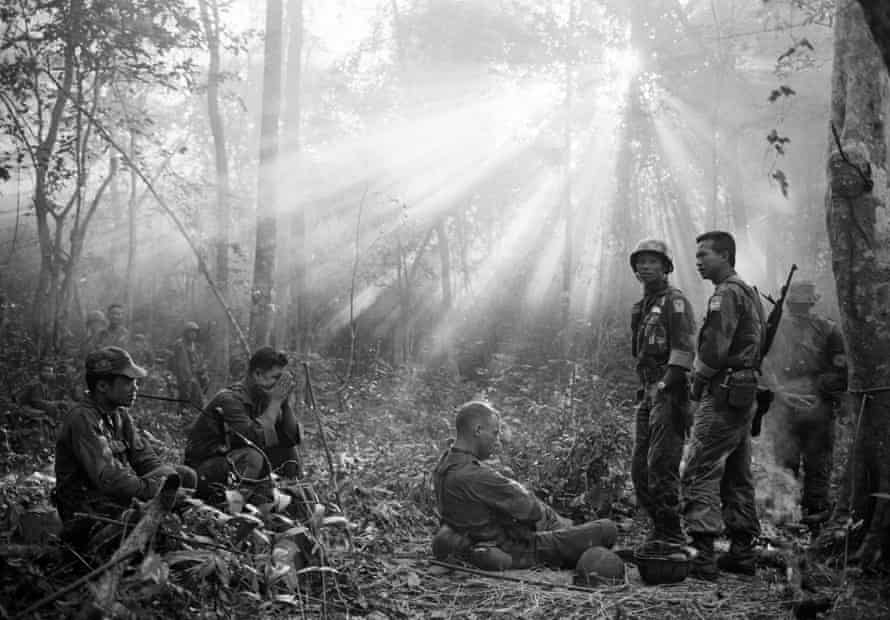
South Vietnamese troops and their US advisers resting in the jungle near the town of Binh Gia, 40 miles east of Saigon, in January 1965. Photograph: Horst Faas/AP
We also tried, of course, to report what was happening in the new Vietnam. Some of it was under our noses, in the very hotels in which we were staying, as staff were summoned to various kinds of re-education meetings. Hoc tap, as it was called, would eventually touch almost everyone. Former officers were called in, grade by grade. Was there to be, at least for a while, a separate southern state? What role would be played by the provisional revolutionary government, which had been such a feature of wartime propaganda? Not for long, and very little, were the answers, but our time was so short and the new authorities so opaque in their workings that we had only slender notions of what was going on.
We had a sense that we – or rather the countries we represented – had been demoted, even if, with one part of our minds, we saw that as a long-deserved comeuppance. That feeling was reinforced by the fact that, while we journalists were not prisoners, we were not free agents either. We could not decide for ourselves whether we would stay in Vietnam or leave. “They” would decide that. We admired them and their discipline – what we thought was their revolutionary purity – but something about their unbending attitude was disconcerting. It seemed to rule out the possibility of a national reconciliation based on even limited compromise. The Italian journalist Tiziano Terzani put it best in his book Giai Phong! (Liberation!): he felt both “a great admiration and a subtle fear” that the revolution was close to “the borders of inhumanity”.
It was sometimes galling to be as excluded as we felt we were. Most of the small group of British correspondents holed up during the day in a spacious villa belonging to a British bank. The bank’s remaining representative, an Indian citizen, was happy to loan it to us because he thought our presence would prevent it being requisitioned. It came with a big, good-natured dog, who was very pleased to see people, as dogs often are. One evening a North Vietnamese patrol arrived, posing some polite questions about why we were there, but often looking pointedly at the dog. “Good to eat,” one of them finally said, rubbing his stomach. “The bastards want to eat our dog,” we said indignantly to one another after they left. A little while later, we British, together with most of the 100 or so journalists who had stayed, were politely thrown out of the country and put on a Russian Antonov passenger aircraft to Vientiane in Laos. Before we left, we tried to make arrangements to protect “our” dog, but we were not very optimistic about them.
Back in Washington, Gloria Emerson of the New York Times, perhaps the most passionately anti-war of all American correspondents, recorded the irrational elation, backslapping, cigar-lighting and self-congratulation over the Mayaguez operation at the White House, and the extraordinary increase in the government’s popularity it brought about. The Mayaguez was a US freight ship whose crew were detained off Cambodia by the Khmer Rouge a few days after the fall of Saigon. The Americans sent in marines to rescue the crew, who, it turned out, were probably not in any danger. The operation then somehow got ludicrously pumped up as a counterweight to the humiliation of 30 April in Vietnam and the earlier fall of Pnomh Penh. In reality it was a botched and stupid affair in which the Americans lost a lot of people while attacking Khmer Rouge forces who – in a foretaste of the future – were in fact preparing to defend what they saw as their territory against the new masters of South Vietnam. In its poor intelligence, wasteful firepower and bloody confusion, it encapsulated much that had been wrong about the war that had just ended.
The Mayaguez affair was the first indication that you could take the United States out of Vietnam, but you could not take Vietnam out of the United States. In the decades since, the US has never ceased to fight the war. It continued to fight it, in the most immediate sense, by vindictively isolating the new Vietnam economically and politically. This it later took to a monstrous extreme by effectively favouring the Khmer Rouge regime remnants who were resisting the new Vietnamese-imposed government in Pnomh Penh.
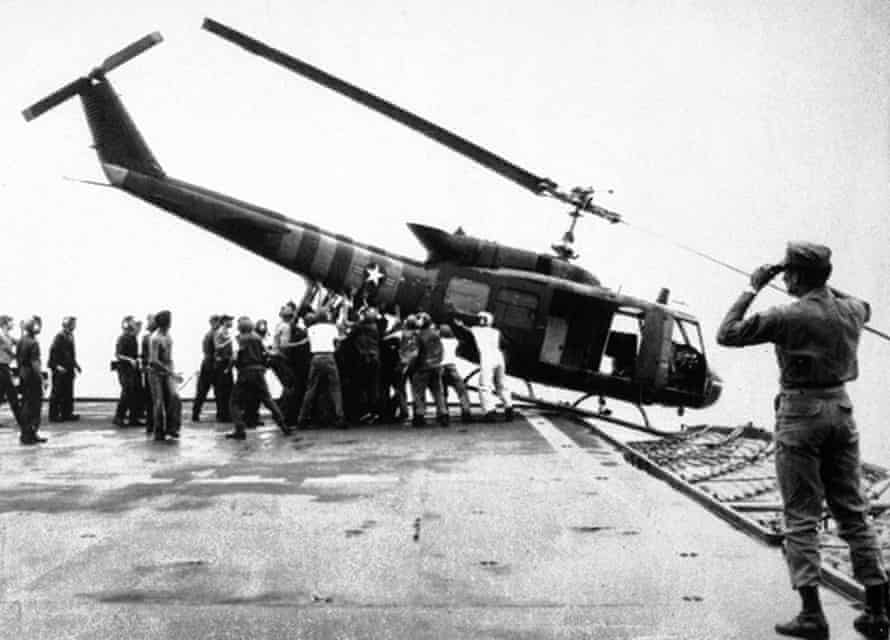
29 April 1975: US navy personnel aboard the USS Blue Ridge push a helicopter into the sea off the coast of Vietnam in order to make room for more evacuation flights from Saigon. Photograph: AP
The two countries are now almost as friendly as Ho Chi Minh had hoped they would be in 1945, when his appeals to the US for help in achieving independence from France went unheard. But if the US has finally stopped chastising Vietnam itself, the war still goes on in other ways. Everything the US has done in the world since then has been conditioned by its fear of the consequences of trying to reassert itself militarily – and by its compulsion to do so. The fear is of another Vietnam, another quagmire, another debacle. The compulsion, though, constantly seeks out other places where something like Vietnam can be taken on again, but this time won, cleanly and conclusively. The US has sought this compensatory victory again and again, most recently in Afghanistan and Iraq. Vietnam, like Hamlet’s ghost, refuses to go away. The war never went away in America, at the most fundamental level, because it became a test of how Americans saw their country.
Vietnam, like Hamlet’s ghost, refuses to go away. It became a test of how Americans saw their country
The young regular army officers who served in Vietnam returned home determined to create a new army. It would be a professional, all-volunteer force, and thus less subject to public pressure over casualties. It would have technology that could replace boots on the ground. But if there had to be boots on the ground, the new army would have skills in counter-insurgency of a kind it had lacked in Vietnam. Finally, it would not go to war without a guarantee that there would be no constraints on the full use of its resources – constraints that, in the view of many soldiers, had cheated the US army of victory in Vietnam. It was all in vain. The US public proved almost as sensitive to the deaths of volunteers as it had been to those of draftees. New technology created as many problems as it solved. Counter-insurgency strategies were still ineffective. And the guarantees that the use of force would not be constrained simply did not happen, because that is not how governments function.
At least three different Vietnam wars have competed for American attention, and for space on the heavily loaded shelves of books about the conflict. In one, the US had all but won, only to throw away its victory because of a lack of resolution, the liberal media’s opposition and congressional foolishness. In a second, it did win, because its aims of containing China and Russia and preventing a domino-fall of other south-east Asian countries into the communist sphere were actually achieved. In the third, the mission was undertaken in ignorance, quite aggressively, in the expectation that setting up a South Vietnamese equivalent of South Korea would be relatively easy, and then lurched out of control. Which war really happened? The war “cleaves us still,” President George HW Bush said in 1988, but “surely the statute of limitations has been reached. The final lesson is that no great nation can long afford to be sundered by a memory.”
For a homely reminder of how the war once touched nearly every American household, consider the buffy. Buffies are ceramic elephants about two-and-a-half feet high, with a flat top on which you can put a drink or a pot plant. They survive across the US as mute proof that a generation of young men went off to war in Vietnam. Made in Vietnam in vast numbers, they were being shipped back at the rate of several thousand a day at the height of the conflict. Hugh Mulligan of the Associated Press wrote in 1983: “They stand at ridiculous attention on the porches of West Point” and “alongside the backyard swimming pools of suburbia.” They could be bought for a few dollars and shipped home for less, thanks to the subsidised US Army Post Office. The name, derived from the acronym for “Bloody Useless Fucking Elephant”, was bestowed on them by a frustrated logistics officer who saw his scarce air cargo capacity being eaten up by the mania for these souvenirs.
Most buffies were garish. But the originals, made in a place called Lai Thieu, north of Saigon, were beautiful pieces of temple art rendered in muted blues and greens. Now, as Linh Anh Moreau – the daughter of Ron Moreau, a distinguished correspondent for Newsweek in Vietnam – wrote in a 2012 blogpost, the old Lai Thieu is long gone: “Most of the old Sino-Vietnamese artisans had died or fled, and with them the secrets of their art. As for the few young men who had learned their skills, most had been drafted into the South Vietnamese army, or had joined the Vietcong, either by force or by choice.” So the tale of the buffies, at first sight a glimpse of the lighter side, is in fact one more narrative of loss and damage.
Gloria Emerson saw no lighter side. “Each winter walking the streets of different American cities,” she wrote in her book about the war, Winners and Losers, “I used to look at the younger men in surplus army jackets, some with the patches I knew so well: the Americal, the Screaming Eagle, Tropic Lightning. For a long time I could not bear those jackets, always suspecting they had been taken off the American corpses in Vietnam, sanitised, pressed, and sold as surplus.”
The guilt of some of those who went to war was matched by the guilt of some of those who did not. In a famous confessional piece, James Fallows wrote of how he and his fellow Harvard students faked ill-health to avoid the draft. As the Harvard men left the examination hall, they saw “the boys from Chelsea, thick, dark-haired young men, the white proles of Boston … They walked through the examination lines like so many cattle off to slaughter … While perhaps four out of five of my friends from Harvard were being deferred, just the opposite was happening to the Chelsea boys. We returned to Cambridge that afternoon … The talk was high-spirited, but there was something close to the surface that none of us wanted to mention. We knew now who would be killed.”
Walking in the botanical gardens again, just before the fall of Saigon, Peter Kann of the Wall Street Journal and I were accosted by a boy of about 13, who drew from a bag a wondrous thing. It was a small model of an American military helicopter made out of junk – the transparent barrels of ballpoint pens, bits of beercans and the like. He had several in the bag. They were so ingenious, and he was so winning as he explained, in pretty fair English, how he made them, that we bought two. For the Wall Street Journal especially, here was a textbook example of entrepreneurial talent – talent of the kind that might not be much favoured in the new Vietnam. I felt my eyes pricking as the boy stowed away his money, and I thought Kann was also affected. We had no reason to suppose the lad would have that bad a time in the future, but the thought was there that Vietnam, having endured a terrible war, almost certainly still had a rough ride before it – and so, in a different way, did the US. Much suffering and grief lay in the past, but there was a presentiment, even as things ended in Saigon, that the future held more of the same.
wsj – The U.S. is investigating whether solar panels shipped from Malaysia, Thailand, Vietnam and Cambodia dodge decade-old China tariffs
Property owners in the windy and sunny parts of the U.S. are pushing back against large-scale renewable energy development, opposition that researchers say could slow the transition to a cleaner economy. Photo: Aaron Yoder/WSJ
SINGAPORE—For the past five years, Southeast Asia has ranked as America’s top source of solar panels from abroad, driven in large part by Chinese manufacturers who expanded into the region after the U.S. in 2012 imposed duties on exports from China. A new U.S. probe has cast a shadow over that growth run.
Washington wants to know how much China-made material is used in solar panels shipped from Malaysia, Vietnam, Thailand and Cambodia—countries that accounted for 85% of American imports last year. It is investigating whether producers do small-time processing in these countries to skirt tariffs while reaching back into China-based supply chains for critical components.
Thanh Niên – Khi nhu cầu về cát ở ĐBSCL càng lớn, dự báo lên tới hàng trăm triệu mét khối/năm thì việc quản lý, khai thác cát bền vững, hạn chế tác động môi trường, ảnh hưởng đến người dân là bài toán vô cùng nan giải.
Dưới cơn mưa tầm tã trắng cả sông Hậu, những xáng cạp khai thác cát vẫn gầm rú như những con quái vật làm náo động đoạn sông giáp ranh giữa tỉnh Vĩnh Long và TP.Cần Thơ. Mỗi khi chiếc cần cẩu vươn dài như một cánh tay khổng lồ quăng gầu sắt xuống sông, sóng nước tung tóe như một vụ nổ mìn. Tiếng động cơ rú lên, khói đen phả ra, từng gầu cát được cần cẩu lôi lên khỏi mặt nước, từ từ di chuyển sang ngang rồi há miệng nhả cát vào khoang của những chiếc xà lan đậu cặp bên. Ngay khi chiếc xà lan đầy khẳm cát, nhổ neo rời đi, lập tức một chiếc xà lan khác đang sắp tài gần đó lại thế chỗ “ăn cát”. Quanh khu vực mỏ cát, hàng chục chiếc xà lan khác đang neo chờ tới lượt. Cách đó chừng trăm mét là cồn Sơn, một cù lao nằm giữa sông Hậu, thuộc quận Bình Thủy, TP.Cần Thơ. Phía đuôi cồn, người dân đã đóng một hàng cọc dài hệt như một bức tường để ngăn sạt lở.
11 February 2022 at 10:10 (Updated on 25 April 2022 at 14:37)
Data on agricultural, hydropower, saltwater intrusion and rainfall patterns in Vietnam Mekong Delta explains where the country’s food comes from, why it’s disappearing and what can be done about it.
The fertile Mekong Delta is a crucial region for Vietnam’s continued food and economic security but a variety of factors have wreaked havoc on how Vietnam grows food, catches fish and ultimately survives a radically changing environment. Here, reporters analyze 20 years of data on agricultural, hydropower, saltwater intrusion and rainfall patterns in Vietnam’s Mekong Delta (VMD) to explain where the country’s food comes from, why it’s disappearing and what can be done about it.
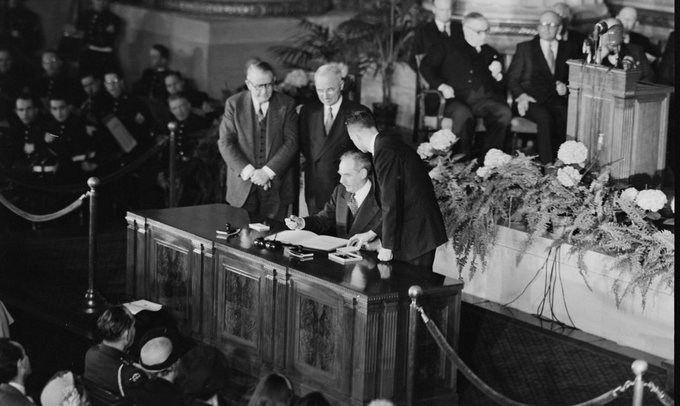
On April 4, 1949, Secretary of State Dean Acheson and President Harry S Truman were present for the signing of the treaty that created North Atlantic Treaty Organization.
OVERVIEW
Formed in 1949 with the signing of the Washington Treaty, NATO is a security alliance of 30 countries from North America and Europe. NATO’s fundamental goal is to safeguard the Allies’ freedom and security by political and military means. NATO remains the principal security instrument of the transatlantic community and expression of its common democratic values. It is the practical means through which the security of North America and Europe are permanently tied together. NATO enlargement has furthered the U.S. goal of a Europe whole, free, and at peace.
Article 5 of the Washington Treaty — that an attack against one Ally is an attack against all — is at the core of the Alliance, a promise of collective defense. Article 4 of the treaty ensures consultations among Allies on security matters of common interest, which have expanded from a narrowly defined Soviet threat to the critical mission in Afghanistan, as well as peacekeeping in Kosovo and new threats to security such as cyber attacks, and global threats such as terrorism and piracy that affect the Alliance and its global network of partners.
In addition to its traditional role in the territorial defense of Allied nations, NATO leads the UN-mandated International Security Assistance Force (ISAF) in Afghanistan and has ongoing missions in the Balkans and the Mediterranean; it also conducts extensive training exercises and offers security support to partners around the globe, including the European Union in particular but also the United Nations and the African Union.
MEMBER STATES
The NATO Alliance consists of 30 member states from North America and Europe. Article Five of the treaty states that if an armed attack occurs against one of the member states, it should be considered an attack against all members, and other members shall assist the attacked member, with armed forces if necessary.
Over the past two decades, the Alliance has developed a network of structured partnerships with countries from the Euro-Atlantic area, the Mediterranean and the Gulf region, as well as individual relationships with other partners across the globe. NATO pursues dialogue and practical cooperation with many partner countries and engages actively with other international actors and organisations on a wide range of political and security-related issues.
NATO is comprised of two main parts, the political and military components. NATO Headquarters is where representatives from all the member states come together to make decisions on a consensus basis. It also offers a venue for dialogue and cooperation between partner countries and NATO member countries, enabling them to work together in their efforts to bring about peace and stability.The key elements of NATO’s military organisation are the Military Committee, composed of the Chiefs of Defence of NATO member countries, its executive body, the International Military Staff, and the military Command Structure (distinct from the Force Structure), which is composed of Allied Command Operations and Allied Command Transformation, headed respectively by the Supreme Allied Commander Europe (SACEUR) and the Supreme Allied Commander, Transformation (SACT).
The primary role of Alliance military forces is to protect peace and to guarantee the territorial integrity, political independence and security of the member states. Alliance forces must be able to deter and defend effectively. The Alliance remains subject to a wide variety of military and non-military risks that are multi-directional and often difficult to predict.
The term NATO Military Exercise includes all exercises for which NATO is the initiating or the joint initiating authority. Associated with NATO Military Exercises are building blocks, such as: seminars, study periods and workshops.
A NATO Military Exercise is scheduled by a NATO Commander. It aims to establish, enhance and display NATO’s Military Capability across the Alliance’s full mission spectrum which is based on the three Alliance military missions:
Article 5 Collective Defence;
Non-Article 5 Crisis Response; and
Consultation and Co-operation.
OPERATIONS
NATO is an active and leading contributor to peace and security on the international stage. It promotes democratic values and is committed to the peaceful resolution of disputes. However, if diplomatic efforts fail, it has the military capacity needed to undertake crisis-management operations, alone or in cooperation with other countries and international organisations. Through its crisis-management operations, the Alliance demonstrates both its willingness to act as a positive force for change and its capacity to meet the security challenges of the 21st century.
Foreign Ministers Meetings and Defense Ministers Meetings provide an opportunity for NATO Allies to address many of NATO’s most pressing security challenges at the some of the highest levels of government. Key strategic issues discussed at these meetings have included Afghanistan, Capabilities, Kosovo, and Missile Defense. Generally attended also by many of NATO’s partners, these meetings are a chance for NATO to strengthen its relationships around the world.
WHY NATO MATTERS
As a political and military alliance, what we do together at NATO directly contributes to the security, the prosperity, and liberty of the people of the United States and every Ally.Our NATO links are solid, forged over 70 years of history. NATO promotes democratic values and encourages consultation and cooperation on defense and security issues to build trust and, in the long run, prevent conflict. NATO is committed to the peaceful resolution of disputes. If diplomatic efforts fail, it has the military capacity needed to undertake crisis-management operations. These are carried out under Article 5 of the Washington Treaty — NATO’s founding treaty — or under a UN mandate, alone or in cooperation with other countries and international organizations. In the history of NATO, Article 5 has been invoked just once, and that was in response to the 9/11 terrorist attacks in the United States.
Về chuyện công bố danh tính các “daddy”, mời các bạn đọc Chương 18: Công lý công bình không phân biệttrong Bộ Huyền sử Bồ tát Đông Hải do Trần Đình Hoành và Phạm Thu Hương cùng viết.
PTH
LĐ – HOÀNG LÂM – Chủ nhật, 24/04/2022 16:16 (GMT+7)
Một đường dây cung cấp “Sugar baby” bị phát hiện, thực chất là một đường dây mại dâm với con số lên tới 1.500 “Sugar baby” tham gia.
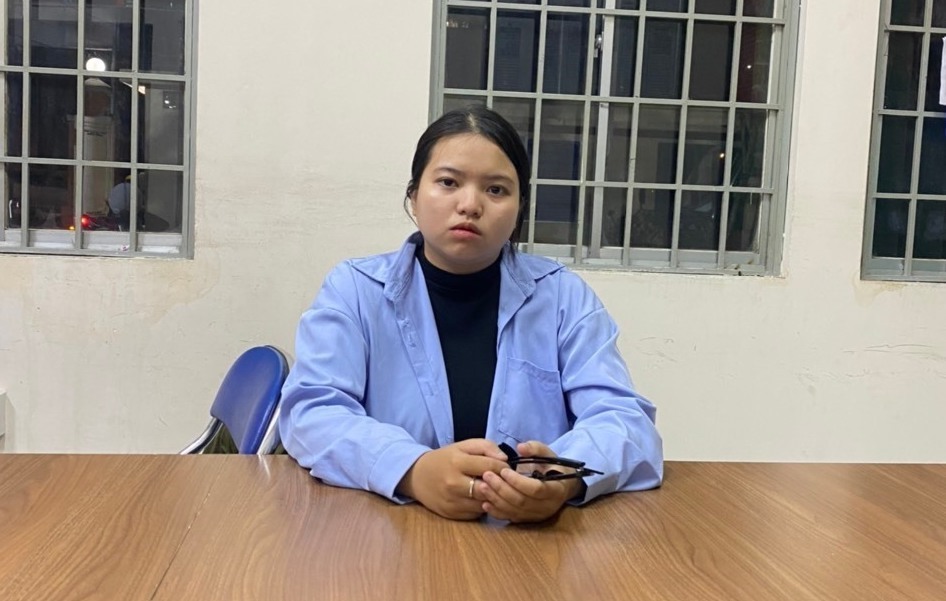
Nữ sinh năm nhất cầm đầu đường dây mại dâm gồm 1500 “Sugar baby” vừa bị phát hiện ở TPHCM. Ảnh: CACC
Cơ quan công an cho biết, cầm đầu đường dây là một “tú bà” mới chỉ là sinh viên năm thứ nhất. Tú bà dùng mạng xã hội để giới thiệu những “Sugar baby” là những người đẹp, sinh viên tạo thành các nhóm kín để thu phí khách mua dâm.
1.500 “Sugar baby” là con số khó tin trong một đường dây. Và chỉ cần nhìn vào nguồn “cung” là đủ biết “cầu” cao như thế nào.
PHONG NHA, Vietnam, April 25 (Reuters) – Vietnamese logger turned jungle tour guide Ngoc Anh knows the value of trees.
For years he chopped them down illegally to sell as timber, often working with others to carry 100-kg logs out of a rapidly thinning forest.
But as extreme rainfall and floods increasingly devastated his community in the central province of Quang Binh, the 36-year-old read up on the ongoing climate and nature crises and turned instead to tourism and conservation.
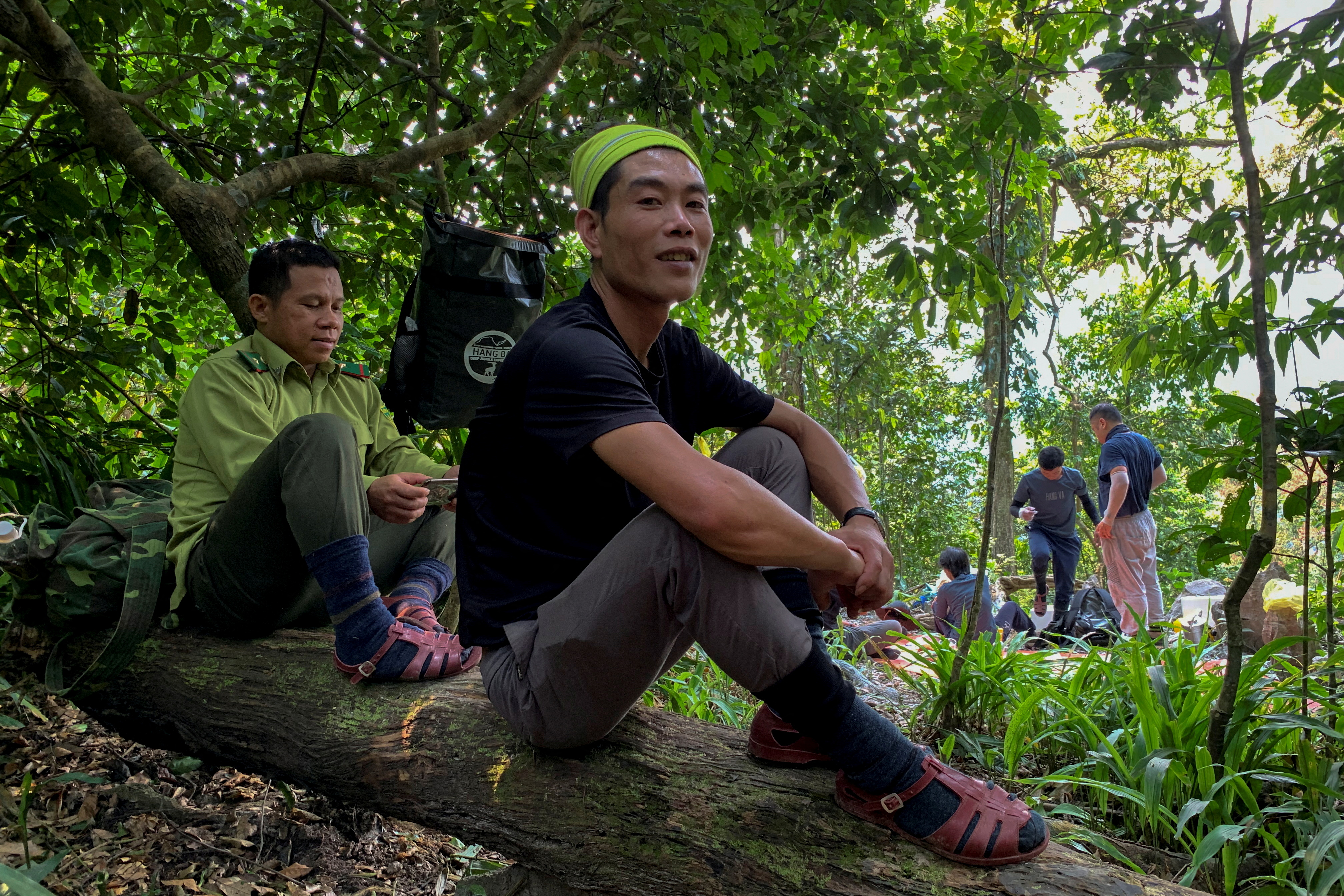
Now, Ngoc Anh is one of 250 former loggers trained by an adventure tourism company to lead mostly foreign tourists through jungles and into some of the world’s largest cave systems in the Phong Nha-Ke Bang National Park, a UNESCO world heritage site.
Nguyen Ngoc Anh, 36, who was an illegal logger turned forest protector poses at Phong Nha National Park, Quang Binh province, Vietnam, April 8, 2022. REUTERS/Hoang Trung
FILE PHOTO: A view shows damaged buildings, with the Azovstal Iron and Steel Works plant in the background, in the southern port city of Mariupol, Ukraine April 19, 2022. REUTERS/Alexander Ermochenko – REUTERS
(Reuters) – Washington’s top diplomat and its defense secretary pledged additional military aid to Ukraine and a return of U.S. envoys to Kyiv as they made the first official U.S. visit since Russia invaded two months ago.
FIGHTING
* Russian forces again attempted to storm the Azovstal steel plant, the main remaining Ukrainian stronghold in Mariupol, Ukrainian officials said, adding that more than 1,000 civilians are also sheltering there.
* Russia’s defence ministry said its high-precision missiles struck nine Ukrainian military targets, including four arms depots in the Kharkiv region, where artillery was stored. Russia forces have failed to capture any major city since they began their invasion on Feb. 24.
Trên trang Facebook của mình, nhiếp ảnh gia Nhật Bản Doi Kuro đã đăng tải một loạt ảnh đặc sắc do ông thực hiện ở Sài Gòn thập niên 1990.
Trong các năm 1989 – 1990, Doi Kuro đã di dọc mảnh đất Việt Nam và chụp hàng trăm bức ảnh đời thường rất sinh động bằng máy ảnh phim. Ông cũng đã trở lại Việt Nam nhiều lần trong các năm 1996 – 1999 và thực hiện một số bộ ảnh khác vào giai đoạn này.
Dưới đây là gần 100 bức ảnh về Sài Gòn qua ống kính của Doi Kuro.












 Đọt Chuối Non