VNE – By Viet Quoc October 5, 2023 | 07:06 pm GMT+7
Do Thanh An (R), son of murdered victim Phan Thi Khanh, speaks with Vo Ngoc, son of wrongfully detained man Vo Te in Binh Thuan Province, June 2022. Photo by VnExpressA deceased man in Binh Thuan Province, who was wrongfully detained 43 years ago for murder, will be compensated over VND1.9 billion ($77,840) by the provincial People’s Procuracy.
65-year-old Vo Ngoc, the son of wrongfully accuised man Vo Te, said his family was informed of the compensation on Tuesday.
The central province’s Procuracy would monetarily compensate Te and his loved ones for lost incomes, property losses, mental impacts and financial support for six of his children, who were under 18 at the point of his imprisonment, among other costs.
Every country should have the ability to tell its story to the world. However, a nation’s narrative should be based on facts and rise and fall on its own merits. The PRC employs a variety of deceptive and coercive methods as it attempts to influence the international information environment. Beijing’s information manipulation spans the use of propaganda, disinformation, and censorship. Unchecked, the PRC’s efforts will reshape the global information landscape, creating biases and gaps that could even lead nations to make decisions that subordinate their economic and security interests to Beijing’s.
PRC Information Manipulation
The PRC spends billions of dollars annually on foreign information manipulation efforts.2 Beijing uses false or biased information to promote positive views of the PRC and the Chinese Communist Party (CCP). At the same time, the PRC suppresses critical information that contradicts its desired narratives on issues such as Taiwan, its human rights practices, the South China Sea, its domestic economy, and international economic engagement. More broadly, the PRC seeks to cultivate and uphold a global incentive structure that encourages foreign governments, elites, journalists, and civil society to accept its preferred narratives and avoid criticizing its conduct.
The PRC’s approach to information manipulation includes leveraging propaganda and censorship, promoting digital authoritarianism, exploiting international organizations and bilateral partnerships, pairing cooptation and pressure, and exercising control of Chinese-language media. Collectively, these five elements could enable Beijing to reshape the global information environment along multiple axes:
Overt and covert influence over content and platforms. Beijing seeks to maximize the reach of biased or false pro-PRC content. It has acquired stakes in foreign media through public and non-public means and sponsored online influencers. Beijing has also secured sometimes restrictive content sharing agreements with local outlets that can result in trusted mastheads providing legitimacy to unlabeled or obscured PRC content. In addition, Beijing has also worked to coopt prominent voices in the international information environment such as foreign political elites and journalists. Beyond focusing on content producers, the PRC has targeted platforms for global information dissemination, for example, investing in digital television services in Africa and satellite networks.
Constraints on global freedom of expression. On issues it deems sensitive, the PRC has employed online and real-world intimidation to silence dissent and encourage self-censorship. The PRC has also taken measures against corporations in situations where they are perceived to have challenged its desired narratives on issues like Xinjiang. Within democratic countries, Beijing has taken advantage of open societies to take legal action to suppress critical voices. On WeChat, an application used by many Chinese-speaking communities outside the PRC, Beijing has exercised technical censorship and harassed individual content producers. Notably, data
harvested by PRC corporations operating overseas have enabled Beijing to fine-tune global censorship by targeting specific individuals and organizations.
An emerging community of digital authoritarians. The PRC promotes digital authoritarianism, which involves the use of digital infrastructure to repress freedom of expression, censor independent news, promote disinformation, and deny other human rights.3 Through disseminating technologies for surveillance and censorship, often through capabilities bundled under the umbrella of “smart” or “safe cities,” the PRC has exported aspects of its domestic information environment globally. Beijing has also propagated information control tactics, with a particular focus on Africa, Asia, and Latin America. In parallel, the PRC has promoted authoritarian digital norms that other countries have adopted at a rapid pace. As other countries emulate the PRC, their information ecosystems have become more receptive to Beijing’s propaganda, disinformation, and censorship requests.
Future Impact
The PRC’s global information manipulation is not simply a matter of public diplomacy – but a challenge to the integrity of the global information space. Unchecked, Beijing’s efforts could result in a future in which technology exported by the PRC, coopted local governments, and fear of Beijing’s direct retaliation produce a sharp contraction of global freedom of expression. Beijing would play a significant – and often hidden – role in determining the print and digital content that audiences in developing countries consume. Multilateral fora and select bilateral relationships would amplify Beijing’s preferred narratives on issues such as Taiwan and the international economy. Access to global data combined with the latest developments in artificial intelligence technology would enable the PRC to surgically target foreign audiences and thereby perhaps influence economic and security decisions in its favor. Lastly, Beijing’s global censorship efforts would result in a highly curated international information environment characterized by gaps and inherent pro-PRC biases.
The Vietnamese People’s Air Force currently maintains a fleet of ten Su-27 Flanker combat aircraft, complemented by 35 Su-30s and 34 Su-22s. In a surprising twist, there’s speculation of a possible addition of American aircraft to Vietnam’s arsenal soon.
The first indication of this evolution came in 2021, as Vietnam placed an order for at least three T-6 Texan II trainers from American manufacturer Beechcraft. The delivery of these aircraft is still pending. This apparent shift is concurrent with the thawing of relations between Vietnam and the United States, a development largely driven by shared concerns regarding China. Continue reading F-16 Viper could fly alongside Su-30 in Vietnam People’s Air Force→
Workers at a factory operated by Intel in Vietnam. Photo: Supplied by Intel
Vietnam and the U.S. have announced their intention to bolster cooperation in the fields of science, technology, digital innovation, semiconductor manufacturing, and chip production, creating ample opportunities for Vietnamese tech firms to establish a strong presence in global supply chains.
This cooperation is poised to present significant opportunities for the development of Vietnam’s domestic semiconductor sector, Vo Xuan Hoai, deputy director of the Vietnam National Innovation Center (NIC), said in an interview with Tuoi Tre (Youth) newspaper.
“Cao Nguyên Thanh Bình”- Bộ lịch 2024 Giáp Thìn thật sang đẹp, đậm đà sắc màu văn hóa bản địa, vui tươi, yêu đời, tràn đầy sức sống đã có bản mẫu để các bạn chọn lựa, đặt hàng làm quà hoặc sử dụng, cho một năm mới thật tốt lành, may mắn.
Cháy, nổ vẫn luôn là nguy cơ tiềm ẩn nhiều rủi ro đem đến nhiều hệ lụy thiệt hại lớn về người và tài sản. Vì thế để ngăn ngừa nguy cơ này tốt nhất chúng ta nên phòng cháy hơn chữa cháy.
Một khu vực mà rất dễ xảy ra cháy, nổ cũng như khó kiểm soát nhưng lại có nhiều người sinh sống chính là những chung cư cao tầng. Vậy nhà chung cư thì cần phải đáp ứng những quy định gì về PCCC?
Hiện nay, tại các chung cư cao tầng, có nhiều trường hợp những người sinh sống tại các khu chung cư bị mắc kẹt khi xảy ra cháy hoặc do trẻ nhỏ ham chơi mà bị mắc kẹt ngoài ban công, lô gia dẫn đến bị thương tích hoặc tử vong. Những tai nạn đó phần lớn đều do thiếu kỹ năng xử lý, theo đó, Bộ Công an hướng dẫn người dân cách xử lý khi bị mắc kẹt ở các tòa nhà cao tầng để di chuyển đến nơi an toàn, như sau:
A fire that broke out before midnight on September 12, 2023 in a Hanoi residential building took the lives of at least 56 people and injured dozens of others, according to authorities. The death toll made the fire Vietnam’s deadliest in 20 years.
Central Office of Communist Party of Vietnam Hanoi, Vietnam
6:33 P.M. ICT
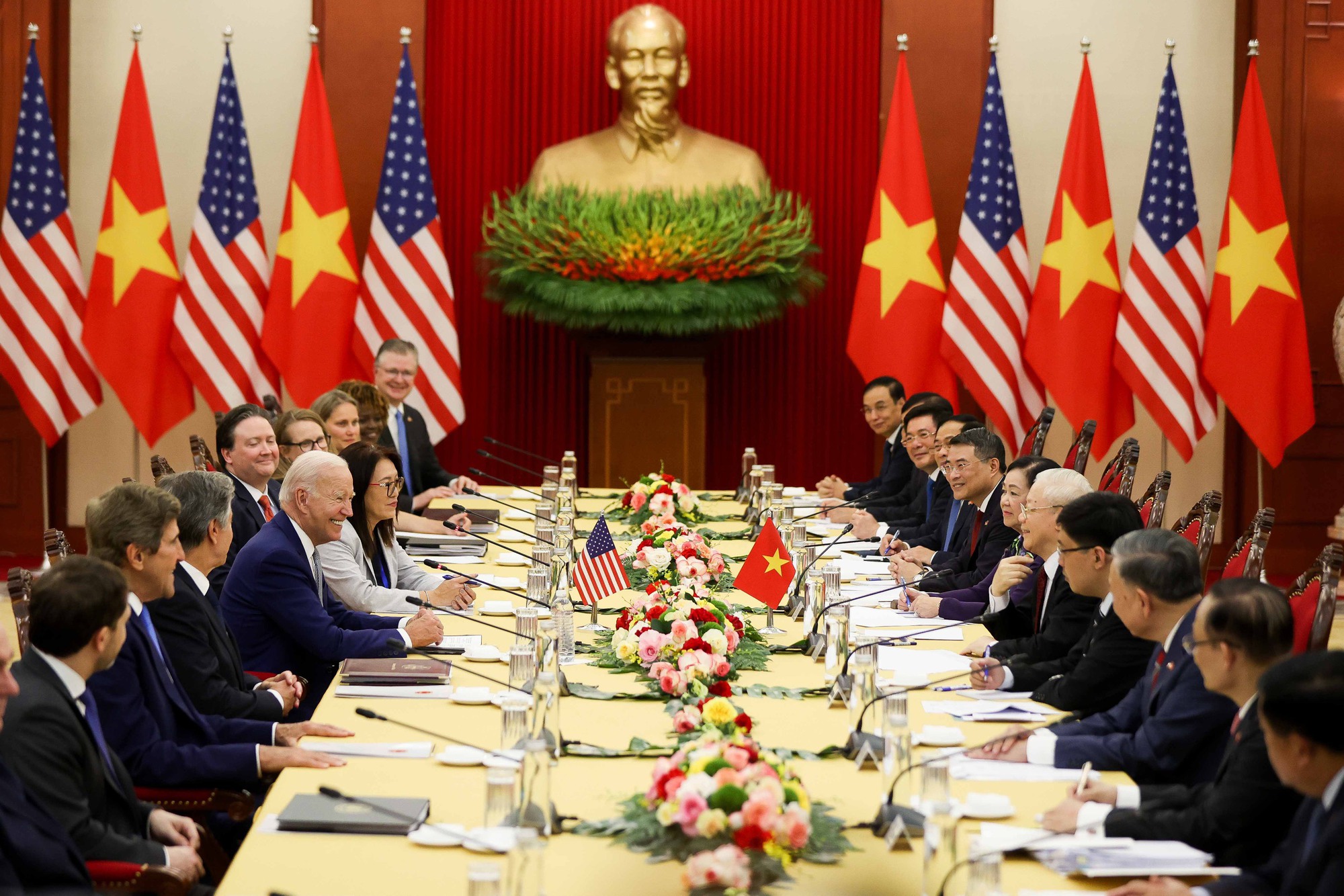
GENERAL SECRETARY TRỌNG: (As interpreted.) Your Honorable Joe Biden, President of the United States of America, distinguished delegates, on behalf of the leaders of the party, state, and people of Vietnam, I’d like to extend my warmest welcome to his Honorable President Joe Biden, who has great affection for the country and people of Vietnam, and for his various contributions to the strengthening of the friendship and cooperation between Vietnam and the U.S. in different capacities.
His visit to Vietnam on this occasion is of great significance, for it coincides with the celebration of the 10th anniversary of the Comprehensive Partnership between the two countries.
Tổng Bí thư Nguyễn Phú Trọng và Tổng thống Mỹ Joe Biden thông báo Việt Nam – Mỹ thống nhất nâng cấp quan hệ lên đối tác chiến lược toàn diện.
Chiều 10.9, tại trụ sở Văn phòng T.Ư Đảng, ngay sau khi kết thúc hội đàm, Tổng Bí thư Nguyễn Phú Trọng và Tổng thống Mỹ Joe Biden thông báo Việt Nam – Mỹ thống nhất nâng cấp quan hệ từ đối tác toàn diện lên đối tác chiến lược toàn diện – cấp cao nhất trong quan hệ ngoại giao nhà nước.
A vital regional river can be a route for U.S. diplomacy.
By Brian Eyler, the director of the Stimson Center’s Southeast Asia Program.
My FP: Follow topics and authors to get straight to what you like. Exclusively for FP subscribers. Subscribe Now | Log In
SEPTEMBER 8, 2023, 4:38 PM
On Sept. 10, Joe Biden pays his first visit to Vietnam as U.S. president, where he is expected to ink a deal to elevate the U.S.-Vietnam relationship from “comprehensive” to “comprehensive strategic”—the highest level of Vietnam’s diplomatic hierarchy. Biden is forgoing this week’s twin summits in Indonesia—the Association of Southeast Asian Nations summit and the East Asia Summit—to show the value Washington places on key bilateral partners, such as Vietnam, in the Indo-Pacific.
Some critics worry that China and Russia, two of Vietnam’s other comprehensive strategic partners, could punish Vietnam for its choice to upgrade relations with the United States. But Vietnam can come out of this complicated diplomatic competition a clear winner by centering the U.S.-Vietnam collaboration on the Mekong—the mighty river that keeps both Vietnam and much of the rest of the world fed.
Hồ thủy lợi Biển Lạc ở tỉnh Bình Thuận được đầu tư xây dựng hàng chục tỷ đồng từ năm 2006 nhằm chào mừng Đại hội Đảng toàn quốc lần thứ 10 rồi bỏ hoang từ đó đến nay.
Từ trên cao nhìn xuống, nhiều người sẽ nghĩ đây là những đầm nuôi tôm hay là thửa ruộng trên một cánh đồng nào đó ở đồng bằng. Nhưng thực chất đó là hồ thủy lợi Biển Lạc. Hồ thủy lợi Biển Lạc diện tích hơn 1000 hecta nằm trên địa bàn 2 huyện miền núi Tánh Linh và Đức Linh của tỉnh Bình Thuận. Những ô nhỏ là ao, hồ, di chứng do hoạt động khai thác khoáng sản vô tội vạ hàng chục năm qua tạo nên.
Trong lòng hồ, hàng chục con tàu khai thác cát neo đậu. Những núi đất sét, cát hàng nghìn m3 tập kết quanh lòng hồ khiến người ta khi nhìn vào không biết đây là một hồ thủy lợi.
Lòng hồ bị đào bới nham nhở, chia tách thành từng ô thửa nhỏ. Mặc sức ai mạnh thì bao chiếm, nơi khai thác khoáng sản, chỗ trồng lúa, nơi trồng sen, nuôi cá…
Cùng tìm hiểu vấn đề này mới quý vị và các bạn theo dõi nội dung chương trình!





 “Cao Nguyên Thanh Bình”- Bộ lịch 2024 Giáp Thìn thật sang đẹp, đậm đà sắc màu văn hóa bản địa, vui tươi, yêu đời, tràn đầy sức sống đã có bản mẫu để các bạn chọn lựa, đặt hàng làm quà hoặc sử dụng, cho một năm mới thật tốt lành, may mắn.
 Những nghệ sĩ nhiếp ảnh tài năng đều rất sẵn lòng tặng tác phẩm, khi mình giới thiệu dự án sản xuất, phát hành một bộ lịch đặc biệt do


 Đọt Chuối Non