Tag Archives: Thông Tin

Why doesn’t Vietnam accept China’s offer to build a high-speed railway connecting the north and south of the country?

Profile photo for Blue Sky

Blue Sky · Technical Service EngineerDec 31

At first, China was very interested in Vietnam’s ‘North-South High-Speed Rail’ project, but many things happened along the way, causing Chinese companies to have concerns and be unwilling to invest further.

In 2011, China Railway Sixth Group undertook the Hanoi Jileng – Ha Dong Light Rail Project. It was originally planned to be completed in 3-4 years, but upon the completion of the project, the Vietnamese side demanded an additional 50 million USD from the Chinese side as a ‘service testing fee.’ When the Chinese side refused, the Vietnamese side withheld the final payment. In order to avoid settling the final payment, the Vietnamese side hired the French consulting company ACT to assess the entire plant. The results showed that the project met quality standards. Ultimately, after the construction period was extended to 10 years, the project was only completed for acceptance and final payment settlement in 2021, and the disputed 50 million USD was never paid.

Continue reading Why doesn’t Vietnam accept China’s offer to build a high-speed railway connecting the north and south of the country?

Do the Chinese who visit Vietnam, or who live in Vietnam, feel that Vietnam is similar to China?

QUORA

Profile photo for Luca Yang

Luca Yang ·Master in Economics, Fudan University (复旦大学) (Graduated 2019)8y

I visited Vietnam last year. Here’s my feeling:

Yes. Put it in another way, both China and Vietnam look like what a transitional economy on the track of fast growth is supposed to be, a hybrid of new and old powered by heated business activities.

In particular, as a tourist, I feel that the way Vietnamese businessman cooperated with the travel agency tried to solicit goods was very familiar to me.

Continue reading Do the Chinese who visit Vietnam, or who live in Vietnam, feel that Vietnam is similar to China?

The latest on what’s happening in China from Asia Society Policy Institute’s  Center for China Analysis

(https://asiasociety.org/policy-institute, Feb. 2, 2026)

THIS WEEK:
Politburo meeting projects institutional continuity after purges, Xi balances Putin and Trump diplomacy, Beijing signals reserve-currency ambitions, “future industries” take center stage in the 15th Five-Year Plan, and Shanxi marks a clean-energy turning pointRead back issues in the China 5 Archive.

China’s President Xi Jinping stands with Politburo Standing Committee members at the Monument to the People’s Heroes on Martyrs’ Day in Beijing’s Tiananmen Square on September 30, 2025. (Photo by Greg Baker/AFP via Getty Images)

1. A Signal of Institutional Stability Following High-Profile Purges

What Happened: On January 30, Xi Jinping chaired a routine Politburo meeting to review the annual Party affairs work reports of the National People’s Congress, the State Council, the Chinese People’s Political Consultative Conference, the Supreme People’s Court, the Supreme People’s Procuratorate, and the Chinese Communist Party Central Secretariat. The meeting also discussed “other matters,” a phrase sometimes used to conceal politically sensitive issues from public reporting. Continue reading The latest on what’s happening in China from Asia Society Policy Institute’s  Center for China Analysis

Why is the Philippines still richer and look a lot more modern than Vietnam?

QOURA

Profile photo for Ngo The Hoan

Ngo The Hoan · Software Engineer with an interest in history

Why is the Philippines still richer and look a lot more modern than Vietnam?

Because many Filipinos love to dig out photos of Vietnam like this:

They then proceed to compare it with photos of their cities like this:

Then conclude that their country looks richer and more developed. But the reality is much more complicated.

You see, each tiny white blob you see in the Vietnam photo is a private property. Something that looks like this on land:

They are called tube houses, a characteristic feature of Vietnamese cities. Tube houses came about due to people’s desire to make use of their small land. The more money you have, the more you build up.

Continue reading Why is the Philippines still richer and look a lot more modern than Vietnam?

Vietnam’s high-speed rail trap: How the hunter became the hunted

Icon for China Focus

China Focus · Carrie Zhao Dec 30, 2025

Recently, Vietnam’s high-speed rail project has turned into quite a comedy of errors. Vietnam tried to replicate China’s classic “two peaches kill three warriors” strategy to pit countries against each other and drive down prices. Instead of trapping China, they ended up ensnaring themselves, with Germany’s Siemens unexpectedly winning the bid in a bewildering turn of events.

Continue reading Vietnam’s high-speed rail trap: How the hunter became the hunted

Why is Vietnam still a poor country despite all the resources it had?

Profile photo for Neel Patel

Neel Patel · Lives in Vietnam7y

Because Vietnam had possibly the worst possible set of circumstances post WWII of any country in the entire world. First, the French did not immediately give it independence the way the British did with India. Instead Vietnam had to fight a war against France, which later turned into a war against the US. In the process millions died and millions more left, often the educated and businessman Vietnamese who were important to the economy. A lot of the country was devastated. Then after Vietnam finally gained its independence completely in the 1970’s (way later than countries like Indonesia, India, Philippines, etc), it had to fight wars with Cambodia and China.

All along western sanctions were still imposed until the 90’s. Diplomatic relations with the US were not re-established until the 90’s. The economy in the 70’s and 80’s did not do well because it was closed off from the rest of the world and heavily socialist and dependent on the USSR. Finally around 1986 the government at least reformed the economy to be more free market. Since that time Vietnam has grown fast. It is now a stable country with one of the fastest growing economies in the world.

Continue reading Why is Vietnam still a poor country despite all the resources it had?

Why is Vietnam so lucky to get Chinese culture? Why can’t the Philippines have Chinese and Japanese culture too? Why didn’t China invade the Philippines?

Profile photo for Anh Lam

Anh Lam · Knows Vietnamese3y

It’s not correct to say that Vietnam has Chinese culture. This is downplaying the unique development of Vietnamese culture.

Vietnamese culture is Chinese-like to untrained foreign eyes (like Korean/Japanese) but once you are familiar, you can see the unique styles to Vietnam, for example the curved roofs of Vietnamese traditional architecture.

Continue reading Why is Vietnam so lucky to get Chinese culture? Why can’t the Philippines have Chinese and Japanese culture too? Why didn’t China invade the Philippines?

Will Vietnam economy pass Thailand in the next 15 years?

Profile photo for Arkaneh Urairat

Arkaneh Urairat · Have just returned to Thailand: 8-year-ago 3y

Will Vietnam economy pass Thailand in the next 15 years?

15 years- so near and yet so far, isn’t it? But some say 20–30 years.

Let’s get real.

Yesterday, all Thai TV viewers were made to see a piece of the news —how Vietnam’s VinFast the first lot of EV vehicles were made to line up waiting for docking on board to ship to the US… the sight that raises everyone’s eye brows.

However, it’s no surprise with Vietnam is one of the few countries to record positive economic growth during the pandemic

Continue reading Will Vietnam economy pass Thailand in the next 15 years?

Siết chuyển giá: Chống thất thoát thuế xuyên quốc gia

Kate Trần 19/08/2025 07:33

VTV.vnViệt Nam đang đối mặt với thách thức: Làm sao vừa giữ chân vốn FDI, vừa bịt “lỗ hổng vàng” mang tên chuyển giá.

Việt Nam đang kiểm soát chặt chẽ đầu vào các dự án FDI

Việt Nam đang kiểm soát chặt chẽ đầu vào các dự án FDI

Đây là nguyên nhân khiến ngân sách bị thất thoát và môi trường đầu tư méo mó. Trong khi dòng vốn ngoại vẫn được kỳ vọng là động lực tăng trưởng, thì việc nhiều doanh nghiệp báo lỗ kéo dài nhưng liên tục mở rộng quy mô đầu tư đang đặt ra dấu hỏi lớn về tính minh bạch. Nếu không sớm hoàn thiện khung pháp lý và tăng cường năng lực thực thi, chuyển giá sẽ tiếp tục là lỗ hổng làm “chảy máu” ngân sách, làm suy giảm niềm tin vào môi trường đầu tư công bằng và bền vững.

Continue reading Siết chuyển giá: Chống thất thoát thuế xuyên quốc gia

Quyền từ chối AI: Khoảng trống chính sách ở Việt Nam

17-9-2025 – Phạm Thu Trang

TiasangỞ Việt Nam, AI đang được thúc đẩy trong nhiều lĩnh vực – từ dịch vụ công, ngân hàng đến tuyển dụng. Nhưng liệu người dân đã có cơ hội để lựa chọn, hay đang bước vào kỷ nguyên số mà “quyền từ chối AI” vẫn còn là một khái niệm xa lạ?

Con người còn bao nhiêu quyền lựa chọn khi phải làm việc, học tập hay sáng tạo trong một môi trường do AI chi phối? Ảnh: https://www.brennancenter.org/
Continue reading Quyền từ chối AI: Khoảng trống chính sách ở Việt Nam

Việt Nam 2025 qua ống kính Thanh Niên

(TN) Trong năm 2025, Báo Thanh Niên đã xuất bản hàng trăm ngàn bức ảnh, ghi lại các sự kiện thời sự quan trọng của đất nước, những khoảnh khắc báo chí, cùng hàng ngàn nhân vật và câu chuyện đời sống xã hội trên khắp mọi miền Tổ quốc. Những khung hình với mong muốn phác họa bức tranh toàn cảnh về Việt Nam năm 2025 trong giai đoạn chuyển mình mạnh mẽ sau cuộc cách mạng sắp xếp lại đơn vị hành chính.

Continue reading Việt Nam 2025 qua ống kính Thanh Niên

Hành trình Net Zero của Việt Nam: Một khoảng trống

1-11-2025 – Phạm Thu Trang

TiasangLàm thế nào để phát triển xanh đi liền với phát triển công bằng?

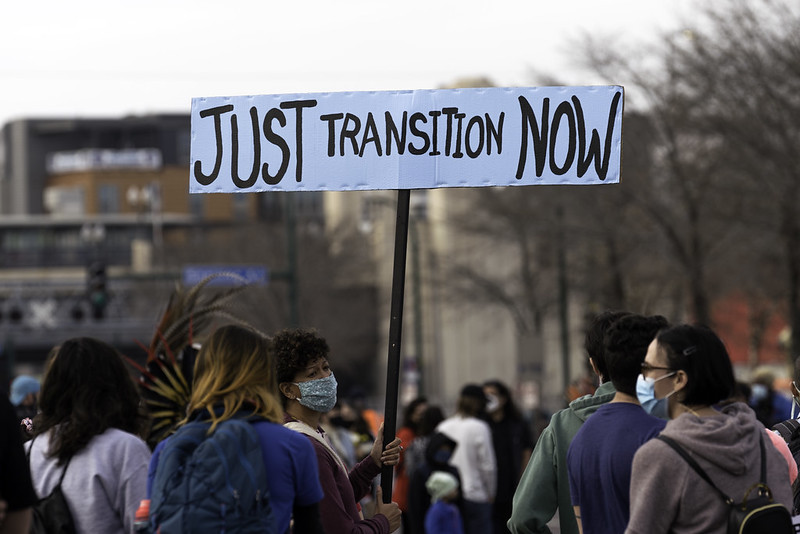
Một người biểu tình tại Minnesota, Mỹ đang giơ tấm biển “Just Transition Now”. Ảnh: Lorie Shaul

Cam kết đạt phát thải ròng bằng “0” vào năm 2050 và Thỏa thuận Đối tác Chuyển dịch Năng lượng Công bằng (JETP) với gói hỗ trợ trị giá 15,5 tỷ USD là những bước đi thể hiện rõ quyết tâm của Việt Nam tiến vào quỹ đạo phát triển xanh và bền vững.

Cho đến nay, phần lớn các thảo luận và chính sách vẫn xoay quanh ba trục chính: vốn đầu tư, công nghệ và khung pháp lý. Đây là những yếu tố nền tảng để thúc đẩy quá trình chuyển đổi năng lượng và hiện thực hóa tham vọng Net Zero. Tuy nhiên, có một khía cạnh quan trọng lại ít được chú ý đúng mức – đó là tác động xã hội.

Chuyển đổi năng lượng sẽ không chỉ tác động đến nền kinh tế, mà còn ảnh hưởng sâu rộng đến đời sống của người lao động, cộng đồng địa phương và các nhóm yếu thế. Nếu không được tính đến, những tác động này có thể tạo ra bất công mới, làm suy yếu đồng thuận xã hội.

Đó là lý do khái niệm Just Transition – Chuyển đổi công bằng – cần được đặt vào trung tâm của hành trình Net Zero.

Continue reading Hành trình Net Zero của Việt Nam: Một khoảng trống

Both Vietnam and China were similarly poor in 1980’s. How did China improve so much faster than Vietnam, as of 2020? Why is the gap between Vietnam and China even widening?

QUORA

Profile photo for Huijian Wu

Huijian Wu · 

CTO (2005–present)4y

Both Vietnam and China were similarly poor in 1980’s. How did China improve so much faster than Vietnam, as of 2020? Why is the gap between Vietnam and China even widening

1. In 1980, China was poor but had been building for 30 years, from 1950-1980, while Vietnam was at war all this time.

Continue reading Both Vietnam and China were similarly poor in 1980’s. How did China improve so much faster than Vietnam, as of 2020? Why is the gap between Vietnam and China even widening?