NEW YORK; August 1, 2023, Asia Society – A new Task Force on U.S.-China Policy report, Prioritizing Southeast Asia in American China Policy, lays out reasons why Southeast Asia is a critically important but under-appreciated region when it comes to U.S. interests and U.S. competition with China, and recommends actions for the U.S. government, in the face of China’s growing influence in the region.
Nickel is an essential component of electric-vehicle batteries and Indonesia is by far the world’s largest producer. A rare visit to one of its biggest nickel plants reveals the heavy environmental cost of mining and processing the metal. Photo: Ulet Ifansasti
Across the Indonesian archipelago, new industrial plants are going up to process chunks of nickel ore for use in electric-car batteries. Five years ago, there were none.
What changed? Chinese companies had a breakthrough.
Guterres: Hottest Month on Record Means ‘Global Boiling’ Has Arrived July is “virtually certain” to be the hottest month (WMO) in human history by a significant margin, scientists from the European Union’s Copernicus Climate Change Service and the World Meteorological Organization (WMO) said in an announcement yesterday. The month has already seen the hottest three days and highest ocean temperatures ever recorded. UN Secretary-General António Guterres warned an era of “global boiling” rather than global warming has arrived (UN News) and said the year of burning heat must translate into accelerated action by states to curb emissions of heat-trapping gasses, as well as more vigorous efforts to bolster climate adaptation. Catastrophic heat waves and wildfires across North America, Asia, and Europe in recent weeks have underscored the changing temperature’s costs for human health. U.S. President Joe Biden said yesterday that extreme heat is costing the United States $100 billion (Bloomberg) per year and threatening lives and business, as he issued a hazard alert to ramp up heat-related protections for workers.
Authors: Alex Wooley, Sheng Zhang, Rory Fedorochko, Sarina Patterson
Citation
Wooley, A., Zhang, S., Fedorochko, R., and S. Patterson. 2023. Harboring Global Ambitions: China’s Ports Footprint and Implications for Future Overseas Naval Bases. Williamsburg, VA: AidData at William & Mary.
Abstract
China has emerged as a dominant maritime nation, with significant commercial and military influence across the world’s seas. Beijing has rapidly increased its investments in global port infrastructure, and the People’s Liberation Army Navy (PLAN) has evolved from a coastal force to the world’s largest blue-water navy. Yet, China has just one official overseas naval base: a facility in Djibouti. In Harboring Global Ambitions: China’s Ports Footprint and Implications for Future Overseas Naval Bases, we scrutinize China’s options for establishing additional overseas naval bases. Leveraging a new dataset and additional research, we “follow the money” to identify the top 20 ports that have received the most official financing from China; analyze potential basing options ocean by ocean; and propose a shortlist of eight locations for future bases. Our accompanying dataset, China’s Official Seaport Finance Dataset, 2000-2021, tracks 123 seaport projects worth $29.9 billion financed by Chinese state-owned entities to construct or expand 78 ports in 46 countries. We argue that the potential for additional Chinese overseas naval bases has significant implications for global politics and requires cautious strategic responses from the West and developing countries.
The NATO Invitee associates itself with this Communiqué.
1. We, the Heads of State and Government of the North Atlantic Alliance, bound by shared values of individual liberty, human rights, democracy, and the rule of law, have gathered in Vilnius as war continues on the European continent, to reaffirm our enduring transatlantic bond, unity, cohesion, and solidarity at a critical time for our security and international peace and stability. NATO is a defensive Alliance. It is the unique, essential and indispensable transatlantic forum to consult, coordinate and act on all matters related to our individual and collective security. We reaffirm our iron-clad commitment to defend each other and every inch of Allied territory at all times, protect our one billion citizens, and safeguard our freedom and democracy, in accordance with Article 5 of the Washington Treaty. We will continue to ensure our collective defence from all threats, no matter where they stem from, based on a 360-degree approach, to fulfil NATO’s three core tasks of deterrence and defence, crisis prevention and management, and cooperative security. We adhere to international law and to the purposes and principles of the Charter of the United Nations and are committed to upholding the rules-based international order. This Summit marks a milestone in strengthening our Alliance.
World leaders and global organisations meet in Paris
Agreement for development banks to boost lending
Rich nations close in on $100 bln climate finance pledge
U.S., China adopt conciliatory tone on debt relief
PARIS, June 23 (Reuters) – Multilateral development banks like the World Bank are expected to find $200 billion in extra firepower for low-income economies by taking on more risk, a move that may require wealthy nations to inject more cash, world leaders said on Friday.
The leaders, gathered at a summit in Paris to thrash out funding for the climate transition and post-COVID debt burdens of poor countries, said their plans would secure billions of dollars of matching investment from the private sector.
Nickel is an essential component of electric-vehicle batteries and Indonesia is by far the world’s largest producer. A rare visit to one of its biggest nickel plants reveals the heavy environmental cost of mining and processing the metal. Photo: Ulet Ifansasti
Across the Indonesian archipelago, new industrial plants are going up to process chunks of nickel ore for use in electric-car batteries. Five years ago, there were none.
What changed? Chinese companies had a breakthrough.
Published May 2023 in Comparative Connections · Volume 25, Issue 1 (This article is extracted from Comparative Connections: A Triannual E-Journal of Bilateral Relations in the Indo-Pacific, Vol. 25, No. 1, May 2023. Preferred citation: Yu Bin, “China-Russia Relations: War and Peace for Moscow and Beijing,” Comparative Connections, Vol. 25, No. 1, pp 161-170.)
Perhaps more than any other time in their respective histories, the trajectories of China and Russia were separated by choices in national strategy. A year into Russia’s “special military operation” in Ukraine, the war bogged down into a stalemate. Meanwhile, China embarked upon a major peace offensive aimed at Europe and beyond. It was precisely during these abnormal times that the two strategic partners deepened and broadened relations as top Chinese leaders traveled to Moscow in the first few months of the year (China’s top diplomat Wang Yi, President Xi Jinping, and newly appointed Defense Minister Li Shangfu). Meanwhile, Beijing’s peace initiative became both promising and perilous as it reached out to warring sides and elsewhere (Europe and the Middle East). It remains to be seen how this new round of “Western civil war” (Samuel Huntington’s depiction of the 1648-1991 period in his provocative “The Clash of Civilizations?” treatise) could be lessened by a non-Western power, particularly after drone attacks on the Kremlin in early May.
Throughout most of the ongoing war in Ukraine, a truism has held across most of the American political spectrum, from left to right, about the second-order effects of the conflict’s outcome. A Ukrainian victory would strengthen the position of the United States vis-à-vis China globally, while a Russian victory would achieve the opposite.
It is easy to see how takes like this gain such a strong foothold. Analysts are quick to apply sweeping, abstract constructs to their assessments of major world events. This time, that has meant a supposed worldwide faceoff between authoritarianism and democracy. Beyond such considerations, many have tried to imagine the Ukraine conflict’s effects on Chinese thinking about Taiwan. Here again, it is supposed that a Ukrainian victory against a vastly larger invading adversary would be deflating for China, lowering the risk of any near-term attempt to take control of Taiwan by force. And a Russian victory, which now seems quite unlikely, would produce the opposite effect.
TTCT – Hai vụ đắm tàu cách nhau 4 ngày và vài nghìn cây số cho thấy thế giới đã trở thành một nơi đáng buồn ra sao.
Mục đích của những người tị nạn này không phải là thám hiểm biển khơi. Ảnh: Daryo.uz
Gần 3h sáng 14-6 trên Địa Trung Hải gần Hy Lạp, thủy thủ đoàn của chiếc Mayan Queen IV nhận tin có tàu gặp nạn ở gần đó, cách có 4 hải lý. Theo luật hàng hải quốc tế, và luật bất thành văn của dân đi biển, các tàu thuyền có bổn phận giúp đỡ và cưu mang nhau.
Tàu Mayan Queen IV là đại du thuyền tư nhân dài 90m và trị giá 175 triệu đô la, thuộc sở hữu một tỉ phú Mexico, có sức chứa thủy thủ đoàn 24 người và 26 khách, nhưng lúc đó chỉ có thủy thủ đoàn 4 người.
Đêm không trăng và đen như mực, nhưng trong vòng 20 phút tàu đến hiện trường. Theo thuyền trưởng Richard Kirkby thì tàu duyên phòng của Hy Lạp đang có mặt và chiếu đèn trên biển.
Ông cho hạ ghe xuống vớt nạn nhân đắm tàu đang bám vào vật nổi lềnh bềnh trên sóng, không ai có áo phao. Theo tiếng kêu yếu ớt của họ trong đêm, Mayan Queen lần dò và vớt lên 104 người Syria, Pakistan, Palestine và Ai Cập. Toàn bộ người được cứu sống là nam.
Tàu đánh cá Adriana dài khoảng 30m, chở 750 người tị nạn vượt biên từ bờ biển Libya sang Âu châu bị lật và chìm chỉ trong vòng 10-15 phút. Khoảng 100 trẻ em và phụ nữ trong hầm tàu không thoát kịp. 80 thi thể sau đó được tìm thấy, số người thiệt mạng như vậy được đoán định khoảng 650.
Sau 5 năm dài vắng bóng, Mỹ đã chính thức tái gia nhập Tổ chức Văn hóa, Khoa học và Giáo dục của Liên Hợp Quốc (UNESCO) vào ngày 30/6.
Trong một phiên họp bất thường hôm 30/6, 193 quốc gia thành viên của UNESCO đã phê duyệt đề xuất tái gia nhập tổ chức của Mỹ với 132 phiếu thuận và 10 phiếu chống.
Mỹ đã rút khỏi UNESCO vào năm 1984, dưới thời chính quyền Tổng thống Ronald Reagan, sau đó quay trở lại vào năm 2004.
Tuy nhiên, mối quan hệ của chính phủ Mỹ với UNESCO này trở nên căng thẳng vào tháng 10/2011, khi các thành viên của cơ quan này bỏ phiếu chấp nhận Palestine là thành viên của tổ chức.
Động thái này đã khiến Hoa Kỳ và đồng minh thân cận Israel tức giận, đồng thời buộc chính quyền của Barack Obama phải ngừng tài trợ cho cơ quan này. Năm 2017, Tổng thống Donald Trump tuyên bố, đất nước của ông sẽ rời khỏi UNESCO hoàn toàn với cáo buộc tổ chức này thiên vị và chống lại Israel. Mỹ và Israel sau đó đã chính thức rời UNESCO vào cuối năm 2018.
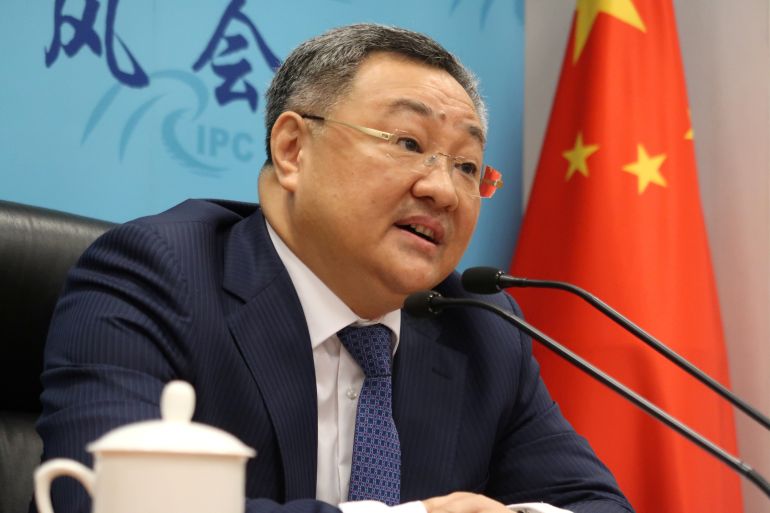
China’s EU envoy, Fu Cong, says Beijing respects the territorial integrity of all countries and stands for peace.
Fu Cong, China’s ambassador to the EU and former head of the arms control department of the Chinese foreign ministry, speaks at a news conference in Beijing [File Photo: Shubing Wang/Reuters]
Brussels, Belgium – China’s envoy to the European Union has suggested that Beijing could back Ukraine’s aims of reclaiming its 1991 territorial integrity, which includes Crimea – the peninsula annexed by Russia in 2014.
In a recent interview with Al Jazeera and two other media outlets, when Fu Cong was asked about supporting Kyiv’s goals, which includes reclaiming other Ukrainian regions now occupied by Russia, the senior Chinese diplomat said: “I don’t see why not.
North and South: French president Emmanuel Macron greets Barbadian prime minister Mia Mottley, whose Bridgetown Initiative inspired this week’s New Global Financing Pact Summit in Paris. Ludovic Marin/AFP via Getty Images
SHARE
When world leaders meet for their much-vaunted “summits,” what do they actually do? The question was posed by last week’s meeting in Beijing between US secretary of state Anthony Blinken and Chinese president Xi Jinping. The meeting lasted a whole thirty-five minutes. It was barely long enough to exchange diplomatic pleasantries, let alone to make progress on the various areas of US–China rivalry, in the South China Sea, on trade, technology and Ukraine. The actual negotiations had clearly happened elsewhere. The summit was mainly an exercise in symbolism: a handshake for the cameras and a carefully worded communique for the record.
The present policy brief is focused on how threats to information integrity are having an impact on
progress on global, national and local issues. In Our Common Agenda, I called for empirically backed consensus around facts, science and knowledge. To that end, the present brief outlines potential principles for a code of conduct that will help to guide Member States, the digital platforms and other stakeholders in their efforts to make the digital space more inclusive and safe for all, while vigorously defending the right to freedom of opinion and expression, and the right to access information. The Code of Conduct for Information Integrity on Digital Platforms is being developed in the context of reparations for the Summit of the Future. My hope is that it will provide a gold standard for guiding action to strengthen information integrity.
Digital platforms are crucial tools that have transformed social, cultural and political interactions
everywhere. Across the world, they connect concerned global citizens on issues that matter. Platforms help the United Nations to inform and engage people directly as we strive for peace, dignity and equality on a healthy planet. They have given people hope in times of crisis and struggle, amplified voices that were previously unheard and breathed life into global movements.
Yet these same platforms have also exposed a darker side of the digital ecosystem. They have enabled the rapid spread of lies and hate, causing real harm on a global scale. Optimism over the potential of social media to connect and engage people has been dampened as mis- and disinformation and hate speech have surged from the margins of digital space into the mainstream. The danger cannot be overstated. Social mediaenabled hate speech and disinformation can lead to violence and death.
The ability to disseminate large-scale disinformation to undermine scientifically established facts poses an existential risk to humanity (A/75/982, para. 26) and endangers democratic institutions and fundamental human rights. These risks have further intensified because of rapid advancements in technology, such as generative artificial intelligence. Across the world, the United Nations is monitoring how mis- and disinformation and hate speech can threaten progress towards the Sustainable Development Goals. It has become clear that business as usual is not an option.


 Daily News BriefJuly 28, 2023



 Đọt Chuối Non