Tsai Ing-Wen’s strategic gamble on US-Taiwan ties
Taiwan Tensions: In Conversation With President Tsai Ing-wen
China slams 60 countries, organizations for congratulating Tsai on reelection

Tsai Ing-Wen’s strategic gamble on US-Taiwan ties
Taiwan Tensions: In Conversation With President Tsai Ing-wen
China slams 60 countries, organizations for congratulating Tsai on reelection
Anthony B. Kim / @AKFREEDOM / August 20, 2020 / 4 Comments
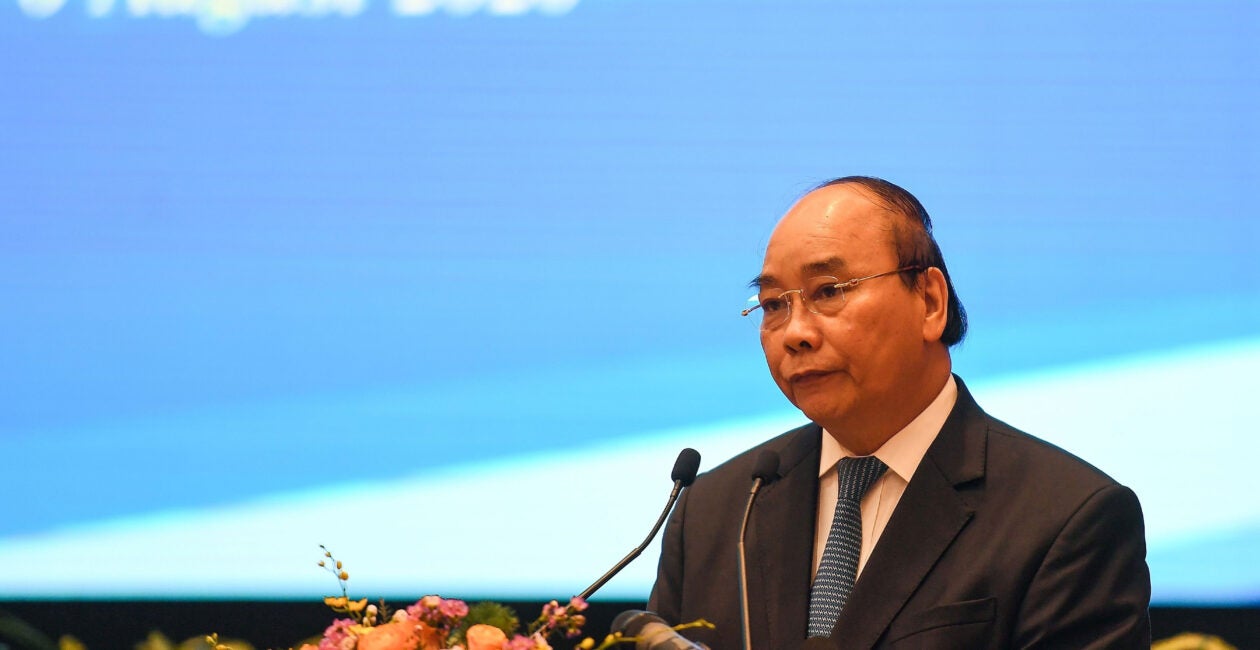
Vietnam was the United States’ 13th-largest trading partner last year, with bilateral trade increasing by more than 30%. Pictured: Vietnamese Prime Minister Nguyen Xuan Phuc addresses an Aug. 6 videoconference on the European Union-Vietnam Free Trade Agreement in Hanoi. (Photo: Nhac Nguyen/Agence France-Presse/Getty Images)
COMMENTARY BY
Anthony B. Kim researches international economic issues at The Heritage Foundation, with a strong focus on economic freedom. Kim is the research manager of the Index of Economic Freedom, the flagship product of the Heritage Foundation in partnership with The Wall Street Journal. Read his research.

Owen Churchill in Washington, DC SCMP
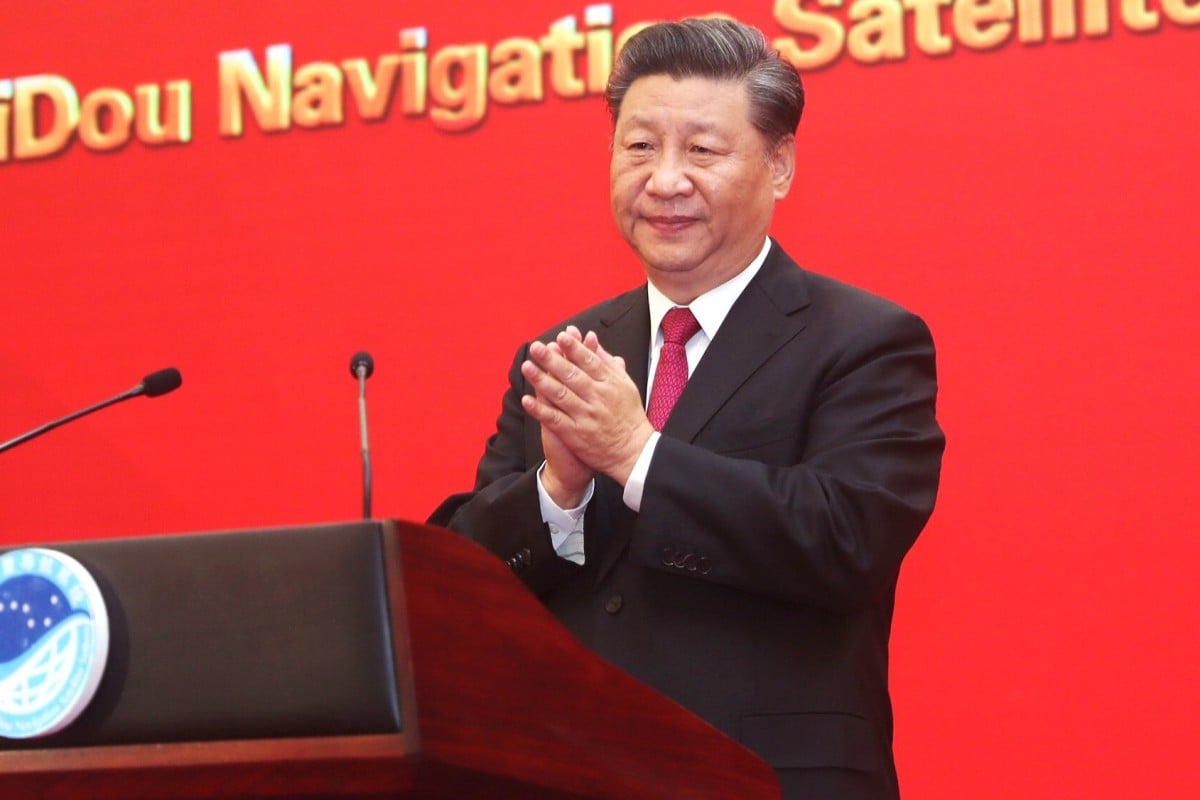
A bill introduced in the US Congress would ban US government documents from referring to Xi Jinping, shown at a ceremony last month in Beijing for the BeiDou navigational satellite system, as China’s president. Photo: Xinhua
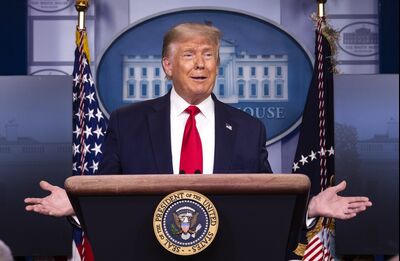
 US President Donald Trump told reporters on Tuesday that he had called off US – China trade deal negotiations.
“I don’t want to talk to them now,” Trump said. “If you know what they’ve done to this country and the world, I don’t want to talk to China just yet. So yes, I canceled the talks.”
Since Trump’s arrival at the White House in 2017, relations between Washington and Beijing have been tense.
Continue reading on CVD >>
US President Donald Trump told reporters on Tuesday that he had called off US – China trade deal negotiations.
“I don’t want to talk to them now,” Trump said. “If you know what they’ve done to this country and the world, I don’t want to talk to China just yet. So yes, I canceled the talks.”
Since Trump’s arrival at the White House in 2017, relations between Washington and Beijing have been tense.
Continue reading on CVD >>
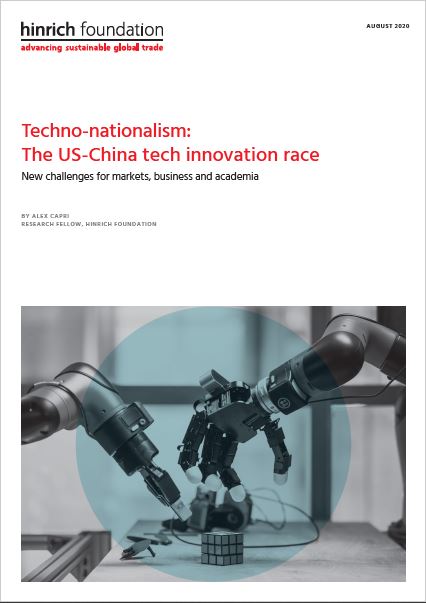
Techno-nationalism: The US-China tech innovation race
New challenges for markets, business and academia
BY ALEX CAPRI
RESEARCH FELLOW, HINRICH FOUNDATION, 20202
Published 03 August 2020
The US-China tech innovation race is challenging the laissez-faire economic model. State interventionism, techno-nationalism and US tech funding initiatives are increasing. This paper outlines the implications for markets, academia, research organizations, and governments of the US-China competition to achieve innovation advantage.
Bloomberg News August 17, 2020, 4:00 AM GMT+7 Updated on
The almost daily drumbeat of tensions between the U.S. and China shows little sign of letting up, while touching on everything from the coronavirus to trade to defense issues to monetary policy.
President Donald Trump has made his tough positions on China a key element in the lead-up to the U.S. presidential election, now less than three months away, and he seems intent on keeping the pressure on.
Tensions have been mounting since the Covid-19 pandemic spread across the globe early this year. Barely a day goes by without Trump slamming what he calls a “plague” unleashed on the world by China in press briefings, Twitter and elsewhere.
The hawks in Donald Trump’s administration are on the ascent. Do not expect the US to u-turn on this march towards a harsher stance on China, say Steven R Okun and James Green.
By Steven R Okun By James Green14 Aug 2020 06:00AM(Updated: 14 Aug 2020 08:07AM) CNA
SINGAPORE: Last week’s suite of actions by the United States against WeChat and TikTok were among the most significant developments since March 2018 when US President Donald took formal action in retaliation for China’s unfair trade practices.
August 10, 2020 5:30 PM GMT+7

What a difference two months can make. In May, Taiwan Semiconductor Manufacturing Co. (TSMC), the world’s largest chipmaker, lost the business of Huawei Technologies—its biggest Chinese customer and the source of 13% of its revenue—as a casualty of geopolitical jockeying between superpowers. But TSMC shareholders took the loss in stride. And by late July, after a stumble by rival Intel, TSMC’s stock had risen almost 50% since May, making it one of the world’s 10 most valuable companies.


Agence France-Presse Published: 1:44am, 25 Jul, 2020 SCMP

By Tony Czuczka August 2, 2020, 10:14 PM GMT+7 Updated on Bloomberg
The Trump administration will announce measures shortly against “a broad array” of Chinese-owned software deemed to pose national-security risks, U.S. Secretary of State Michael Pompeo said.
The comments suggest a possible widening of U.S. measures beyond TikTok, the popular music-video app owned by ByteDance Ltd., one of China’s biggest tech companies. President Donald Trump told reporters Friday that he plans to ban TikTok from the U.S., but his decision hasn’t been announced. Pompeo signaled he expects a Trump announcement “shortly.” Chinese newspapers slammed a potential ban on TikTok.
The president continues to weigh his options and may have an answer Monday or Tuesday, Fox Business reported on Sunday evening.
![Wang Wenbin says 'malicious slander' is behind US order to close Chinese consulate in Houston, Texas [Ng Han Guan/ AP Photo]](https://www.aljazeera.com/mritems/imagecache/mbdxxlarge/mritems/Images/2020/7/24/a4e742b193d747f5b0ab15870a1ab14f_18.jpg "China orders closure of US consulate in Chengdu")
15:08 | 22/07/2020VOV
Vietnam supports a comprehensive, fair and lasting solution to the conflict between Palestine and Israel through dialogues and negotiations, as well as the exercise of indisputable legal rights of Palestinians.

Ambassador Dang Dinh Quy, head of the Vietnamese Permanent Mission to the United Nations, made the reaffirmation at an online meeting of the UN Security Council (UNSC) on July 21 discussing the Middle East situation, including the recent Palestinian issue.

By Anna Fifield July 22, 2020 at 5:14 p.m. GMT+7 Washington Post
CHANGSHA, China — The United States has ordered China to close its consulate general in Houston “in order to protect American intellectual property and American’s private information,” State Department spokeswoman Morgan Ortagus said Wednesday.
Beijing vowed to retaliate, calling the order “an unprecedented escalation” in a broader conflict between the world’s two biggest economies, which now encompasses trade and technology, freedom of the press and religion, and the coronavirus and the race for a vaccine.
eastasiaforum.org Author: Thang Nam Do, ANU
Vietnam needs to address environmental challenges to fully reap the benefits from its new free trade and investment agreements with the European Union. On 8 June, Vietnam’s National Assembly ratified the EU–Vietnam Free Trade Agreement and Investment Protection Agreement, following the European Parliament’s approval in February. Ratifying the agreement clears the path for Vietnam to expand exports to the potentially lucrative EU market and to attract more investment from the economic bloc.
 Đọt Chuối Non