Me? Me? Me?... Yeah yeah yeah amigo... What can me say about me-self?... me-self...me-self... Ole ole ole... me me me... I'm a young banana shoot... My dad is Banana Pa... My mom is Banana Ma... I am happy happy happy... I run around... oops... I can't run... I sing aloud... all day long... I sing in the rain... I sing in the shine... I sing day and night... I sing all the time...
I watch the butterflies and the bees... and the cranes and the geese...
Aha aha aha... here we go again... this little swallow circling on my head... the little swallow on my head... is about to poop on me... Hey, little fella, don't cha know where to unload ya poopa?... But, that's alright... I can swallow my pride to befriend a swallow... Yup yup yup... swallow my pride to befriend a swallow...
Indonesia, this year’s Association of Southeast Asian Nations (ASEAN) chair, held a flurry of ministerial meetings earlier this month. From July 11-12, it hosted the ASEAN Foreign Ministers’ Meeting in Jakarta. Timor Leste, which became an ASEAN observer state last year, sent a delegation for the first time. Chief among the ministers’ conversation topics was the ongoing civil war in Myanmar; moreover, ministers shared their continued concerns regarding aggressive Chinese behavior in the South China Sea. On July 13, ASEAN foreign ministers, joined by their counterparts from Japan, China, and South Korea, met for the 24th ASEAN Plus Three Foreign Ministers’ meeting. Lastly, Indonesia hosted the ASEAN Regional Forum on July 14, setting the stage for ASEAN partners such as the United States, Russia, and China, to meet on the sidelines.
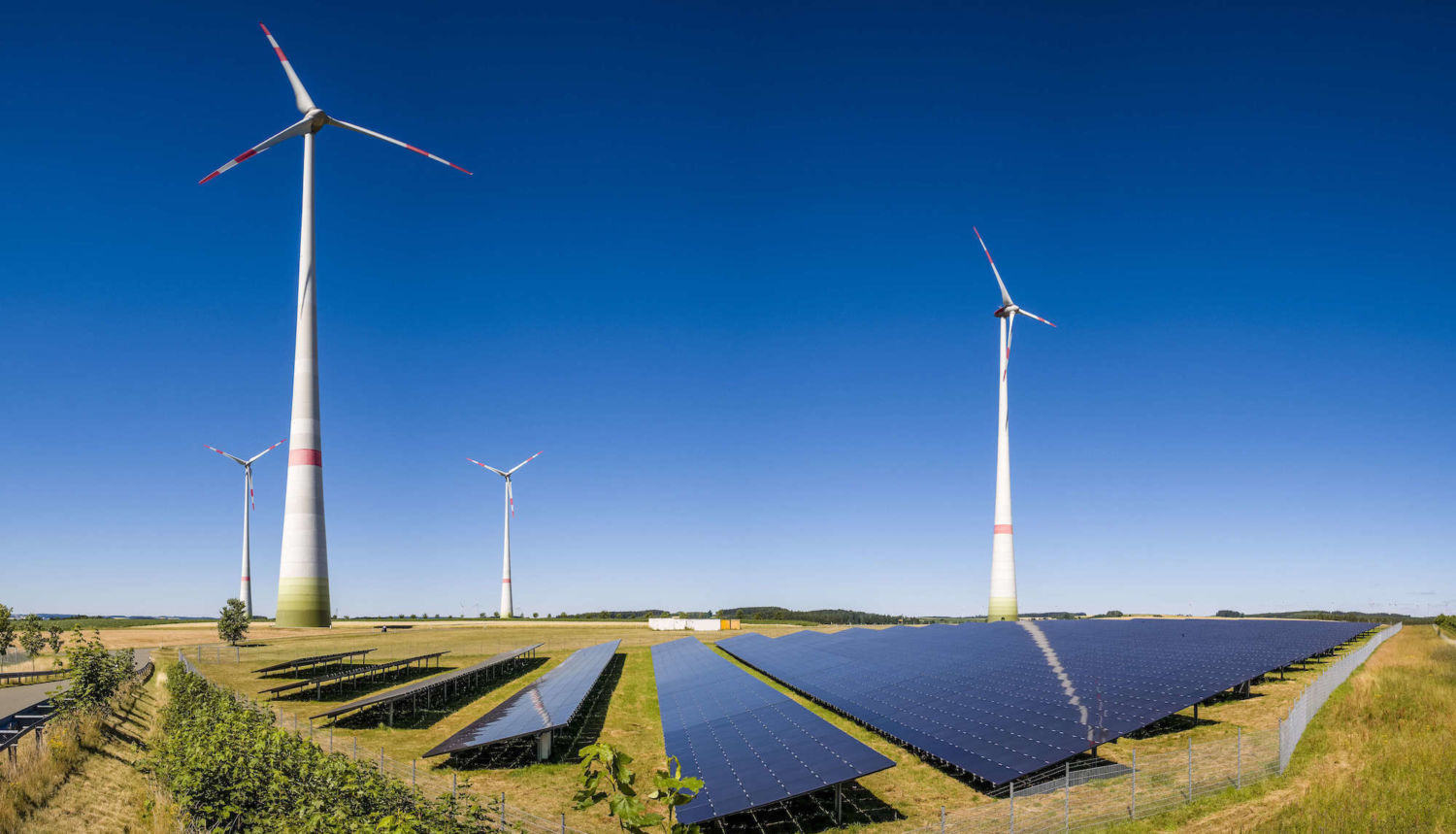
Renewable energy skeptics argue that because of their variability, wind and solar cannot be the foundation of a dependable electricity grid. But the expansion of renewables and new methods of energy management and storage can lead to a grid that is reliable and clean.
As wind and solar power have become dramatically cheaper, and their share of electricity generation grows, skeptics of these technologies are propagating several myths about renewable energy and the electrical grid. The myths boil down to this: Relying on renewable sources of energy will make the electricity supply undependable.
Có người phó mặc nỗi đầy vơi Lắm kẻ cạn đêm thức ngậm ngùi Hậu quả phá rừng sông suối ngập Lũ tràn nước cuốn cửa nhà trôi Trần gian vạn thủa cơn binh lửa Dòng chảy ngàn năm cuộc lở bồi Xin chớ khóc than đừng sợ hãi Bình thường như chuyện nắng mưa thôi.
Hoang Thi Ai holds up her phone showing a photo of her son, Hoang Van Tiep, who she later discovered was among the 39 people who were found dead in a truck container in Essex, the UK, in 2019 [File: Hau Dinh/AP Photo]
In late October 2019, ambulance crews in the United Kingdom were called to a scene of horror.
On a quiet road in a nondescript industrial park in Essex, the bodies of 39 people were found when the heavy steel doors of a refrigerated truck trailer were opened.
The victims had suffocated. Death came slowly as oxygen levels inside the airtight container depleted for the 28 men, eight women and three children as their attempt to be smuggled into the UK ended tragically.
The youngest were two 15-year-olds. All were from Vietnam and the majority were from one province – Nghe An.
“I’m sorry Dad and Mum,” 26-year-old Pham Thi Tra My tapped out in a final text message she composed for her parents.
Rafting is the tactic of tying ships at anchor together to establish a semi-persistent floating outpost that is hard to uproot.
Gaute Friis | JULY 16, 2023
Rows of PAFMM trawlers rafting near Whitsun Reef, March 25, 2021 (Source: Asia Maritime Transparency Initiative, Maxar Technologies)
Gaute Friis
Team Member
“Rafting” refers to the gray zone tactic of tying ships together at anchor to establish semi-persistent floating outposts that are difficult disperse due to their collective mass.
The ships are generally the component of China’s People’s Armed Forces Maritime Militia (PAFMM) known as Spratly Backbone Fishing Vessels (SBFV). According to the Asia Maritime Transparency Initiative’s detailed report on the PAFMM, these SBFVs receive generous government subsidies to remain at sea for most of the year, specifically to assert Beijing’s expansive maritime claims.
This tactic describes maneuvering one’s ship dangerously across the bow of another, often forcing the other ship to take evasive action to avoid a collision.
Gaute Friis | JULY 18, 2023 Sealight 333
PLAN Destroyer Lanzhou, at right, is seen here sailing within 40 meters of the USS Decatur, to the left (Source: USN)
Gaute Friis
Team Member
Bow-crossing describes a harassment tactic in which a ship abruptly maneuvers to cross dangerously across the bow of another in violation of the 1972 International Regulations for Preventing Collisions at Sea (COLREG) and the 2014 Code for Unplanned Encounters at Sea (CUES).
This maneuver is intended to force the other ship to take evasive action to avoid a collision. It may be used to disrupt freedom of navigation operations (FONOPS) or other assertions of international law or national sovereignty.
A recent example was documented in June 2023, when a Peoples Liberation Army Navy (PLAN) vessel crossed dangerously in front of U.S. Navy destroyer USS Chung-Hoon during a joint Taiwan Strait passage with the Canadian frigate HMCS Montreal, forcing the U.S. ship to reduce speed to avoid a collision:
China’s ships use bow-crossing to protest the activities of other countries’ ships in waters over which it claims sovereignty or jurisdiction, and to send the message that Beijing is willing to escalate tensions in defense of its claims.
In nautical terms, it involves a closest point of approach (CPA) of less than 2 lengths of the ship being intercepted. They are usually referred to by the U.S. Navy as “unsafe and unprofessional maneuvers”.
Other examples:
On September 30, 2018, the PLAN Type 052C Luyang II-class destroyer Lanzhou intercepted the U.S. Arleigh Burke-class destroyer USS Decatur, which was conducting a FONOP with 12 nautical miles of Chinese-occupied artificial islands in the South China Sea. The picture at the top of this post shows how close the two ships came to colliding.
On June 21, 2014, CCG vessel Haijian 2168 approached Vietnam Coast Guard (VCG) ship CSB 4032 at high speed. The VCG ship had to change directions repeatedly to avoid a collision as the distance between the two ships came within 30 meters.
On December 5, 2013, a Chinese warship cut across the bow of the missile cruiser U.S.S. Cowpens at a distance of less than 200 yards in international waters.
In March 2009, five Chinese ships (a combination of PLAN, CCG and militia) harassed the U.S. surveillance ship USNS Impeccable in international waters in the South China Sea, forcing the American ship to make an emergency maneuver to avoid a collision.
Editor’s note: This post was originally published on 7 July under the title “Unsafe Maneuvers”, but was retracted when we decided to divide it into two separate categories. Apologies for any confusion.
Gaute Friis
Gaute is a Defense Innovation Scholar at Stanford’s Gordian Knot Center for National Sec
CCG 5201 blocks the path of BRP Malapascua, forcing it to abort its planned patrol of the Second Thomas Shoal after a 30 minute stand-off, April 26, 2023 (Source: BBC)
Gaute Friis
Team Member
Blocking is a form of bow-crossing meant to physically impede the passage of another ship to its destination. Blocking is typically used by Chinese ships to hinder other countries from resupplying or reinforcing their outposts in the South China Sea.
Distinct from other forms of bow-crossing, blocking is used for area denial rather than operations disruption and will often result in more protracted stand-offs. China uses this tactic to assert its claims of jurisdiction as well as to prevent certain activities–most notably the reinforcement of other claimants’ existing Spratly Island outposts.
One such blocking maneuver occurred on April 26th, 2023, when China Coast Guard (CCG) ship 5201 blocked the path of the Philippine Coast Guard (PCG) patrol vessel BRP Malapascua. This forced the much smaller PCG ship to abort its planned route to the entrance of Second Thomas (Ayungin) Shoal during a resupply mission to the Philippines’ outpost aboard BRP Sierra Madre:
China routinely prevents the entry of Philippine ships into the interior of Second Thomas Shoal as a cornerstone of its strategy to prevent the rusting outpost from being repaired or replaced until it breaks up or otherwise becomes uninhabitable. For nearly a decade it has allowed only small wooden boats carrying food and replacement troops to pass through its blockade.
Resupply boat brings food and replacement troops to the Philippine Navy’s outpost aboard BRP Sierra Madre, Second Thomas Shoal, 21 June 2022. Credit: Inquirer/ Marianne Bermudez
Other examples:
On September 19, 2019, also near Second Thomas Shoal, a CCG ship blocked Philippine civilian vessels while they were conducting a resupply mission to the BRP Sierra Madre.
On November 13, 2015, about 13 nautical miles from Subi Reef, CCG cutters 35115 and 2305 blocked the path of a Vietnamese replenishment ship heading towards the Vietnamese outpost on Southwest Cay, forcing the ship to find a different route to its destination. PLA Navy Type 072A landing ship 995 later blocked the ship’s path again, this time brandishing small arms and firing a warning shot.
Quyết định 843/QĐ-TTg năm 2023 về Chương trình hành động quốc gia hoàn thiện chính sách và pháp luật nhằm thúc đẩy thực hành kinh doanh có trách nhiệm tại Việt Nam giai đoạn 2023-2027 do Thủ tướng Chính phủ ban hành
Căn cứ Luật Tổ chức Chính phủ ngày 19 tháng 6 năm 2015; Luật sửa đổi, bổ sung một số điều của Luật Tổ chức Chính phủ và Luật Tổ chức chính quyền địa phương ngày 22 tháng 11 năm 2019;
Căn cứ Nghị quyết số 99/NQ-CP ngày 30 tháng 8 năm 2021 của Chính phủ ban hành Chương trình hành động của Chính phủ nhiệm kỳ 2021 – 2026 thực hiện Nghị quyết của Quốc hội về Kế hoạch phát triển kinh tế – xã hội 5 năm 2021 – 2025;
Căn cứ Nghị quyết số 01/NQ-CP ngày 06 tháng 01 năm 2023 của Chính phủ về nhiệm vụ, giải pháp chủ yếu thực hiện kế hoạch phát triển kinh tế – xã hội, dự toán ngân sách nhà nước và cải thiện môi trường kinh doanh, nâng cao năng lực cạnh tranh quốc gia năm 2023;
As much as 17 billion USD is needed to build two railway routes connecting to seaports, namely Lao Cai-Hanoi-Hai Phong and Bien Hoa-Vung Tau, according to the Ministry of Transport (MoT).
Monday, July 17, 2023 at 17:06
A pre-feasibility study is underway for the Bien Hoa-Vung Tau route with 1,435mm gauge tracks. It is 128km long with a total investment of 6.2 billion USD.
Meanwhile, the detailed planning of the 380km-long Lao Cai-Hanoi-Hai Phong project has been basically completed at a cost of about 11 billion USD.
According to the MoT, a large amount of the money for the two projects will come from the public investment fund.
Due to their big investment, the two projects have been included in the list of those that call for foreign investment in the 2021-2025 period, the ministry said, adding that it is preparing for capital mobilisation so that construction of the projects will start before 2030.
The world’s largest and most populous continent is reckoning with the deadly effects of extreme summer weather, as countries endure blistering heatwaves and record monsoon rainfall, with governments warning residents to prepare for more to come.
This month torrential rains inundated parts of Japan, China, South Korea and India, upending the lives of millions and causing flash floods, landslides and power cuts. Record temperatures also led to a rise in heat-related illnesses, particularly among vulnerable communities such as the elderly.
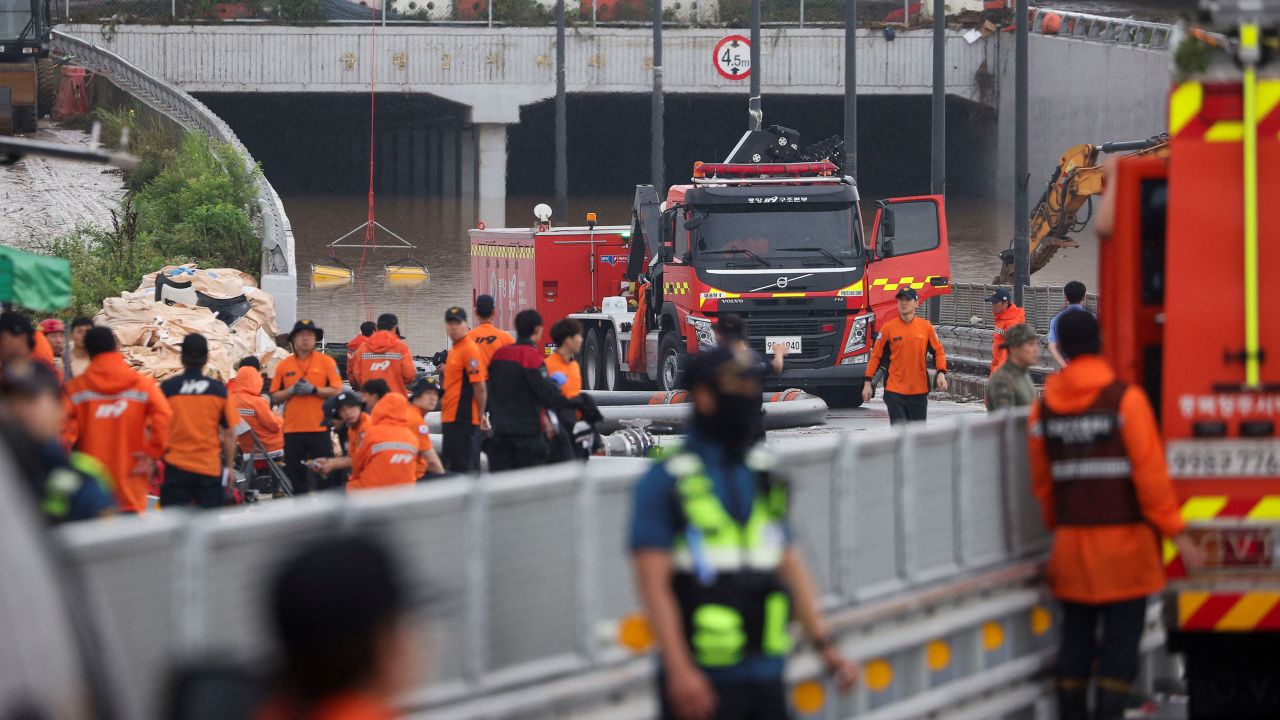
On Saturday, at least 13 people in the central South Korean city of Cheongju died after waters from a burst riverbank flooded an underpass, trapping vehicles, including a public bus.
At least 41 people have died in South Korea in recent days and thousands more have been forced to evacuate their homes and seek temporary shelter, as heavy downpours hit central and southern parts of the country.
In response to the loss of life, South Korean President Yoon Suk Yeol called for an overhaul of the country’s approach to extreme weather.
“This kind of extreme weather event will become commonplace — we must accept climate change is happening, and deal with it,” Yoon said Monday.
Ad Feedback
Rescue workers at the flooded underpass in Cheongju, South Korea on July 16, 2023.Kim Hong-ji/Reuters
In neighboring Japan, record rainfall in the southwest of the country resulted in devastating flooding that left at least six people dead, and many others still missing.
Bitter and earthy. Fit for instant brews only. Robusta coffee has a dire reputation, but a small group of farmers in Vietnam are trying to turn its fortunes around as a warming world threatens the industry.
Climate change has threatened to erase major cities in Vietnam, including its biggest metropolis, Ho Chi Minh City. A historic downpour which sank many parts of the city late last year was seen as a mere tip of the iceberg. It’s predicted that by 2050, the city will go underwater if no concrete measures are taken to prevent the phenomenon of rising sea levels, land subsidence, weak soil foundation due to groundwater extraction, rapid developments and population growth. What has been done to respond to the gradual sinking of the city? Can it survive a looming threat to its existence?




 Đọt Chuối Non