Đây là bài hát nhạc blues được Muddy Waters sáng tác và trình diễn, phát hành vào tháng 2-1950. Bài hát là cách giải thích của ông về “catfish blues” – “nhạc blues cá da trơn”, nhạc blues Châu thổ có từ những năm 1920 ở Mississippi, Mỹ.
McKinley Morganfield (4/4/1913 – 30/4/1983) được biết đến với nghệ danh Muddy Waters, là ca sĩ và nhạc sĩ nhạc blues người Mỹ, là nhân vật quan trọng trong bối cảnh nhạc blues thời hậu chiến tranh thế giới thứ 2, và thường được trích dẫn là “cha đẻ của nhạc blues Chicago hiện đại”. Sự nổi tiếng của ông đóng vai trò là cầu nối giúp nhạc blues cá da trơn có lượng khán giả rộng rãi nhất. Continue reading Đá lăn – Rolling Stone→
You are OK when you sit by a lake to enjoy the cool breeze and the little waves twinkling under the warm sun and think about nothing other than “This is so relaxed and wonderful.”
Ivory seized from a smuggler is destroyed in Da Nang City, Dec. 28, 2023. Photo by VnExpress/Ha Hoai
Nearly 10 tons of endangered animal parts from Africa, including ivory and rhino horns that were seized from a smuggler in Da Nang City, have been incinerated.
A court in the central city ruled Thursday to burn 456.9 kg of elephant tusks, 140 kg of rhino horns, 6.2 tons of pangolin scales, and 3.1 tons of lion bones.
The animal parts, which would cost an estimated VND300 billion (US$12.36 million) on the black market, were seized from Nguyen Duc Tai, 33, a Da Nang resident.
theguardian.com Saltwater damage could see precious historical Buddhist artworks dating back hundreds of years slowly fade entirely from view
by Rebecca Ratcliffe and Navaon Siradapuvadol in NonthaburiWed 29 Nov 2023 02.37 GMT
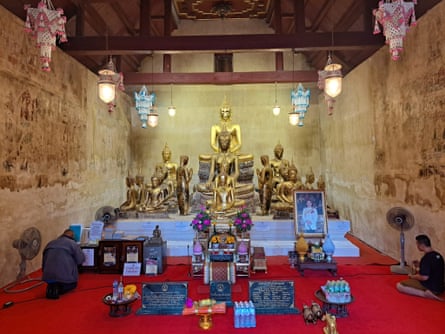
Inside Wat Prasat, a temple in Nonthaburi, just north of Bangkok. Thailand. The temple contains faded, salt-damaged murals. The salt damage comes from rising sea levels caused by the climate crisis. Photograph: Rebecca Ratcliffe/The Guardian
If you look closely, you can just about see the characters and scenes that once stretched across the walls of Wat Prasat, a temple in Nonthaburi. There’s the dark shape of an elephant’s head, a figure slouching on its back; outlines of swords pointing upwards to the centre of the display; patches of curved roofs.
“The mural used to be more vivid,” says Phra Maha Natee, the abbot of Wat Prasat. Even when he was a novice monk, 20 years ago, the image – which shows one of the jātakas stories that recall the Buddha’s past lives – was easier to understand. “The colour was brighter and sharper,” he says.
The murals offer a glimpse into a past era – a time of prosperity but also social upheaval, when a more empowered nobility had emerged, as did a desire, say historians, for Buddhism to play a more stronger role in reinforcing discipline in society. They date back to the mid or later years of the Ayutthaya kingdom in Siam, which existed from 1351 to 1767, in what is now Thailand and are a treasured early example of the art form.




 Đọt Chuối Non