All posts by Đào Thu Hằng

I'm from Hanoi, Viet Nam. I'm an author of Dot Chuoi Non (dotchuoinon.com/author/hangbelu/), a blog on Positive thinking, founded by Dr. Tran Dinh Hoanh, an attorney in Washington DC. I'm a co-founder of Conversations on Vietnam Development - cvdvn.net, a virtual think tank. I am a co-founder of two companies in Viet Nam working on children education services. I advise companies on STEAM education, English language education for children and students in Vietnam. I'm studying the Buddha's teaching and the teaching of Jesus. I practice mindful living including meditation. I hold a PhD on Sustainable Energy Systems from University of Lisbon and Aalto University. I graduated from Hanoi University of Technology on Environmental Engineering. I obtained a Master degree of the same major from Stanford University and Nanyang Technological University. My English-language blog at: hangbelu.wordpress/. I play table tennis as a hobby.

Fast and dubious: How electric cars are tiring the Mekong – Xe điện phát triển nóng đang bào mòn Mê Kông

mekongeye.com

This five-part series explores how the acceleration of electric vehicle adoption could increase the demand for rubber—a commodity that has historically driven deforestation and land grabbing across the Mekong region. Experts say the EV transition will boost rubber demand, as EVs need specialized tires that can bear heavier vehicle weight and high torque.

This matters to the Mekong region. Our data analysis shows that Cambodia, Laos, Myanmar, Thailand, and Viet Nam together supply nearly 50% of the world’s natural rubber. About 70% of global rubber goes into tires. Without effective traceability in place, deforestation and land conflicts, many of which are ongoing and affecting the lives and livelihoods of local communities—are unlikely to be solved.

Story by Mekong Eye’s investigation team
This series was produced in partnership with Earth Journalism Network and the Pulitzer Center

Electric vehicles (EVs) are on the rise — from Bangkok to Hanoi to Vientiane — promising a cleaner future as part of the global shift to clean energy, with more than 17 million electric cars sold worldwide in 2024.

But there is still a cost to pay for these ‘green cars’. With their heavier battery weight and higher torque, EVs wear out their tires faster than gasoline-powered cars, and therefore consume more tires throughout their lifetime.

In every tire is natural rubber, the key raw material that ensures durability, elasticity and strength.

The growing demand for EV tires has had significant implications for the Mekong region — Cambodia, Laos, Myanmar, Thailand and Viet Nam — which produces about 50% of the world’s natural rubber and hosts major plants for multinational tire manufacturers and EV makers.

Continue reading Fast and dubious: How electric cars are tiring the Mekong – Xe điện phát triển nóng đang bào mòn Mê Kông

Japan pulls out of Vietnam nuclear project, complicating Hanoi’s power plans​

Reuters.com By Francesco Guarascio and Phuong Nguyen Updated December 8, 2025

Workers repair an electric grid in Hanoi
  • Summary
  • Timeline for Vietnam project too tight, Hanoi envoy says
  • Ties already strained over petrol motorbike ban hurting Honda
  • Demand surging from industry, expanding middle class
  • Extreme weather events also threatening supply

HANOI, Dec 8 (Reuters) – Japan has dropped out of plans to build a major nuclear power plant in Vietnam because the time frame is too tight, Japanese ambassador Naoki Ito told Reuters, potentially complicating Vietnam’s long-term strategy to avoid new power shortages.

Vietnam, home to large manufacturing operations for multinationals including Samsung and Apple, has faced major power blackouts as demand from its huge industrial sector and expanding middle class often outpaces supplies, strained by increasingly frequent extreme weather, such as droughts and typhoons.

The Reuters Power Up newsletter provides everything you need to know about the global energy industry. Sign up here.

“The Japanese side is not in a position to implement the Ninh Thuan 2 project,” the ambassador to Vietnam said, referring to a plant with a planned capacity of 2 to 3.2 gigawatts. The project is part of Vietnam’s strategy to boost power generation capacity.

Continue reading Japan pulls out of Vietnam nuclear project, complicating Hanoi’s power plans​

Nuclear energy: Where China is getting with small modular and fusion reactors

On Oct. 13 of this year, the PRC state media outlet CPNN, reported that China is pulling ahead in advanced nuclear power technology development with the launch of the large-scale production “Hualong One” (also known as HPR1000). As it develops, China not only aims to tackle the transmission bottleneck in the south, but also to export to countries like Pakistan as the PRC’s “business card” to the world.

China’s dual goals of localization and export orientation have long defined its nuclear strategy. Led by state-owned giants such as the China National Nuclear Corporation (CNNC), Beijing has invested heavily in domestic innovation while aggressively expanding into overseas markets. Beijing has sought to expand its reactor sales to markets such as Argentina and the United Kingdom, while also securing control over upstream uranium resources. CNNC’s 2019 acquisition of Namibia’s Rössing Uranium Mine, one of the world’s largest open-pit uranium operations, underscored China’s growing dominance across the nuclear value.

Beijing’s policy support for state-owned enterprises has enabled it to build a vertically integrated nuclear industry, driving rapid advances in small modular reactors (SMRs), fourth-generation technologies, and nuclear fusion research (the Artificial Sun). Furthermore, intensifying US–China competition is reshaping global nuclear exports and deepening the geopolitical risks of dependence on Chinese nuclear systems.

Continue reading Nuclear energy: Where China is getting with small modular and fusion reactors

The lights dim on Laos’ brief Bitcoin dream

mekoneye.com By Võ Kiều Bảo Uyên 17 November 2025 at 14:50

Four years after it first approved Bitcoin mining projects powered by surplus hydropower, Laos is beginning to rethink whether the energy-hungry industry — now linked to massive transnational cryptocurrency scams — is worth keeping alive

High-rise buildings stand in the Boten Special Economic Zone in northern Laos, near the border with China. The area is suspected to be a hotspot for scam operations, including schemes that store fraudulent money in crypto for later laundering. PHOTO: Thanh Hue

Houaphanh Province, LAOS — Bitcoin is a world far away from 19-year-old Chai, an ethnic Hmong and a college student who has never owned a computer. 

But its shadow has already crept into his mountainous village, where power outages are common—often a side effect of the vast energy demands elsewhere, including cryptocurrency mining.

Despite the national grid being connected to his remote community seven years ago, he and his classmate studied by candlelight, oil lamp, or mobile flashlight at night to prepare for university entrance exams. The blackout worsens during the dry seasons when hydropower drops. 

Continue reading The lights dim on Laos’ brief Bitcoin dream

Time for Vietnam to resolve its renewable energy legal quagmire

fulcrm.sg Published 19 Nov 2025 Le Hong Hiep

In Vietnam, an impasse over feed-in-tariffs for renewable energy producers threatens foreign investors’ confidence in government policies

Afestering legal crisis is threatening to derail Vietnam’s energy development plans. 173 solar and wind projects, representing about US$13 billion in investments, are stuck in limbo due to ongoing disputes regarding their feed-in-tariffs (FITs) – the guaranteed payments that the government would pay for their contribution to the power grid. This situation raises concerns about Vietnam’s business environment and the consistency of its economic policy. If Vietnam does not resolve these disputes promptly, the country could face significant legal, financial, and reputational repercussions.

Between 2018 and 2021, Vietnam experienced a significant boom in renewable energy, primarily fuelled by the government’s commitment to offer attractive 20-year FITs to investors for projects that began commercial operations before designated deadlines. However, in 2023, an investigation by the Government Inspectorate found that many of these projects had not obtained their Construction Completion Acceptance (CCA) certificates before their Commercial Operation Date (COD). Following the inspection, the Ministry of Industry and Trade issued a new circular, effective June 2023, stipulating that renewable energy projects must obtain a CCA certificate before being recognised for COD. This effectively disqualified the affected projects from receiving the original FIT rates.

Continue reading Time for Vietnam to resolve its renewable energy legal quagmire

Tai nạn lao động năm 2024: Tăng cả số vụ, số người chết và thiệt hại kinh tế

Giảm tai nạn lao động rất dễ, chỉ cần thanh tra đi ngang qua những nơi xây dựng, nhìn cách thiên hạ làm việc là biết ngay họ có an toàn hay không, lý do gì chính phủ không giải quyết được.

TĐH

***

cuocsongantoan

Thông báo tình hình tai nạn lao động do Bộ Lao động – Thương binh và Xã hội (công bố tháng 2/2025) cho thấy, năm 2024 cả nước đã xảy ra 8.286 vụ tai nạn lao động, làm 8.472 người bị nạn, trong đó 727 người chết, 1.690 người bị thương nặng. So với năm 2023, số vụ tai nạn tăng 892 vụ, số người bị nạn tăng 919 người, và số người chết tăng 28 người – một xu hướng đáng lo ngại, gióng lên hồi chuông báo động về an toàn lao động.

Không chỉ dừng lại ở thiệt hại về người, tổn thất kinh tế do tai nạn lao động năm 2024 ước tính lên tới hơn 43.000 tỷ đồng, tăng gần 26.000 tỷ đồng so với năm trước. Thiệt hại này bao gồm chi phí thuốc men, điều trị, mai táng, bồi thường, và tổn thất sản xuất – một gánh nặng không nhỏ đối với doanh nghiệp, xã hội và đặc biệt là các gia đình người lao động.

Tai nạn lao động năm 2024: Tăng cả số vụ, số người chết và thiệt hại kinh tế
Các đội thi Công ty Thủy điện Quảng Trị thực hiện phần thi thực hành sơ cấp cứu tai nạn lao động. Ảnh: Trang Sinh.

Continue reading Tai nạn lao động năm 2024: Tăng cả số vụ, số người chết và thiệt hại kinh tế

Vietnam’s push for ‘chip-to-ship’ conglomerates raises red flags

Reuters.com November 5, 20252:32 PM GMT+7

[1/3]A logo on a Vinfast electric car and Vietnam’s national flag sticker at the ’80 Years Journey of Independence – Freedom – Happiness’ expo ahead of the country’s Independence Day celebration, at the National Exhibition Center in Hanoi, Vietnam, August 31, 2025. REUTERS/Athit Perawongmetha/File Photo Purchase Licensing Rights, opens new tab

  • Summary
  • Hanoi backs national champions with ‘preferential’ policies
  • Vingroup encouraged to bid for $70 billion railway, sources say
  • Central bank, finance ministry, Fitch flag financial risks
  • Investors remain cautious, fear favouritism

Continue reading Vietnam’s push for ‘chip-to-ship’ conglomerates raises red flags

TP.HCM trước nguy cơ “dời đô” vì chìm dần

Sụt lún nghiệm trọng đang xảy ra tại TP.HCM thực tế đã được nghiên cứu và cảnh báo cách đây hơn 15 – 20 năm. Tuy nhiên, chính sách phát triển đô thị ở đây khi tính đến nguy cơ sụt lún vẫn xìu xìu ển ển.

TP.HCM đang ‘chìm dần’ và ‘chìm’ nhanh thứ 2 thế giới. Nếu Việt Nam tiếp tục chậm trễ trong quy hoạch và xây dựng, Việt Nam sẽ giống Indonesia khi phải di dời thủ đô do thành phố Jakarta đang chìm dần. Tương lai có thể tệ hơn khi TP.HCM bị lún nhiều gấp 4 lần Jakarta.

Đào Thu Hằng

***

TP HCM ‘chìm dần’

VNE – Thứ tư, 29/10/2025, 06:00 (GMT+7)

Mỗi năm nước biển dâng một cm, tốc độ lún bình quân của TP HCM 2-5 cm khiến nhiều khu vực địa hình thấp, nền đất yếu đang “chìm dần”.

Continue reading TP.HCM trước nguy cơ “dời đô” vì chìm dần

Protected areas hit hard as Mekong countries’ forest cover shrank in 2024

mongabay.com Gerald Flynn 6 Oct 2025Asia

  • The five Mekong countries lost nearly 1 million hectares (2.5 million acres) of tree cover in 2024, with nearly a quarter of which was primary forest, and more than 30% of losses occurring inside protected areas.
  • Cambodia and Laos saw some of the highest levels of loss inside protected areas, driven by logging, plantations and hydropower projects, though both countries recorded slight declines from 2023.
  • In Myanmar, conflict has complicated forest governance, with mining and displacement contributing to losses, though overall deforestation fell slightly compared to the previous year.
  • Thailand and Vietnam bucked the regional trend, with relatively low forest losses in protected areas, supported by logging bans, reforestation initiatives, and stricter law enforcement.

See All Key Ideas

BANGKOK — The Mekong countries of Cambodia, Laos, Myanmar, Thailand and Vietnam lost a combined area of tree cover of nearly a million hectares in 2024, or an area almost the size of Lebanon. That’s according to Mongabay’s analysis* of satellite data published by the Global Land Analysis and Discovery (GLAD) laboratory at the University of Maryland, in partnership with Global Forest Watch (GFW).

GFW data show 991,801 hectares (2.45 million acres) of tree cover were lost in 2024, including nearly 220,000 hectares (544,000 acres) of primary forest, across the five Mekong countries. More than 30% of tree cover loss recorded in 2024 occurred inside protected areas, although across the region, the rate of deforestation — both within protected areas and outside of them — slowed slightly from 2023. Despite this, the drivers of deforestation vary somewhat from country to country, and last year’s losses still reflect a grim trajectory for forests in the Mekong region.

The economies of almost all Mekong countries are heavily reliant on agriculture, with forests cleared for both agribusiness-run plantations or subsistence farming plots. But research indicates the conversion of forest to croplands has resulted in increasingly unpredictable weather patterns and subsequently poorer agricultural yields.

Continue reading Protected areas hit hard as Mekong countries’ forest cover shrank in 2024

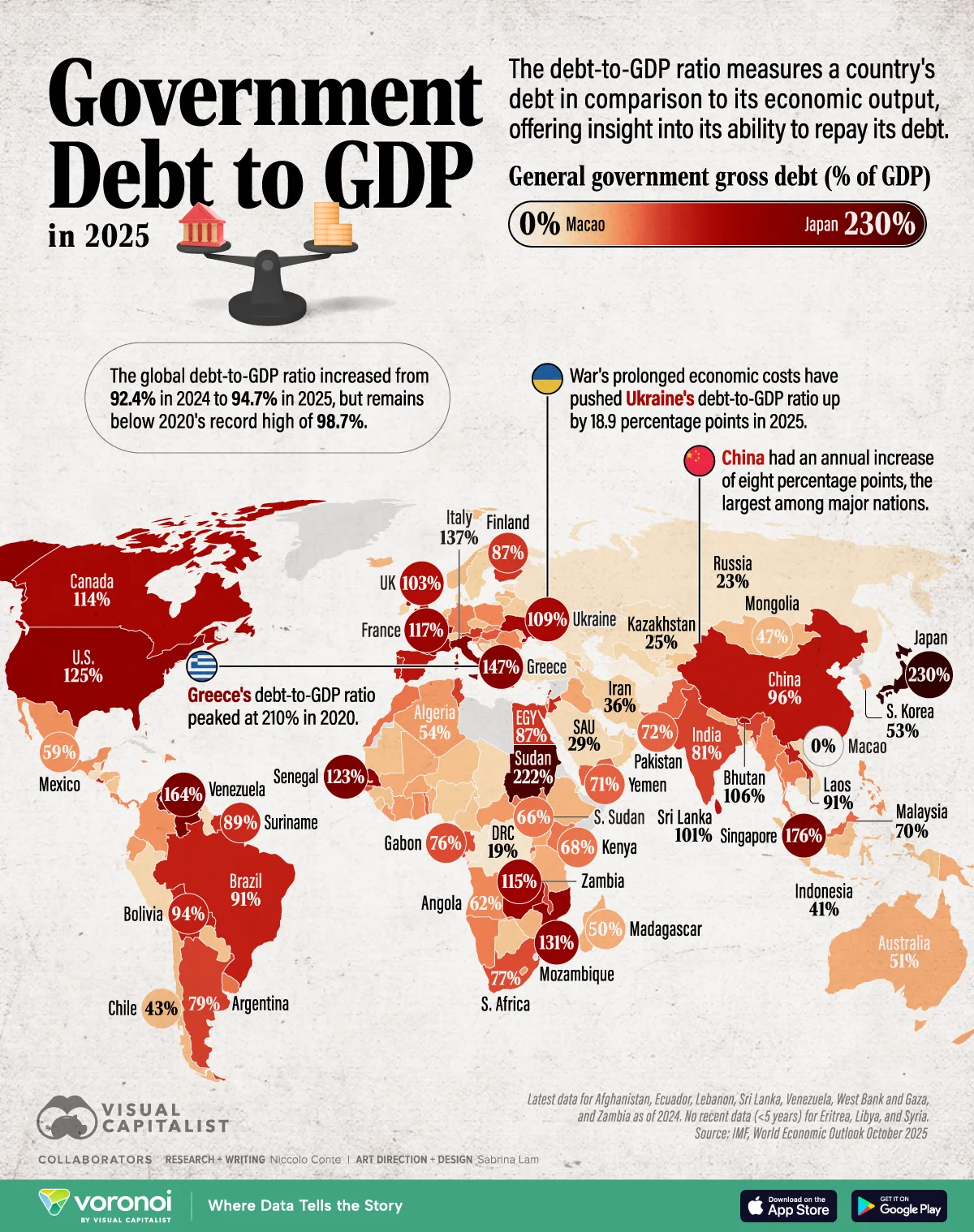
Government Debt to GDP by Country in 2025

visualcapitalist

By Niccolo Conte Graphics/Design: Sabrina Lam

Global map of government debt in 2025 by country

Key Takeaways

  • The global debt-to-GDP ratio rose 2.3 percentage points to 94.7% in 2025, but is still below the pandemic-era peak of 98.7% in 2020.
  • Japan remains the world’s most indebted nation at 230% of GDP, followed by Sudan (222%) and Singapore (176%).

Global debt levels continue to rise, with 2025 marking another year of fiscal strain across both advanced and developing economies.

Continue reading Government Debt to GDP by Country in 2025

Bảo tàng dừa sáp Trà Vinh

thanhnien.vn – Duy Tân – 22/07/2025 08:00

Mong muốn bảo tồn giá trị văn hóa và lan tỏa giá trị của dừa sáp, anh Trần Duy Linh (38 tuổi, ngụ xã Tam Ngãi, Vĩnh Long – trước đây là xã Thạnh Phú, H.Cầu Kè, Trà Vinh) xây dựng bảo tàng với kinh phí hơn 20 tỉ đồng.

Tri ân người mang dừa sáp về Việt Nam

Tọa lạc tại xã Tam Ngãi, Vĩnh Long, bảo tàng dừa sáp khánh thành ngày 13.12.2024 sau gần 2 năm xây dựng, với tổng vốn đầu tư hơn 20 tỉ đồng. Công trình được xây dựng trên diện tích gần 1.500 m2, gồm 1 trệt và 2 lầu.

Nơi đây tái hiện sinh động câu chuyện về cây dừa sáp, từ sự xuất hiện đầu tiên đến hành trình gắn bó với đời sống của người dân bản địa. Không gian trưng bày tôn vinh sự giao thoa văn hóa độc đáo giữa 3 cộng đồng Kinh, Khmer và Hoa, những cư dân đã chung tay tạo nên nét văn hóa đặc sắc cho vùng đất này.

Chàng trai đầu tư hơn 20 tỉ đồng xây bảo tàng dừa sáp - Ảnh 1.
Bảo tàng dừa sáp do anh Trần Duy Linh đầu tư xây dựng là bảo tàng tư nhân đầu tiên của Vĩnh Long
Continue reading Bảo tàng dừa sáp Trà Vinh

Hậu quả từ phá rừng

  • Hậu quả từ phá rừng và biện pháp bảo vệ rừng hiện nay
  • Hậu họa phá rừng tự nhiên: Lũ ngập tràn, hạn khô khốc
    ***

Hậu quả từ phá rừng và biện pháp bảo vệ rừng hiện nay

TCTC – Trang Phạm – 06:16 05/10/2024

Ngoài ảnh hưởng của biến đổi khí hậu, đặc điểm địa lý thì tình trạng mưa lũ ở nước ta trở nên nghiêm trọng hơn phần lớn là do vấn nạn chặt, phá rừng đầu nguồn để khai thác gỗ, phát triển nông nghiệp, thủy điện… Chính điều này gây ra sự suy giảm thảm thực vật ở lưu vực, khả năng cản trở dòng chảy khi mưa lũ giảm, khiến tốc độ di chuyển của mưa lũ nhanh hơn.

Hậu quả từ phá rừng và biện pháp bảo vệ rừng hiện nay - Ảnh 1

Continue reading Hậu quả từ phá rừng

Thực thi thuế tối thiểu toàn cầu tại Việt Nam

08/05/2025

TS. Trần Thế Nữ
Trường Quốc tế – Đại học Quốc gia Hà Nội

(Quanlynhanuoc.vn) – Bối cảnh toàn cầu hóa cùng sự phát triển của công nghệ đã tạo ra nhiều thách thức trong việc quản lý thuế, đặc biệt đối với các doanh nghiệp đa quốc gia có chiến lược tối ưu hóa thuế. Trong bối cảnh này, Việt Nam cần tăng cường công nghệ và chuyển đổi số trong quản lý thuế, cải tiến quy trình thanh tra và kiểm soát thuế, đơn giản hóa thủ tục kê khai thuế, và đào tạo đội ngũ cán bộ thuế. Đồng thời, việc hợp tác quốc tế sẽ giúp Việt Nam tiếp cận các mô hình quản lý thuế hiệu quả và bảo đảm tính minh bạch trong việc thu thuế từ các doanh nghiệp xuyên quốc gia. Cùng với đó, việc thực thi thuế tối thiểu toàn cầu không chỉ giúp tăng cường công bằng trong thu thuế, mà còn thúc đẩy môi trường đầu tư công bằng và bền vững tại Việt Nam. 

Từ khóa: Thuế tối thiểu toàn cầu; quản lý thuế; chuyển đổi số; thỏa thuận quốc tế; cải cách thuế.

1. Giới thiệu chung

Bối cảnh toàn cầu hóa cùng sự phát triển bùng nổ của công nghệ đã tác động mạnh mẽ đến các mô hình kinh doanh truyền thống, tạo ra nhiều loại hình kinh doanh mới mẻ. Điều này, đòi hỏi các cơ quan quản lý nhà nước phải thích nghi với những biện pháp quản lý phù hợp, đặc biệt là trong lĩnh vực thuế. Tuy nhiên, sự chênh lệch về trình độ quản lý và chính sách thu hút đầu tư nước ngoài giữa các quốc gia đã tạo ra những “lỗ hổng”, tạo cơ hội cho các doanh nghiệp đa quốc gia né tránh nghĩa vụ thuế đối với hoạt động kinh doanh của họ. Nghiên cứu của Johannesen1 đã chỉ ra những tồn tại nghiêm trọng trong hệ thống thuế toàn cầu hiện nay là các công ty đa quốc gia (MNCs) thường xuyên chuyển lợi nhuận sang các “thiên đường thuế” với mức thuế thấp, dẫn đến tình trạng thất thu thuế đáng kể cho các quốc gia sở tại. 

Continue reading Thực thi thuế tối thiểu toàn cầu tại Việt Nam

Không gian công cộng cho người khuyết tật: Thực trạng và giải pháp

baoxaydung.vn 20/01/2025, 08:42

Các không gian công cộng sẽ mang đến lợi ích rất lớn cho người khuyết tật, nhưng thực tế là nhóm đối tượng yếu thế này vẫn đang gặp rất nhiều khó khăn để tiếp cận và sử dụng những không gian được làm ra cho tất cả mọi người.

img
Người khuyết tật có nhu cầu rất lớn về việc tiếp cận và sử dụng các không gian công cộng. (TPG)

Quy định pháp lý cơ bản đầy đủ…

Hiện nay, Việt Nam có hơn 7 triệu người khuyết tật và họ cũng có nhu cầu được giao lưu, sinh hoạt như người khỏe mạnh, lành lặn. Hiểu rõ nhu cầu của nhóm người yếu thế này, Đảng và Nhà nước đã ban hành nhiều cơ chế, chính sách để hỗ trợ, giúp đỡ người khuyết tật dễ dàng hòa nhập với xã hội hơn, có một cuộc sống tốt đẹp hơn, hạnh phúc hơn. Một trong những vấn được dư luận xã hội quan tâm là xây dựng các không gian công cộng hòa nhập, đảm bảo người khuyết tật có thể tiếp cận và sử dụng.

Continue reading Không gian công cộng cho người khuyết tật: Thực trạng và giải pháp

Hình thái lây nhiễm HIV ở Việt Nam thay đổi

vnexpress.net Thứ hai, 18/11/2024, 20:26 (GMT+7)
Dịch HIV/AIDS đang diễn biến phức tạp, hình thái lây nhiễm thay đổi từ đường máu ở nhóm nghiện chích ma túy sang lây truyền qua đường tình dục.

Thông tin được bà Phan Thị Thu Hương, Cục trưởng Cục Phòng, chống HIV/AIDS, Bộ Y tế, cho biết tại buổi họp báo nhân Ngày Thế giới phòng, chống AIDS, chiều 18/11. Tại Việt Nam, kể từ ca nhiễm đầu tiên được phát hiện năm 1990 tại TP HCM, ước tính hiện nay có khoảng 267.000 người đang sống chung với HIV. Đến nay, 100% số tỉnh, thành phố có người nhiễm.

9 tháng đầu năm nay, cả nước ghi nhận 11.421 trường hợp phát hiện mới HIV dương tính, 1.263 trường hợp tử vong. Trong số người mới phát hiện nhiễm HIV, 83% là nam giới, độ tuổi chủ yếu từ 15 – 29 (40%) và 30 – 39 (27%), nhóm chiếm tỷ lệ cao nhất là nam quan hệ tình dục đồng giới (42%).

Continue reading Hình thái lây nhiễm HIV ở Việt Nam thay đổi